Do you think you’re a genius trader? Let’s see how the market strips you bare in the next pump.

A bull run is perhaps the most dangerous time for any investor. Sounds paradoxical, right? It seems like when the market is "painting green" and everyone around you is in euphoria, you should be shoveling money in by the truckload. But in reality, this is precisely when most people make their most fatal mistakes. The market presses two main buttons in your head: greed and the Fear Of Missing Out (FOMO).
At these moments, your main enemy is not the charts, not the "whales," and not the manipulators—it’s you. Your own dopamine cycles and the inability to say "stop" in time. Let’s break down this mechanics in a friendly way, without unnecessary complexity.

1. The Anatomy of Losing Your Mind
Our brains are not evolutionarily adapted to trading cryptocurrency. We are hardwired for survival in the wild, not for managing hyper-volatile assets in the blockchain era.
The Illusion of Genius: When your portfolio grows by 20% overnight, dopamine is injected into your brain. You start thinking, "Oh, I’m a genius trader!" You’re already picturing the color of the Lamborghini you’re going to order, even though your account only covers a used scooter. You attribute the market's growth to your skill rather than the general uptrend. In that moment, you lose your critical thinking.
The Anchoring Effect: You fixate on numbers. "Bitcoin was 60k, now it’s 80k, so it’ll be 120k soon." You anchor to the price and ignore reality. The market turns around, and you sit there with that "anchor," slowly sinking to the bottom, hoping the price will "return." This state of denial is a direct path to losing 90% of your deposit.
Adaptation to Luck: If you accidentally made money on a memecoin, you start considering it the norm. You increase positions and take leverage because the "risk seems justified." But as soon as the market shifts phase, such "geniuses" lose everything, and their "strategy" turns into looking for a job at a construction site. Luck is not a strategy.

2. DCA: Math Against Chaos
Many think that Dollar-Cost Averaging (DCA) is a strategy for the lazy. In reality, it is a professional tool.
Why DCA is your greatest protector:
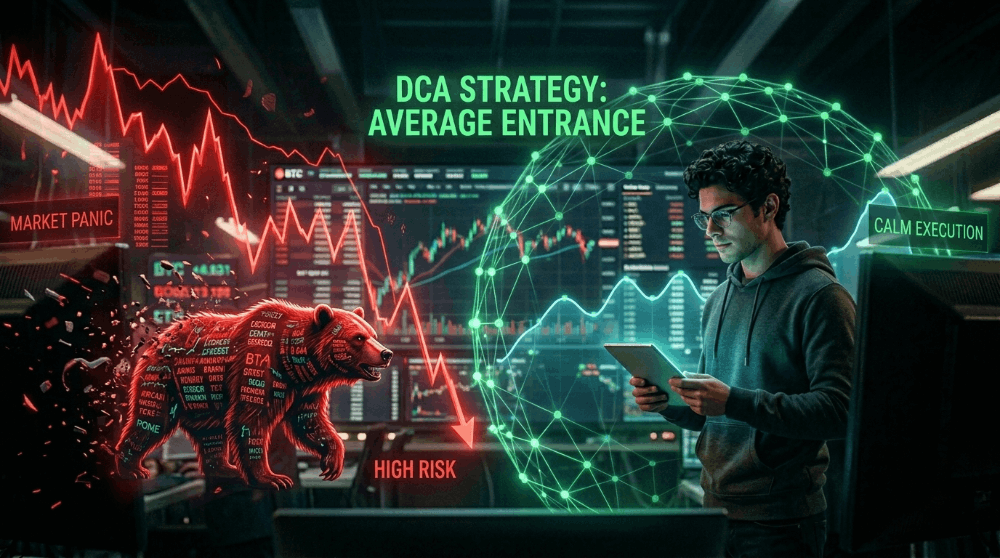
Imagine: you bought an asset for $1,000 at $100. Tomorrow, the price dropped to $80. Your emotions scream: "I should have waited!" You’re panicking, your palms are sweating, you want to sell everything. But if you are using DCA, you buy another $1,000 at $80. Your average price becomes $90. That is your mathematical shield.
Eliminating "Timing": Trying to guess the "bottom" or the "top" is an activity that kills your nervous system. With DCA, you simply follow the chart. You don't need to feel like a prophet; being systematic is enough.
Psychological Comfort: DCA makes volatility your ally. If the price drops, you rejoice because you will buy more coins for the same amount.
Automation: Remove the human factor. Set up an auto-buy. The less often you check the exchange app, the lower the chance you’ll do something stupid.
3. Exit Protocol: How Not to Turn Profit into Dust
Most people know how to enter the market, but nobody knows when to exit. In a bull run, the price flies up, and it seems like it will grow forever. This is the "greedy hamster" trap.
Create your "Exit Protocol":
Partial Targets: Never sell everything at once. Divide your portfolio into 10 parts. Set targets: at a 50% increase from entry, sell 10%; at 100%, sell another 20%. This guarantees that you will come out "in the green," even if the market collapses tomorrow.
Rebalancing Rule: If your portfolio consisted of 50% BTC and 50% alts, and after a rise, alts started taking up 80%, you have become too risky. This means your portfolio has started to resemble a casino where you always bet on "red," hoping the house won't close. Sell some alts and return to your original balance.
Stability as a Refuge: Move part of the profit into stablecoins (USDT/USDC). Let them sit in a cold wallet. That is your "gunpowder" to buy assets when everyone else is crying during the bear market.


4. Golden Portfolio Rules for the "Long Game"
To avoid turning your investments into a casino, follow three pillars:
"Core" and "Satellites": 70% of the portfolio in fundamental assets (BTC, ETH). That’s your core. Only 10-20% can be used for "games" with new projects. If the "games" burn up, your main capital remains intact.
Never Use Leverage: In a bull run, leverage is a way to gift your money to the exchange. The exchange will be very grateful for your deposit, especially if you start using 50x leverage to "get rich quick." Only play with your own money.
Information Detox: During a bull run, there will be a million "experts" on the internet. The more you listen to them, the less you have your own strategy. Unsubscribe from hype-driven channels.
5. Case Study: Mistakes That Cost Millions
Let’s break down how people lose their deposits.
Scenario 1: "The Train Left." An asset has grown by 200%. You panic that you're missing the party of a lifetime and go "all-in" at the peak. Two hours later, the market corrects. You sell in a panic, locking in a loss. This is a classic: buy the highs, sell the lows—a tactic that should be taught in schools as an example of what not to do.
Scenario 2: "Faith in the Project." You fell in love with the technology. It’s dropping, but you keep buying. You turn into an "involuntary investor." There is no room for love in the market. Every asset has price levels. If a level is broken, get out.
6. The Role of Discipline and Self-Control: How Does a Pro Think?
A professional doesn't try to predict the market. They create a system where they mathematically cannot lose in the long run.
Trade Journal: Record every trade. Why did you buy? Why did you sell? After a month, you will see your behavior patterns. You will realize that you lose money most often due to fear or greed.
Stablecoin Account: Think of them not as "money outside the market," but as "capital awaiting an opportunity." You haven't left the game; you’ve just loaded your cannons.

7. Metaphysics of the Crypto Market: Marathoner vs. Sprinter
Bitcoin has existed for over 15 years. It is a series of cycles. Each cycle is a stress test for your psyche.
Risk Management as Religion: Set a limit per trade. No more than 5% of your portfolio on a single risky asset. This will allow you to make 20 mistakes in a row and still stay in the game.
Sleep and Health: It sounds cliché, but if you aren't sleeping because you're watching charts, you’ll make bad decisions. A tired brain is more prone to risk than a hungry student in line for instant noodles. Remember: crypto is just a tool.
8. How to Survive the "Bear Market" and Emerge a Winner
Most beginners fear the "bear market." But for a pro, this is shopping time.
Accumulation Period: When everyone is panicking and shouting "crypto is dead," that is the moment to start DCA. You buy assets for pennies.
Analysis: When the market is calm, you can study new projects, read White Papers, and find real gems, not trashy memecoins created yesterday evening.

9. Philosophy of Success in Crypto
Cryptocurrency is a maturity test. Here, the market literally punishes greed and rewards patience. Remember: safety is what you do before the hack, and strategy is what you follow before greed overcomes you. Don't try to outrun the market; try to outlast it.
Be disciplined, don't fuss, and look at a horizon of several years, not several hours. This is the only way you can not only make money during the bull run but also keep it when "winter" arrives. Because winter is coming, and in crypto, it happens suddenly and without warning.
How do you handle your emotions when the market is flying upward? Do you stick to a strategy or try to catch every peak? Share in the comments—let's discuss! 👇
Subscribe to my profile; there will be plenty of interesting and useful information! 🛡️📈🚀
Disclaimer: This article is just my thoughts and experience. It is not financial advice. The crypto market is a dangerous thing; always think for yourself before clicking the "Buy" button. DYOR.