CRYPTO
Have you ever wondered what actually keeps crypto running behind the scenes?
When you send money digitally, what really happens after you press “send”?
Who approves it?
Who checks it?
And how does the system know nobody is cheating?
Let’s break it down in a simple, human way — like a story you can actually relate to.
💭 So… who is in control of your transaction?
When you send crypto on networks like Bitcoin, it doesn’t go to a bank. There is no customer service agent pressing “approve.”
So the question becomes:
👉 Who verifies it?
👉 Who makes sure it’s real?
👉 Who prevents fraud?
The answer is: a decentralized system of computers around the world.
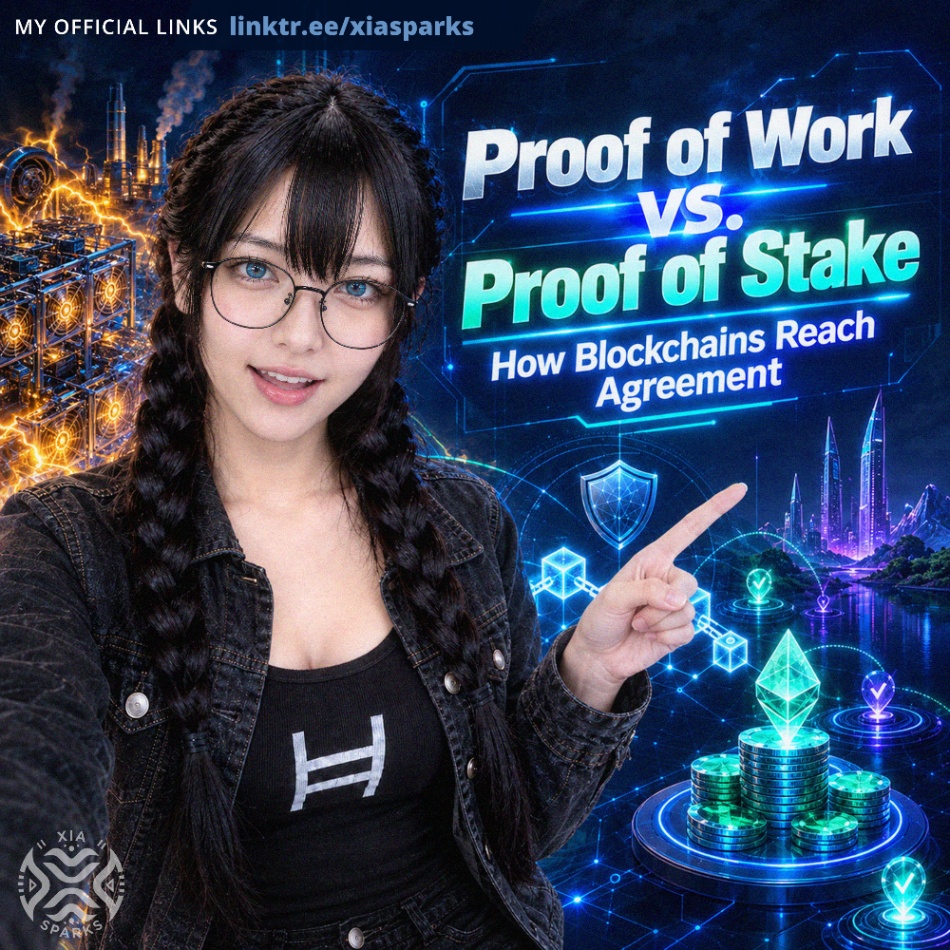
But there are two main ways this system works:
🔥 1. Proof of Work — “The mining world”
Have you ever thought:
“What if computers had to compete to solve problems to earn money?”
That’s exactly what Proof of Work is.
In this system, we call the participants miners.
⛏️ So what are miners actually doing?
They are not mining gold. Not mining coins from the ground.
Instead, they are:
Competing with powerful computers
Solving extremely hard math puzzles
Trying to be the first to finish
Winning the right to add a new block
And when they win?
💰 They get rewarded with crypto.
🤔 But here’s a deeper question:
Why would anyone spend electricity and money just to solve puzzles?
Because the system pays them.
They earn:
New coins
Transaction fees
So mining becomes a global competition powered by profit.
⚡ But here’s the trade-off:
Mining is powerful, but:
It uses a lot of electricity
It requires expensive machines
It’s mostly controlled by big mining farms now
So then another idea was born…
🌱 2. Proof of Stake — “The staking world”
Now imagine this:
What if instead of machines competing… people used their coins as “trust”?
That’s Proof of Stake.
Used by networks like Ethereum, this system removes heavy mining.
👤 So who runs the network here?
Not miners.
They are called validators.
🧾 What do validators actually do?
Have you ever wondered:
“Who checks if my transaction is real?”
Validators do that job.
They:
Check if transactions are valid
Group them into blocks
Confirm what gets added to the blockchain
Help secure the entire system
💡 But here’s the interesting part:
They don’t compete with machines.
Instead, they are chosen based on how much crypto they “stake” (lock up).
So you might ask:
“Why would someone lock their money just to help a network?”
Because they earn rewards for it.
But if they cheat?
⚠️ They lose part of their staked coins.
🏢 Where do companies fit into all of this?
Now think bigger:
“Are only individuals doing this… or companies too?”
The answer: both.
Companies run large validator systems using servers and data centers.
They:
Stake large amounts of crypto
Run multiple validator nodes
Earn rewards at scale
Operate like blockchain infrastructure businesses
But here’s the key idea:
👉 Even companies don’t control the system
👉 They just participate in it
🔍 So what is mining really?
After all this, let’s simplify everything:
Mining (Proof of Work) =
👉 Competing with computers to solve puzzles and earn rewards
Validation (Proof of Stake) =
👉 Locking coins and being chosen to verify transactions
🧠 The big picture most people miss
Have you ever asked yourself:
“Why does crypto even need all of this?”
Because there is no bank.
So instead, the system needs:
Security
Trust
Agreement
Fraud protection
And it achieves that using:
Miners (in Proof of Work systems)
Validators (in Proof of Stake systems)
All working together globally without a central boss.
💭 Final thought
So the next time you hear “crypto,” don’t just think about coins going up and down.
Ask yourself:
Who is securing this network right now?
Who is validating these transactions?
And what power is keeping it all honest without a bank?
Because behind every simple transaction…
there is a global system of machines, people, and incentives working silently in the background.