Why You Can't Eavesdrop On Artemis II

Spaceflight communications have changed dramatically since Apollo.
If you’re reading this within a few days of it being published, four astronauts are currently in deep space heading back to the moon for the first time in decades. They are sending telemetry and voice data back to Earth. Here’s why your rtl-sdr isn’t going to hear a any of it.
When Apollo 11 first landed on the moon, radio amateurs around the world would be listening in. With a good antenna system and a receiver that was capable of listening in on the 2.2GHz band, no NASA permission would be needed to hear Neil Armstrong take his first steps in real-time.
As Apollo 13 would teach us, sometimes in space, things do not go to plan. While Artemis sends the same type of telemetry, communication and location data back to Earth that Apollo did, for security and operational reasons, much of this data is now encrypted. If we point a dish at the spacecraft and tune a receiver to the right frequency, we can see, thanks to the carrier signal, that something is there. However, we can’t see exactly what it is that is being said or what that something is.
Essentially, the difference between 1969 and 2026 communications comes down to three simple things. Digital modulation, good encryption and an ultra-modern laser communication system that doesn’t use radio at all.
Let’s have a more detailed look at how this has changed over the past few decades.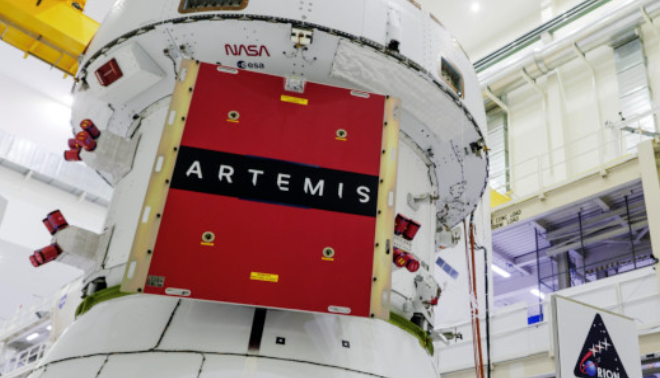
Artemis II Communications Systems
While the payload on Artemis is quite complex and features a range of communication, navigation and telemetry systems, we can break this list down into just a few types of systems that might be of interest to Radio Hackers readers and general spaceflight nerds.
S-Band Communication System
Frequency: 2025–2110 MHz (uplink), 2200–2290 MHz (downlink)
Direction: Uplink + Downlink
Purpose: Command, telemetry, voice
Notes: Core mission link, moderate data rates, robust fallback layer
First is the S-band Communication system. Running at 2.2 GHz, the primary link sends its data in a part of the spectrum that sits just below Wi-Fi and Bluetooth transmissions at 2.4GHz. This is one of the core mission links that relies on the deep-space network to achieve and maintain reliable communications. To detect the encrypted carrier here, you’ll need a dish of at least 4 m and a way to ensure the dish is accurately tracking the spacecraft.
If you’re able to detect the link, the best you’ll get is an encrypted carrier thanks to some cutting-edge encryption.
X-Band High-Gain Telemetry System
Frequency: 8025–8400 MHz
Direction: Primarily Downlink
Purpose: High-rate telemetry & data
Notes: Used with Deep Space Network, higher gain, narrow beam
Next is the X-band, high-gain telemetry system. Running higher in the spectrum in the 8GHz band, this telemetry link has a higher data transfer rate to ensure consistent, accurate telemetry is received to help manage the spacecraft. Being a high-gain system means that the antenna radiation pattern is extremely narrow, making accurate tracking all the more important.
This system is far beyond the range that a stock RTL-SDR unit can tune.
Ka-Band System
Frequency: 25.5–27 GHz
Direction: Downlink
Purpose: High-throughput data
Notes: Experimental, very high capacity, precise pointing required
Running at 25GHz, the Ka-band telemetry downlink is used to carry out high-speed transfer of telemetry data. Aiming to provide a stronger, more reliable link with a higher transfer rate, this is an experimental system that requires even more accurate tracking in comparison to the X-band system mentioned previously.
Optical Communications (O2O)
Frequency: Infrared laser (1550 nm)
Direction: Downlink
Purpose: Ultra-high-speed data
Notes: Up to 260 Mbps, weather and alignment sensitive
A brand new optical communications link, the O2O system, is going to be both interesting and dull to the average publication reader. This is a cutting-edge, laser-based communication system that provides a high-speed data rate, meaning that the overall design of the system is an interesting read. However, due to the laser-based nature of the system, there is little chance of being able to detect this system when it is in use.
While radiofrequency-based transmissions are able to be detected thanks to the way the RF propagates, laser communications work entirely differently. Thanks to the tightly focused beam of the laser, you’ll need to be extremely close to the receiving station to have any chance of a successful detection. This means that the O2O system is beyond the reach of most amateur stations.
Modulation Upgrades
While Apollo missions would broadcast in voice, the evolution of modern digital communications schemes means that the Artemis missions would use these schemes to increase both security and reliability.
With Apollo, things were pretty simple. If you could receive the carrier, you could also receive the audio. With Artemis relying on Phase Shifted Keying (or variations of), simply receiving the carrier will sound like little more than white noise on an average receiver.
Things aren’t “tune and listen” anymore. To successfully decode this, you’d need to identify the exact symbol rate, modulation scheme, coding rate and frame structure.
And, as an additional complication, NASA publishes none of this information for primary mission links.
Cutting-Edge Encryption
Theoretically, we can use software to help identify this missing modulation information. So, if we assume that we have for a moment, you’ll quickly hit the next brick in the wall. Namely, some cutting-edge encryption strategies.
With the US government placing a far greater value on secure communications in comparison to the 1960s, security would be built into the core design of modern communications systems like datalinks and telemetry, rather than being treated as a mere afterthought.
The keys for this encryption method are not published by NASA, and it’s fair to say that if you’re intending to try to crack them, you’re going to need a lot more than the average GPU cluster to have a remote chance of doing so.
While many communications protocols from space are not encrypted due to their open source nature (think weather satellites and some International Space Station downlinks), security on crewed missions is operationally sensitive, and this is reflected in the communications architecture.
The Wildcard: A Laser Comms Package
The O2O system is deserving of its own breakdown due to the fact that it is some cutting-edge tech that, if successfully tested, could rewrite the rules regarding how we manage spacecraft communications from a reliability and security perspective.
O2O is fascinating not only for what it currently does, but also for what it has the potential to do. If the X-band system is a floodlight, O2O is the laser pointer, sending its data back in a tightly formed and highly accurate beam.
This link has the potential for true, high-speed data rates that are capable of sending back high-definition video and telemetry at rates that far exceed traditional systems.
However, it is not without its problems. That same narrow beamform that provides additional security can also influence reliability, meaning that precision tracking is everything. This is because when a laser link degrades, there is no graceful reduction in signal like a traditional system. When tracking accuracy is lost, so is the link.
O2O is also a great example of how physics can be used to help provide security. That narrow beamwidth that provides high-speed data transfer also provides increased security thanks to those same characteristics, making interception difficult.
Is The Golden Age Over?
The era of casually listening in to a spacecraft might not be over just yet, but the dynamic has definitely changed since the 1990s. While Apollo and the Shuttle would be an open book, Artemis has all the hallmarks of a closed system.
From an operational perspective, this isn’t necessarily a bad thing. The increased security posture gives NASA assurances that it can communicate securely when needed, while new technology like O2O gives the means for high-quality video to be streamed from deep space.
This opens up new possibilities when we consider the impact on deep space travel. And, while the manned missions might be beyond the reach of the average amateur, there are still plenty of interesting spacecraft that remain operational and have no such restrictions.
While modern encryption spoiled the fun for those who would like to listen in, you can still receive a ton of information by following the official NASA sources for information.
You can check out the Deep Space communications network and see when Artemis II is transmitting by visiting this link.
Get live updates on the Artemis II mission and hear the breaking news first-hand by following the NASA blog.
Receive live views from Orion and imagery from the NASA mission control centre by taking a look at NASA Live.
Investigator515 explores the RF spectrum, cybersecurity, and the hidden tech behind modern espionage.
Follow for new content weekly
Bluesky • X • Substack
You might also like,
- Your First SIGINT Toolkit For Under $100.00
- Hidden Trackers: 5 Ways Your Tech Betrays You
- The Night Stealth Fell: The Story Of Vega-31