The Last Alpha

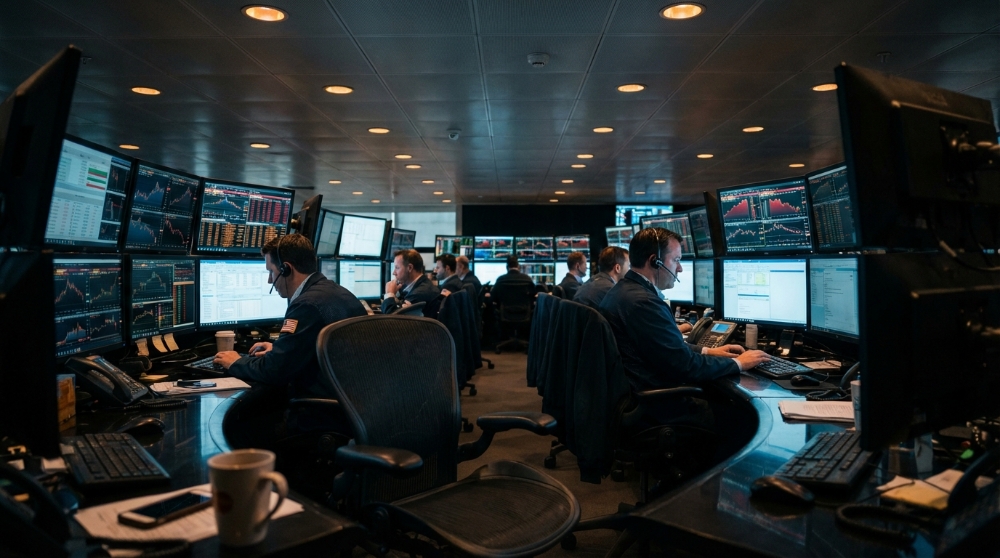
That feeling is the defining psychological condition of institutional finance in 2026.
Markets no longer wait for conviction. They punish hesitation with the cold arithmetic of microseconds. The question serious capital allocators must now sit with is not whether machines can trade — they demonstrably can, with a ruthlessness no human limbic system can match — but whether the human intuition that once built generational fortunes has become, structurally, a liability.
The honest answer is: partially, yes. And the implications compound daily.
What separates survivors from casualties in this environment is not intelligence. It is architecture. The firms generating durable alpha today are not the pure quant shops running black-box momentum strategies, nor the last romantics doing discounted cash flow analysis on legal pads. They occupy a harder position to build and nearly impossible to replicate: the Quantamental middle ground, where machine breadth and human depth operate as a single cognitive unit.
Think of it as the Centaur framework. The machine is the radar array — processing satellite imagery of retailer parking lots, parsing 10-Q filings through NLP models trained on decades of earnings call transcripts, scanning cross-asset correlation matrices for regime shifts before they register on any human screen. The human manager is the pilot: not reading every instrument simultaneously, but making the call that no pre-programmed decision tree can — the one that requires understanding why a geopolitical fracture in the South China Sea matters differently this quarter than it did in 2019.
This is not philosophy. It is mechanical necessity.
The cognitive ceiling is real, and its coordinates are well-documented. Humans can actively monitor, at functional capacity, somewhere between five and nine variables in a dynamic decision environment. The modern equity market, on any given session, generates upward of 2.5 quintillion bytes of data. The gap between those two numbers is not a challenge. It is a structural disqualification for the un-augmented mind.
This is precisely the terrain that platforms like Kensho, Sentieo, or a purpose-built quantamental infrastructure layer are designed to occupy — serving as the algorithmic co-pilot that converts raw data exhaust into decision-grade intelligence. The role of such a system is not to replace judgment. It is to ensure that when human judgment finally engages, it is operating on sanitized, factor-weighted signal rather than noise dressed in narrative clothing.
And yet, the skeptic deserves the floor.
The Black Box problem has not been solved. It has been rebranded. During the March 2020 liquidity dislocation, a significant cohort of systematic strategies hit simultaneous stop-losses, amplifying drawdowns in instruments their own backtesting had classified as uncorrelated. The models were not wrong about history. They were blind to the tail. Backtesting Bias remains the original sin of quantitative finance — the seductive error of mistaking pattern recognition for predictive truth.
No factor model survives first contact with a genuine Black Swan. What survives is the human in the cockpit who understands the model's assumptions well enough to override it.
Building toward this edge requires sequence, not speed. Begin with data hygiene — garbage in, garbage out is not a cliché, it is a Sharpe Ratio killer. Then construct your factor exposure deliberately: value, momentum, quality, low-volatility, each calibrated to your liability horizon. Layer alternative data only after your fundamental framework is stable enough to absorb signal without being destabilized by it. Finally, define your override protocols before you need them — because in a volatility spike, you will not have time to write philosophy.
The singularity of finance is not a future event. It is present-tense, compounding quietly in the server farms beneath New Jersey suburbs and the co-location cages in Equinix data centers across three continents. The sterile hum of that infrastructure is now the baseline frequency of capital markets.
The question is not whether your portfolio has exposure to AI. Every portfolio does — as counterparty, as competitor, as market-maker. The question, the only one worth losing sleep over, is whether the intelligence guiding your allocations is built to operate within this architecture — or whether it is still, somewhere deep in its assumptions, waiting for a market that no longer exists.