EDUCATIONAL DOCUMENTATION: THE DEFINITION OF A COMPANY

A Multidisciplinary Journey Towards an Evolved Understanding
CONTENTS
- The Urgency of a Good Definition
- The Sciences that Look at Structure and Matter
- The Sciences that Look at Life and Mind
- The Sciences that Look at Environment and Relations
- Synthesis: Integrating Everything into an Evolved Definition
LAYER 1 – THE URGENCY OF A GOOD DEFINITION
Why spend time defining "company"?
Picture these three real-life situations:
Case 1. The free educational app.
A group of young people creates a digital platform to teach math to children in rural areas. They sell nothing, have no clear legal form, and pursue no profit. One day, an investor wants to support them, but because they are not legally constituted as a "company", they cannot easily receive funds. The traditional definition leaves them out.
Case 2. The multinational that dissolves itself.
A large textile corporation operates in several countries through dozens of intertwined subsidiaries. When it is discovered that its processes pollute a river in an impoverished region, it becomes impossible to pinpoint a specific responsible party. Each entity claims to be independent. The definition of a company, stretched to its limit, dilutes accountability.
Case 3. The store that closes in silence.
A family hardware store closes after forty years. Without a closure plan, it dismisses its employees without adequate severance and leaves debts with local suppliers. The neighborhood loses an essential service and several families are left unprotected. The company disappears, but the damage remains.
What thread ties these stories together? A definition of a company that fails to capture reality. When the concept is too narrow, it excludes valuable projects. When it is too loose, it allows shields of irresponsibility. When it ignores the full cycle, it paves the way for traumatic endings.
This document invites you on a journey through multiple sciences to build a deeper understanding. It is not about memorizing a definition, but about understanding where each component comes from and why a company is so much more than a legal entity with a profit motive. By the end, you will be able to explain what a company really is with a solidity that few textbooks offer.
LAYER 2 – THE SCIENCES THAT LOOK AT STRUCTURE AND MATTER
Disciplines explored: Physics, Mathematics, Statistics, Probability, Systems Engineering, Computer Engineering, Cybersecurity, Cryptography.
A company is not just a legal concept. It is a physical and logical reality. It occupies space, consumes energy, generates waste, and can be modeled as a system. Let's start with the sciences that examine matter and structure.
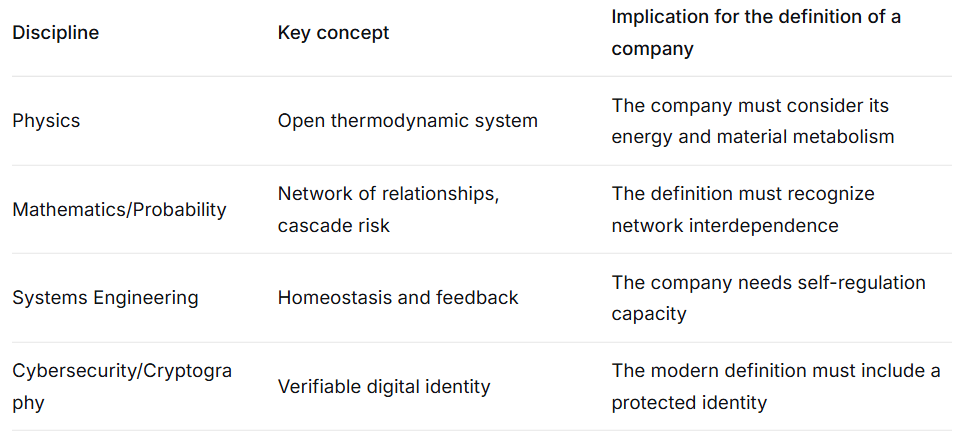
2.1 PHYSICS (THERMODYNAMICS)
A company consumes and transforms energy.
Every company, without exception, takes materials and energy from the environment, transforms them, and returns products, services, and waste. It is an open thermodynamic system. This physical perspective reminds us of something obvious but frequently forgotten: no company escapes the material limits of the planet.
Think of a furniture factory. It receives wood, electricity, water. It produces tables, but also sawdust, dissipated heat, and wastewater. If the definition of a company only considers the financial balance sheet, those waste products remain invisible. Yet, in the long run, the costs of managing them (or the consequences of not doing so) can destroy both the company and the community around it.
Implication for the definition:
A complete definition of a company must incorporate its physical metabolism. It is not just about "producing goods or services", but about doing so with an awareness of the flow of materials and energy involved. Ignoring this dimension is like defining a car without mentioning that it consumes fuel and emits exhaust.
Everyday example:
A bakery that uses electric ovens and biodegradable packaging is not the same as one that burns old tires to heat the oven, even though both sell bread. The difference lies in their physical metabolism, and any serious definition should be able to capture that distinction.
2.2 MATHEMATICS, STATISTICS AND PROBABILITY
A company is a network of relationships.
If we were to draw a company on paper, we would sketch points (people, contracts, debts, orders) and lines connecting them. That is a graph. A company is not an isolated entity, but a node within a dense web of relationships.
From a mathematical perspective, a company can be modeled as a set of contracts and transactions. Statistics and probability allow us to measure the risk that any of those connections will fail. And when a critical node breaks, the effects spread like dominoes.
Implication for the definition:
The definition of a company must recognize its structural interdependence. A company does not end at its office door; it extends through the network of suppliers, customers, and partners. A single point of failure (depending on a sole supplier, a single large client) makes it fragile, even if its internal accounts are healthy.
Everyday example:
Imagine a restaurant that buys all its fish from a single supplier. If that supplier goes bankrupt or suffers an accident, the restaurant is left without raw materials overnight. The company appeared solid, but its hidden dependence made it vulnerable.
2.3 SYSTEMS ENGINEERING AND COMPUTER ENGINEERING
A company needs to self-regulate.
A stable system is not one that never receives disturbances, but one that has mechanisms to detect deviations and correct them in time. This is called homeostasis in biology and feedback in engineering.
A company without indicators, without early warnings, without information circuits that connect daily operations with managerial decisions, is a blind system. Sooner or later, it dangerously drifts off course without anyone noticing.
Implication for the definition:
The definition must include the capacity for self-regulation. A company is not just a production apparatus; it is a system that needs sensors, control loops, and learning capacity. Information must flow, not stagnate at a single hierarchical level.
Everyday example:
Driving a car without a dashboard is dangerous: you do not know your speed, whether you have fuel left, or if the engine is overheating. A company without feedback systems drives equally blind.
2.4 CYBERSECURITY AND CRYPTOGRAPHY
A company has a digital identity to protect.
In the 21st century, a company exists as much in the physical world as in the digital one. Its identity on the internet —its website, its bank accounts, its databases— can be impersonated, attacked, or stolen. If it cannot prove who it is, it loses the trust of customers and partners.
Cryptography provides tools to build a verifiable identity. Cybersecurity teaches how to defend that identity. A modern company that ignores this dimension is building on sand.
Implication for the definition:
The contemporary definition of a company must include the notion of verifiable identity. A paper-based commercial register is not enough. A robust digital identity is needed so that others can verify that the company is who it claims to be.
Everyday example:
You have searched for a product online and found two stores with the same name and logo. One is real, the other a fake designed to scam. Without digital verification mechanisms, the consumer is left unprotected and the legitimate company suffers reputational damage.
SUMMARY OF LAYER 2
QUESTIONS FOR REFLECTION
- Do you know of a company that went bankrupt because it depended too much on a single customer or supplier? What lesson does that leave?
- Do you think the companies in your area measure and manage their energy consumption and waste well? What would happen if they didn't?
- Have you ever doubted the authenticity of a company on the internet? What elements made you distrustful?
LAYER 3 – THE SCIENCES THAT LOOK AT LIFE AND MIND
Disciplines explored: Biology, Neuroscience, Cognitive Sciences, Psychology, Behavioral Psychology, Sociology, Anthropology.
If the sciences in the previous layer showed us that a company is a physical and logical system, the sciences in this layer reveal something deeper: a company breathes because it is made of people. It is not a machine. It is a living organism shaped by mind, biases, culture, and rituals.
3.1 BIOLOGY AND NEUROSCIENCE
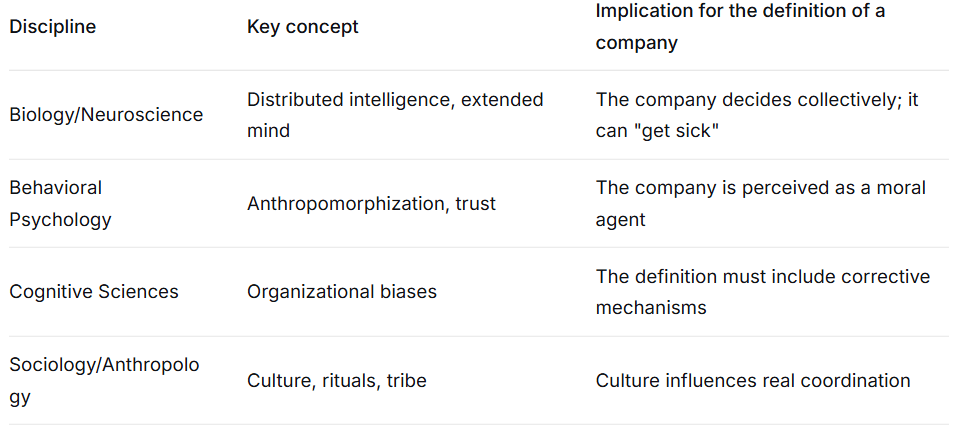
A company thinks in a distributed way.
In biology, an organism does not have all its intelligence in a single cell. It is distributed. Similarly, in a company, intelligence does not reside exclusively in the CEO. It resides in processes, in teams, in institutional memory, in the accumulated culture.
Neuroscience speaks of the "extended mind": we humans think with the help of our environment (a diary, a calculator, a colleague). A company is, in essence, a collective extended mind that processes information, learns, remembers, and sometimes gets sick.
Implication for the definition:
The definition of a company must recognize that it makes collective decisions and that this distributed intelligence can fail. It is not a perfectly rational agent; it is an organism with both potential and pathologies (such as groupthink).
Everyday example:
Have you ever seen a company where everyone thinks alike, nobody questions the boss's decisions, and mistakes are repeated? That is groupthink. The company "thinks", but in a sick way. Recognizing this helps design corrective mechanisms.
3.2 PSYCHOLOGY AND BEHAVIORAL PSYCHOLOGY
We perceive companies as moral persons.
Human beings tend to anthropomorphize. We treat companies as if they had personality, intentions, and moral character. We say "this company is honest" or "that company is abusive" just as we would of a person. And we act accordingly: we buy from those who generate trust, and flee from those who betray us.
This psychological dimension is real and has massive economic effects. A company that loses the trust of its customers suffers damage that is often irreparable, no matter how solid its finances were.
Implication for the definition:
The definition must include the dimension of a perceived moral agent. Trust is not an ornament; it is a structural pillar. Defining a company solely by its capital and its contracts ignores the glue that truly holds it together with its ecosystem.
Everyday example:
Think of a bank that charged hidden fees for years. When the scandal breaks, customers flee, investors withdraw, and the company's value plummets. Its legal structure didn't change, its machinery didn't change. What changed was the perception of its moral character. And that was enough.
3.3 COGNITIVE SCIENCES
Biases are also organizational.
We know that individuals make systematic errors of judgment: excessive optimism, loss aversion, anchoring on the first piece of information received. Companies, being made up of people, inherit those biases and sometimes amplify them.
Implication for the definition:
A good definition does not assume that a company is a perfectly rational agent. It acknowledges the presence of biases and, therefore, the need for mechanisms to counteract them: cross-checks, external audits, cognitive diversity in decision-making.
Everyday example:
Launching a product without sufficient testing because the director is "sure it will work" is a classic case of optimism bias. If the company had a mandatory verification process, the individual bias would not translate into a multi-million-dollar flop.
3.4 SOCIOLOGY AND ANTHROPOLOGY
A company is a tribe with its own culture.
Every company develops a culture: initiation rituals (the first day at work), founding heroes (the visionary entrepreneur), taboos (topics that are not spoken about), visible and invisible hierarchies. Sociology and anthropology teach us to read these codes.
Two companies in the same sector, with the same size and the same resources, can have completely different results solely because of their culture. A toxic culture destroys value. A collaborative culture multiplies it.
Implication for the definition:
The definition of a company cannot ignore culture. It is not enough to describe the formal organization chart. The way people actually relate, the values that are practiced (not the ones framed on the wall), determine the company's capacity to coordinate and survive.
Everyday example:
You know a family business where the owner treats employees poorly and they work without enthusiasm. Next door, another similar business where the team feels valued and customers notice it upon entering. The difference is not in the product or the price. It is in the culture.
SUMMARY OF LAYER 3
QUESTIONS FOR REFLECTION
- Can a company have values different from those of its owners or managers? Have you seen any such case?
- Have you ever been part of a group decision that was clearly wrong but no one dared to question? What bias was at play?
- Think of a company you admire and another you distrust. What does that difference say about how you perceive their "personality"?
LAYER 4 – THE SCIENCES THAT LOOK AT ENVIRONMENT AND RELATIONS
Disciplines explored: Economics, Game Theory, Business Strategy, Politics, Geopolitics, Ecology, Sustainability, Communication, Philosophy, Ethics.
No company floats in a vacuum. It exists in an ecosystem of markets, laws, borders, natural resources, and social values. This layer explores the sciences that look outward, at the company's relationships with its environment.
4.1 ECONOMICS AND GAME THEORY
Why does the company exist?
The economist Ronald Coase asked a seemingly simple question: if the market coordinates economic activity through prices, why do companies exist? His answer was brilliant: because using the market has costs (finding suppliers, negotiating contracts, monitoring compliance). The company arises to reduce those transaction costs by internalizing certain activities under a hierarchy.
But when technology drastically reduces coordination costs (think of digital platforms), the classic boundaries of the company blur. Game theory adds another layer: the company also exists to generate trust in situations where opportunism could ruin everything.
Implication for the definition:
The definition must explain the boundary of the company: what it does internally and what it leaves to the market. And that boundary today is dynamic, not fixed.
Everyday example:
A craftsman who works alone decides to hire his first employee. At that moment, a company in the Coasean sense is born. He prefers to pay a fixed salary and coordinate work internally, rather than subcontracting each piece and constantly renegotiating.
4.2 BUSINESS STRATEGY AND RISK MANAGEMENT
The definition of a company can be a weapon.
When the definition is loose, some organizations exploit it strategically. They create artificially fragmented structures to dilute responsibility, evade taxes, or hide liabilities. What seems like a legal technicality has massive consequences in real life.
Implication for the definition:
A solid definition closes doors to structural opportunism. It cannot limit itself to describing the legal form; it must look at the real function and the economic substance.
Everyday example:
After the 2008 financial crisis, it was discovered that many banks had created "investment vehicles" that were technically not consolidated companies, so their risks did not appear on the balance sheets. They were invisible until they burst. The definition allowed the hiding place.
4.3 POLITICS, GEOPOLITICS AND LAW
The company as a subject of power.
Companies not only obey laws; they also influence them. At a global level, the definition of a company varies between countries, and major powers use that definition as a geopolitical tool. When a country imposes sanctions on "Russian companies", someone has to decide what makes a company Russian.
Implication for the definition:
A modern definition must be aware of its political dimension and aspire to principles that transcend borders, without imposing a single cultural vision.
Everyday example:
A digital nomad entrepreneur operates from four countries, with clients in twenty more. Where is the company? What laws govern it? The traditional definition based on a physical establishment wobbles.
4.4 ECOLOGY AND SUSTAINABILITY
The company is a subsystem of the biosphere.
The economy is a subsystem of the biosphere, not the other way around. This means that the company, as an economic unit, cannot grow infinitely on a finite planet. Its metabolism consumes resources and generates waste that nature must absorb.
Ignoring this reality is like defining a fish without mentioning the water in which it swims. Many companies that went bankrupt in the past did so because they exhausted the resources on which they depended.
Implication for the definition:
The 21st-century definition must incorporate the ecological footprint as a constitutive part. A company that is not sustainable is, by definition, temporary. It is not a healthy company.
Everyday example:
An agricultural company that depletes the underground aquifer from which it extracts water for irrigation is destroying its own operational base. Today's profits reflect apparent success; its ecological reality reflects a future bankruptcy.
4.5 PHILOSOPHY AND OPERATIONAL ETHICS
Can a company have a purpose beyond profit?
For decades, the dominant doctrine held that the only social responsibility of a company was to maximize its profits (Milton Friedman). Today that view is insufficient. Models such as B Corporations are emerging, which modify their bylaws to protect their social mission even if the owners change.
Philosophy forces us to ask: can a legal entity have values? Or do values only belong to the individuals who make it up? What does an ethical company mean?
Implication for the definition:
The definition must include a dual purpose: generating economic value and contributing positively to society and the environment. Not as a voluntary add-on, but as part of its essence.
Everyday example:
A company that sells shoes and donates another pair for each one sold to someone in need has incorporated its social purpose into its business model. It is not separate philanthropy; it is its way of being a company. The definition must be able to capture that difference.
SUMMARY OF LAYER 4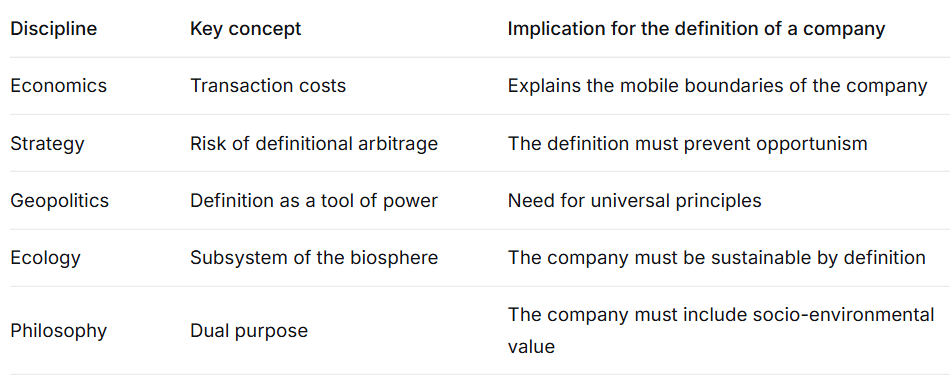
QUESTIONS FOR REFLECTION
- Should a company prioritize economic profit above any other consideration?
- Do you think it is possible for a company to be truly sustainable in the long term?
- Who should decide if a company is "ethical": the market, consumers, the State, or an independent body?
LAYER 5 – SYNTHESIS: INTEGRATING EVERYTHING INTO AN EVOLVED DEFINITION
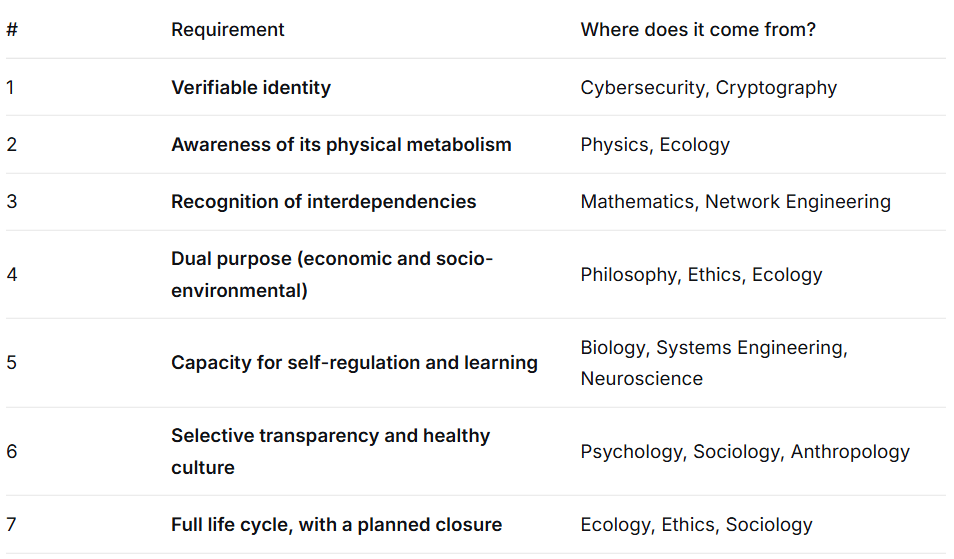
We have journeyed through eleven disciplines grouped into three broad layers. Each has imposed a requirement on the definition of a company. Now we are going to integrate everything.
5.1 REQUIREMENTS A ROBUST DEFINITION MUST FULFILL
Following the multidisciplinary analysis, a complete definition of a company should meet these seven requirements:
5.2 ARCHITECTURE OF THE EVOLVED COMPANY
Let's now imagine the company as a structure of interconnected modules:
Identity core.
Answers the question "who are you?". Includes legal identity and verifiable digital identity. It is the root of trust.
Purpose module.
Answers "why do you exist?". Defines the economic mission and the socio-environmental contribution. It is not a slogan; it is the company's DNA.
Governance module.
Answers "how do you decide?". Includes the rules of decision-making, the distribution of power, and the mechanisms to correct biases.
Operations module.
Answers "how do you produce and deliver value?". Connects with the company's physical and energy metabolism.
Resilience module.
Answers "how do you withstand shocks?". Includes financial cushions, supplier diversification, and continuity plans.
Transparency module.
Answers "how do you account for yourself?". Defines what information the company shares, with whom, and at what moment.
Closure module.
Answers "how do you end without causing harm?". Requires a responsible liquidation plan, protection for employees and creditors.
5.3 THE OPTIMIZED DEFINITION AND ITS BREAKDOWN
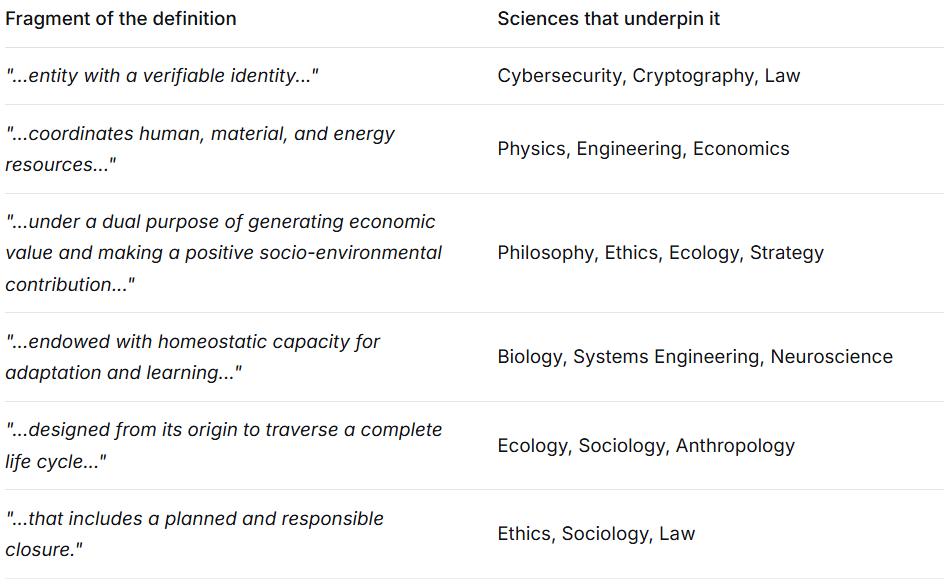
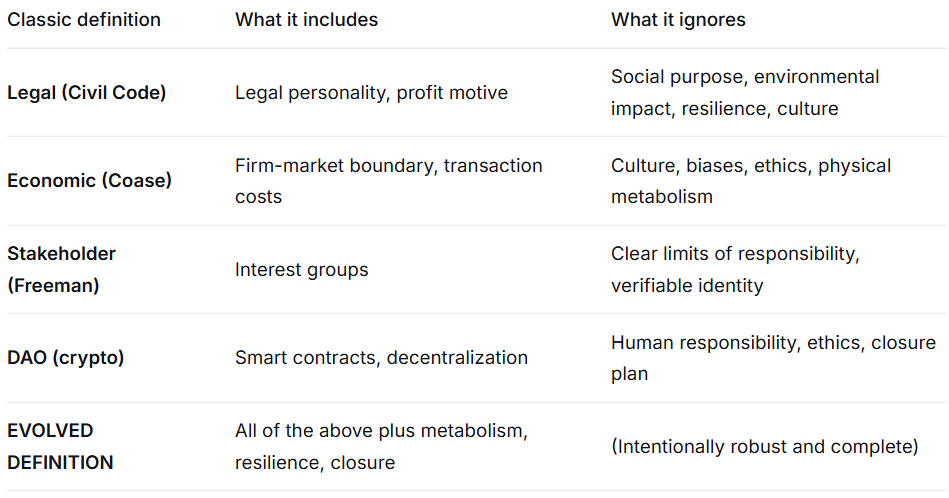
Below, we present the evolved definition to which this multidisciplinary journey leads. We will break it down phrase by phrase so you can see exactly where each component comes from.
"A company is an entity with a verifiable identity that coordinates human, material, and energy resources under a dual purpose of generating economic value and making a positive socio-environmental contribution, endowed with homeostatic capacity for adaptation and learning, and designed from its origin to traverse a complete life cycle that includes a planned and responsible closure."
Breakdown:
5.4 COMPARISON WITH TRADITIONAL DEFINITIONS
5.5 APPLICATION TO REAL COMPANIES
I now propose two exercises to consolidate what you have learned:
Exercise A. Analyze a company you know.
Take a business close to you (the neighborhood coffee shop, a large tech company, an NGO, your own business if you have one) and evaluate it against the seven requirements. Which ones does it meet? Which ones does it miss? What are the consequences?
Exercise B. Write your own definition.
Using what you have learned in this document, write your own definition of a company. The goal is not to copy the one we have proposed, but to build your own with the elements you consider essential. Then compare it with your classmates' definitions and debate the differences.
5.6 FINAL QUESTIONS FOR CLOSURE
- Do you think this evolved definition is applicable to any culture or corner of the world? What adaptations would it require in your local context?
- What does this multidisciplinary approach add that you don't find in a traditional business administration textbook?
- Do you think the companies in your real environment are ready to embrace a definition like this? What obstacles would they encounter?
CONCLUSION
We have journeyed from the urgent need for a good definition to an evolved proposal that integrates eleven disciplines. We haven't memorized a slogan. We have understood where each component comes from and why it matters.
A company is not just a legal entity. It is not just a production function. It is not just a set of contracts. It is all these things and many more. It is a physical system, a network of relationships, an extended mind, a perceived moral agent, a tribe with culture, a subsystem of the biosphere, and an entity with responsibility from its birth until its closure.
Understanding this is the first step toward building, managing, or transforming companies that not only survive in the market, but contribute to a fairer and more habitable world. Because a company, in the end, is nothing other than people coordinating to achieve together what they cannot achieve alone. And how we define it determines how we will live.
End of the educational documentation.