How Big Tech Built an Empire of Surveillance, and Blockchain's Bold Rebellion

Imagine you’re scrolling through your feed late at night, heart racing from a fiery headline that pits “us” against “them”. A notification pings, another “like” on your post. Before you know it, hours have vanished, and your data? It’s already been sliced, diced, and sold to advertisers who know your fears better than your friends. 
This isn’t dystopian fiction. It’s your daily reality in 2026, where Big Tech’s invisible web ensnares billions. But what if there’s a way out. A digital underground railroad powered by blockchain that puts power back in your hands? Buckle up as we dissect tech’s meteoric ascent, unmask its manipulative underbelly, and ignite the spark of a peer-to-peer revolution. This isn’t just an article, it’s a wake-up call to reclaim your freedom and start questioning what you read and see.
From Garage Dreams to Global Dominance

Technology didn’t just evolve, it exploded like a supernova, reshaping humanity in its image. Picture the 1940s hulking ENIAC computers filling entire rooms, crunching numbers for wartime code-breaking. Fast-forward to the 1990s internet boom, where dial-up modems screeched to life, connecting the world in ways once confined to sci-fi novels. The 2000s birthed social media juggernauts like Facebook, turning personal connections into billion-dollar data mines. Now, in the 2020s, generative AI like ChatGPT and Grok isn’t just assisting. It’s creating art, code, and even entire strategies, blurring the line between human and machine.
This frenzy is fueled by Moore’s Law, the prophetic 1965 observation by Intel co-founder Gordon Moore that transistor counts on chips double roughly every two years, slashing costs and skyrocketing power. Today, that means smartphones are more powerful than NASA’s Apollo-era computers sit in over 7 billion pockets worldwide. Let that sink in for a second.
By mid-2025, global internet users surpassed the 6 billion milestone, representing more than 70% of the world’s population and growing faster than ever. But this connectivity comes at a colossal cost: Data centers, the beating hearts of the cloud, are projected to consume over 1,000 terawatt-hours (TWh) of electricity by 2026. Enough to power entire nations like Japan or Germany, and double the 2022 levels, driven by AI’s insatiable hunger for computation. In the US alone, data center power demand is set to hit 75.8 GW in 2026, nearly tripling by 2030 as AI workloads explode. What started as innovation has morphed into an energy-guzzling behemoth, quietly reshaping our planet’s resources while promising endless convenience.
The Dopamine Trap and Surveillance Machine
Big Tech doesn’t just serve you, it devours you, one swipe at a time. Platforms like TikTok and Instagram are engineered like slot machines, leveraging “dopamine loops” to hijack your brain’s reward system. Every like, share, or notification triggers a hit of dopamine. The same chemical rush from food, sex, or drugs. Creating an addictive cycle that’s hard to break. Studies from Stanford Medicine and the NIH reveal that prolonged social media use rewires neural pathways, spiking anxiety and depression while diminishing real-world enjoyment. A month-long “dopamine fast” from these apps can reset your brain, but who has the willpower when algorithms personalize feeds to exploit your vulnerabilities?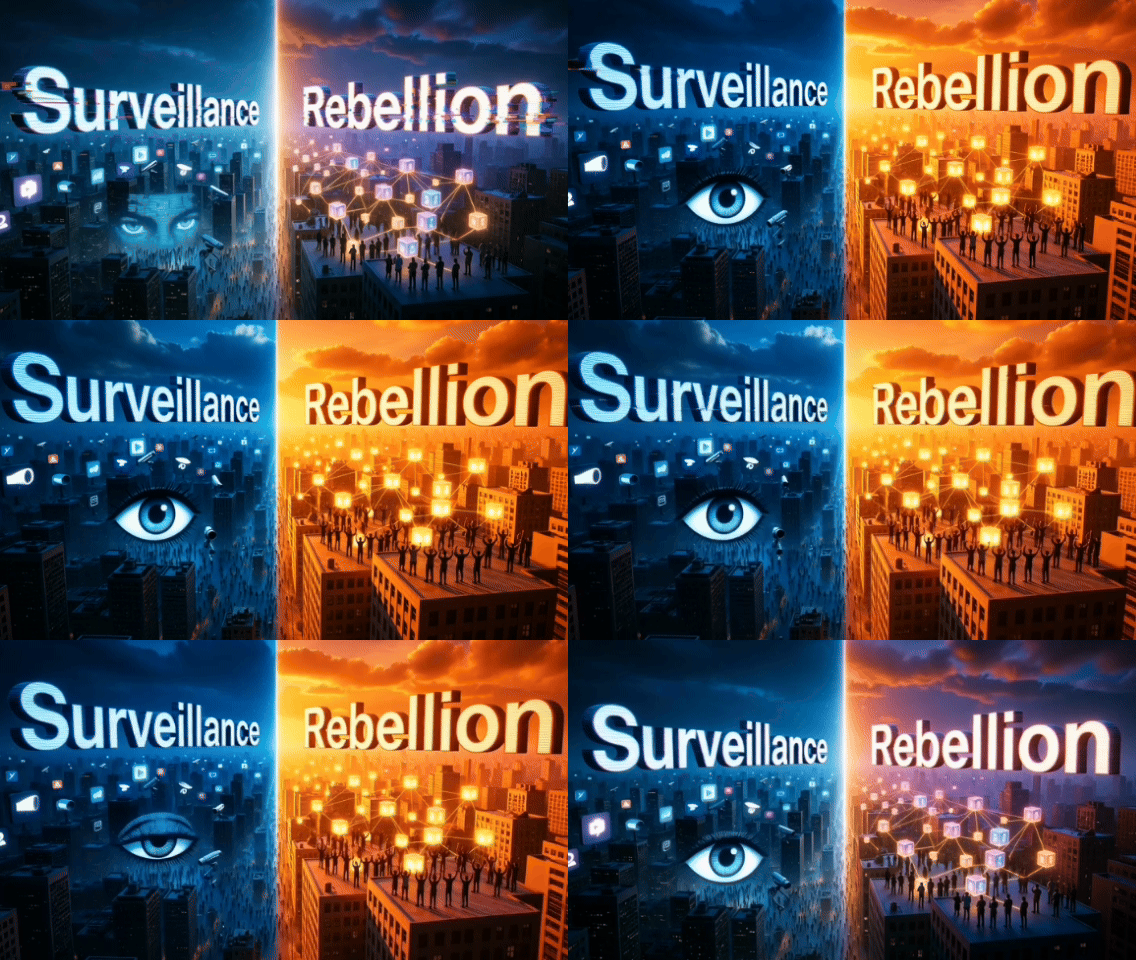
It’s not just addiction, it’s surveillance on steroids. Google tracks your searches, Amazon logs your purchases, and Meta builds “360-degree profiles” from cookies, location data, and even facial recognition. In 2026, with over 1 billion people using AI daily, these profiles are sold to advertisers who bombard you with hyper-targeted ads, like weight-loss pitches after a fitness app browse, that prey on insecurities. Techniques like A/B testing refine this manipulation, turning your attention into the ultimate commodity. As former Facebook executive Chamath Palihapitiya once admitted, “The short-term, dopamine-driven feedback loops that we have created are destroying how society works.” This isn’t progress, it’s a velvet-gloved invasion of your mind and privacy.
Fueling Division for Dollars
In the cutthroat arena of digital media, outrage is the new oil. News outlets and social platforms thrive on “rage bait”. Sensational headlines designed to ignite fury and boost engagement. A viral tweet or post screaming “This One Thing Will Destroy Your Future!” isn’t journalism, it’s a calculated hook. Research shows that rage-inducing content can skyrocket interactions by up to 200%, with shares, comments, and views exploding as users argue in echo chambers. Algorithms on platforms like X (formerly Twitter) and YouTube amplify this, rewarding divisive topics like culture wars or political scandals because they keep eyeballs glued, and ad dollars flowing.
Outlets like Fox News and CNN aren’t immune. They’ve evolved the old “If it bleeds, it leads” mantra into “If it enrages, it trends.” This feedback loop erodes civil discourse, fostering tribalism where facts drown in a sea of hot takes. Creators profit handsomely. The more outrage, the higher the engagement, and the bigger the payout from ad revenue or sponsorships. As one psychologist notes, rage bait exploits our brain’s negativity bias, making it impossible to look away. Even as it poisons public dialogue and mental health.
The Unholy Alliance of Power and Profit
Power doesn’t corrupt, it consolidates. Big Tech’s influence slithers into halls of government, where billions in lobbying dollars shape laws to their liking. In Q3 2025 alone, giants like Meta, Google, and Amazon shelled out a record $16 million on lobbying. Part of a broader surge where AI-related advocacy hit nearly $92 million in the first nine months. Meta led the pack, funneling millions to influence policies on data privacy and antitrust, while OpenAI ramped up to $3.5 million in 2024–2025.
Revolving doors spin wildly. Ex-regulators land cushy board seats at Meta or Google, ensuring oversight is toothless. Firms like Palantir snag massive government contracts, think their 2026 deal with the U.S. Department of War or USCIS for immigration tech that roots out “fraud schemes,” all while raising alarms about surveillance overreach. In 2026, AI ethics boards are dominated by industry insiders, greenlighting mass data harvesting under “national security” guises. EU’s Digital Markets Act and U.S. probes fizzle under this pressure, stifling competition and normalizing a surveillance state where dissent is censored and innovation is gatekept.
Blockchain’s Peer-to-Peer Revolution
But hope isn’t lost. Blockchain, the defiant protocol that flips the script on central control. Born from Satoshi Nakamoto’s 2008 Bitcoin whitepaper, it enables direct, trustless value transfers without banks or Big Tech middlemen. No more KYC (Know Your Customer) chokeholds that track every transaction for governments. True peer-to-peer (P2P) thrives in decentralized apps (dApps) like MinSwap (ADA) for swapping crypto, DorkFi (Voi) for lending without banks, or MagicEden for NFT trading, all running on networks like Cardano or Voi’s Layer 1 solutions.
By 2026, blockchain adoption has surged. Over 283 million people, 4% of the global population use it daily, with 61% of crypto owners planning to buy more this year. These systems are resilient. No single entity can shut them down, as proven during crackdowns on centralized exchanges. “Regulatory clarity” bills? They’re often wolves in sheep’s clothing, designed to prop up the very gatekeepers who’ve abused power. Instead, blockchain revives freedom through immutable ledgers, zero-knowledge proofs for privacy, and community governance. Think Blockchains like Cardano or Midnight.
Now do not get me wrong. This next level tech can and will be used against us unless we make the right choices. Each blockchain is not created equally and for the people. Some are made to be tracked. Some are made to work agaisnt you. If the blockchain you are using gatekeeps node operations and makes it so you need a large amount of Crypto or high end equipment then you might want to explore new options. I suggest and always will suggest Voi Blockchain and Cardano. That is just me though.
Rediscovering P2P Roots in a Digital Age
Peer-to-peer isn’t new, it’s ancient actually. Millennia before corporations, humans bartered goods, exchanged cash under tables, and built mutual aid networks in villages. Banks disrupted this with fractional reserves and debt traps, culminating in crashes like 2008’s financial meltdown, where trillions in bailouts rewarded the reckless. Blockchain breathes life back into this ethos. Projects like Iagon decentralize file-sharing (bye, centralized servers) are creating real world use cases for the future. Decentralized storage is the next evolution in cloud computing I think. That is for another article though.
In gaming, dApps like Decentraland let players own and trade in-game assets as NFTs, creating real economies.
DeFi platforms like DorkFi (Voi) enable interest-earning loans without credit checks, empowering the unbanked. This isn’t speculation, it’s a return to resilient, ruler-free systems that foster innovation and equity.
Wielding Power Ethically
With great power comes great responsibility. Spider-Man’s mantra rings true here. Banks squandered fiat control through predatory loans and inflation; blockchain must avoid the same pitfalls. Prioritize privacy-first tools like zero-knowledge proofs, which verify transactions without revealing details. Community governance in DAOs (Decentralized Autonomous Organizations) ensures no new tyrants emerge. As users, shift from hype-driven speculation to building. Support dApps that liberate, like decentralized social platforms or content economies where creators earn directly from fans.
Breaking Free
Technology’s glittering promise has twisted into a cage of addiction, division, and surveillance. But blockchain hands you the key. A peer-to-peer renaissance that’s ancient yet cutting-edge. Reject Big Tech’s grip, dive into decentralized worlds where you control your data, attention, and future. Start small, Explore a dApp today, question that rage-bait headline, and demand transparency. The revolution isn’t coming, it’s here and it’s unstoppable.
Thanks for reading everyone! Until next time. Have a good day 💪
Original article on Medium