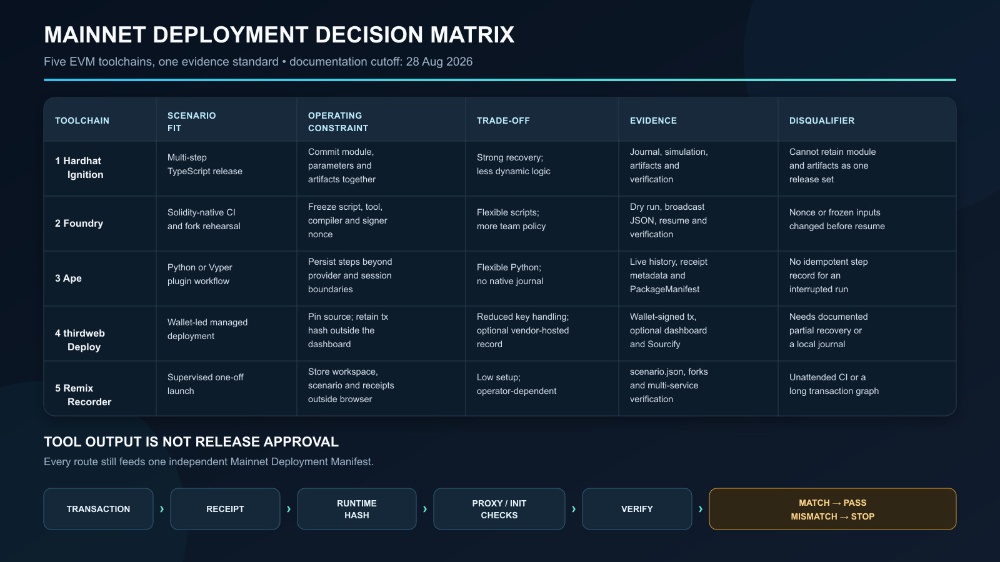
Top 5 Smart Contract Deployment Toolchains for Mainnet Launches

Choose by the release evidence your team can retain, not by demo speed.
Rank by the question an independent reviewer must answer after broadcast: what can the retained evidence prove?
Disclosure: Pharos Production prepared this comparison as the evaluator and is not one of the ranked alternatives. The evidence cutoff is 28 August 2026. Product capabilities are tied to official documentation. This is a dated editorial ranking under the stated criteria, not a benchmark score.
This ranking covers EVM launches and compares five toolchains against the same evidence jobs:
- preserve a repeatable deployment plan with pinned inputs and versions
- rehearse or simulate before broadcast
- retain addresses, transaction hashes and receipts
- recover safely from a partial run
- verify source and deployed runtime identity
No tool fills the complete record. The broader Web3 stack boundary determines which signer, RPC, explorer and operations evidence must join its output.
Decision matrix
Hardhat Ignition
Scenario fit: Multi-step TypeScript release
Operating constraint: Commit module, parameters and artifacts together
Trade-off: Strong recovery with less dynamic module logic
Evidence: Journal, simulation, artifacts and verification
Disqualifier: Module and artifacts cannot be retained as one release set
Foundry
Scenario fit: Solidity-native CI and fork rehearsal
Operating constraint: Freeze script, tool, compiler and signer nonce
Trade-off: Flexible scripts with more policy owned by the team
Evidence: Dry run, broadcast JSON, resume and verification
Disqualifier: Nonce or frozen inputs changed before resume
Ape
Scenario fit: Python or Vyper deployment across plugin ecosystems
Operating constraint: Persist steps beyond provider and session boundaries
Trade-off: Flexible Python with no native reconciliation journal
Evidence: Live history, receipt metadata and PackageManifest
Disqualifier: No idempotent step record for an interrupted run
thirdweb Deploy
Scenario fit: Wallet-led managed deployment
Operating constraint: Pin the source project and retain the transaction hash outside the dashboard
Trade-off: Reduced key handling with a vendor-hosted optional record
Evidence: Wallet-signed transaction, optional dashboard and Sourcify
Disqualifier: Team requires documented partial-run recovery or a local journal
Remix Recorder
Scenario fit: Supervised one-off launch
Operating constraint: Store workspace, scenario and receipts outside the browser
Trade-off: Low setup with high operator dependence
Evidence: scenario.json, forks and multi-service verification
Disqualifier: Unattended CI or a long transaction graph
1. Hardhat Ignition: strongest built-in deployment state machine
Hardhat Ignition ranks first for releases with dependent transactions. Its Future graph writes each action and result to a journal that reconstructs prior state.
Before resuming, Ignition reconciles the current module with its record and stops incompatible changes. It simulates each transaction with eth_call, waits for configured confirmations and supports --verify.
The journal does not store the module definition. Commit the module, parameters, compiler configuration and artifacts together. Compare runtime code and proxy slots against the approved release. This fits TypeScript teams with multi-step, interruptible deployments.
2. Foundry: strongest Solidity-native release path
Foundry makes deployment logic testable in Solidity. A forge script run without --broadcast is a dry run. Broadcasting writes JSON artifacts under the project's broadcast directory, and --resume can continue a partially failed sequence. The same workflow can request contract verification.
Fork tests, deployment code and post-deployment assertions can share Solidity. Configuration helpers can write deployed addresses to a versioned file.
Broadcast JSON proves what Forge sent, not why inputs were approved or where authority ended. Pin the script hash, chain ID, tool version and compiler settings. Because --resume skips simulation and requires an unchanged signer nonce, verify it against live state before continuing. Foundry fits Solidity-heavy CI with fork rehearsal and assertions.
3. Ape: best Python-first deployment record
Ape Framework runs deployment logic as Python and supports different networks, providers, compilers and explorers through plugins. On live networks it saves deployment history. A contract's creation metadata can expose the transaction hash, block, deployer, factory and receipt. Selected deployments can also be tracked in an EthPM package manifest, while publish=True sends source to a configured explorer.
That makes Ape a strong choice when deployment depends on Python-based data preparation or a multi-ecosystem workflow. The completed record belongs in a mainnet deployment runbook that reviewers can inspect without reconstructing the original Python session.
Ape does not present the same first-class write-ahead journal and reconciliation model as Ignition. Local-network history lasts only for the script session, and creation metadata for an existing contract can depend on an Otterscan-capable node, archive access or an explorer plugin. A production script should therefore persist its own step identifiers, expected addresses and stop conditions. The trade works best for Python teams, Vyper projects and deployments that need flexible provider or ecosystem plugins.
4. thirdweb Deploy: best wallet-led managed flow
thirdweb Deploy accepts contracts built with Hardhat or Foundry, opens a browser flow and lets a connected wallet sign without exporting its private key into a deployment script. The documented flow can add the contract to a dashboard and automatically submits it to Sourcify for verification.
That reduces signer handling, but the dashboard should not become the only release archive. The cited deployment documentation does not describe a local write-ahead journal or a reconciliation mechanism equivalent to Ignition. Retain the constructor inputs, chain ID, signer, transaction hash, source commit and observed runtime code in your own evidence package. Choose this route when managed wallet signing and Sourcify matter more than custom orchestration.
5. Remix Recorder: best for controlled one-off launches
Remix Deploy & Run can compile with explicit settings, connect to a browser or mobile wallet, deploy to a public network and submit source to several verification services. Its Recorder saves a transaction sequence as scenario.json, which can be reviewed, changed and replayed in another environment. Remix also offers in-browser forks for rehearsal against live state.
The main limitation is durability. Remix documentation warns that browser storage is inherently unstable and recommends a remote repository instead. Save the workspace, compiler settings and scenario.json outside the browser before mainnet. Replaying a scenario is not the same as reconciling a partially completed live deployment, so do not blindly replay constructors after an interruption. Remix fits a small, supervised deployment whose every wallet approval and receipt will be captured manually, not unattended CI or a long transaction graph.
The manifest every toolchain still needs
The ranking becomes operational when all five toolchains are forced to populate one neutral Mainnet Deployment Manifest:
release:
  chain_id:
  tool_and_version:
  git_commit:
  compiler_and_settings_hash:
  plan_or_script_hash:
  signer_address:
  signing_policy_reference:
  transactions:
    - hash:
      receipt_status:
      contract_address:
  expected_runtime_code_hash:
  observed_runtime_code_hash:
  verification_provider_and_status:
  proxy_kind:
  implementation_address:
  admin_or_beacon_address:
  initializer_calldata_hash:
  authority_handoff_transaction:
  reviewer:
  stop_on_mismatch: true
Not every release uses a proxy, so those fields may be marked not applicable, but they must not be silently omitted. The same rule applies to an initializer or authority handoff. A mismatch in chain ID, input hash, receipt, runtime code, proxy slot or verification result produces STOP, not a note to investigate after traffic moves.
Derive the expected runtime hash from fully linked deployment bytecode under the pinned compiler settings. Linked-library addresses, immutable substitutions and compiler metadata must match; hashing an unresolved artifact can create a false mismatch.
When this ranking does not apply
- A non-EVM chain needs its own chain-native deployment and verification model.
- An upgradeable launch needs proxy-specific storage and upgrade-safety validation in addition to the base deployer.
- A governance or multisig launch may require the tool to prepare transactions while a separate system collects approvals and executes them.
- An organization's signer policy may disqualify a tool even when its deployment artifacts are strong.
Pick the toolchain that leaves the fewest manual gaps for your actual release. If the team cannot reproduce the approved inputs, recover a partial run, match deployed runtime code and retain the receipts without relying on one operator's browser or vendor dashboard, the launch evidence is incomplete.