Oracle Freshness Budgets: Stop on Stale Data


A price can be the latest answer available and still be too old to authorize a loan. The contract call succeeds, the number looks plausible and the user interface shows a green connection indicator. None of those observations establishes that the next state change should use that price.
An oracle freshness budget is an application rule: the maximum age of a validated observation that a particular operation may consume. Exceeding it must change the operation's permission, not merely produce an alert. Borrowing against stale collateral should fail before debt increases. A repayment that genuinely needs no valuation may remain available through a separately reviewed path.
This article uses an illustrative EVM lending system, not a deployed protocol. Every numeric threshold below is a synthetic policy choice, not a Chainlink recommendation. The reusable output is an operation policy matrix and a circuit-breaker drill record. The design question is narrow: what happens between receiving an oracle answer and committing a price-dependent state transition?
A heartbeat is not your acceptance budget
Chainlink Documentation states:
Chainlink Data Feeds do not provide streaming data.
Source: Chainlink, official documentation, What are Chainlink Data Feeds?. Publication date not stated. Accessed October 9, 2026.
The same documentation describes updates driven by deviation thresholds or heartbeat intervals. Those mechanisms govern feed publication. Your budget governs acceptance by your application. Treating them as interchangeable hides the decision about how much uncertainty a state change can tolerate.
A concrete recent reminder appears in Chainlink's September 29, 2026 release notice. Scheduled, cron-based updates for specified feeds were due to shut down on or shortly after September 30. The notice distinguishes that change from feed deprecation: heartbeat and deviation updates continue. It does not prove that every listed deployment completed the change at one exact instant.
An application that expected an update at a fixed wall-clock time therefore needs a different assumption from one that checks age at use. Review the actual feed and chain configuration rather than importing a familiar number from another integration. Record the configuration's retrieval date alongside your policy version.
If a feed normally updates less frequently than your application can safely tolerate, increasing the budget to avoid reverts does not resolve the mismatch. Choose a suitable data product, reduce the exposure of the operation or accept a deliberately unavailable path. That is an architecture decision with business consequences, not a monitoring adjustment.
The budget's rationale should explain the loss mechanism. Which asset can move against the system while its observation ages? How much new exposure can enter before the next valid update? Can an attacker repeat the operation or concentrate it in one block? A smaller timeout cannot compensate for an unlimited borrowing path, and a tight exposure cap does not make an invalid observation valid. Evaluate those controls together while retaining separate pass conditions.
There is also an availability cost. If the system rejects whenever a normal update arrives slightly late, users may face avoidable interruption. Measure that behavior during rehearsal, then let the risk owner decide whether the chosen data product supports the desired operation. Do not relabel a rejected transaction as a network problem simply because the contract is enforcing the configured budget correctly.
Start with operations, not one global timeout
List every operation that consumes a valuation, including indirect calls through vaults and adapters. For each one, identify the state change a wrong price could authorize. A shared oracle library is useful only if every relevant path uses it and the returned value cannot outlive its validation context.
Our fictional system uses a 120-second maximum age for price-dependent execution. That value is selected solely to make the boundary visible in the examples. Borrowing, collateral withdrawal and liquidation each require a fresh price plus the other gates described below. This does not mean that one budget is appropriate for every real lending protocol.
The operation policy matrix has four columns: operation, valuation dependency, rejection behavior and exception evidence. Written as review cards, its initial rows are:
- Borrow: valuation required; reject before debt or token transfer changes; no stale-price exception.
- Withdraw collateral: valuation required; reject before collateral leaves; no stale-price exception.
- Liquidate: valuation required; reject before seizure or debt settlement; sequencer recovery restrictions also apply where relevant.
- Repay a fixed debt amount: no price required in this hypothetical path; permit only the reviewed debt reduction; no collateral release or automatic swap.
- Add collateral: no price required in this hypothetical path; permit only receipt and accounting of the asset; no immediate borrowing or share issuance based on valuation.
- Display an estimate: stale data may be displayed with its timestamp and an unavailable-execution warning; the estimate grants no execution permission.
Those exceptions are conditional. A deposit that mints shares from portfolio value needs a price. A repayment that swaps one asset into another may need a price. Inspect the complete call path before labeling an action risk-reducing. A function name is not evidence that stale data cannot create exposure.
For teams buying implementation work, Pharos Production's smart contract development service includes oracles and supporting deployment, monitoring and upgrade tooling. The stale-data problem belongs in that implementation scope: ask for this operation matrix and the rejection evidence, rather than accepting oracle integration as a completed checkbox. This is a service-scope mapping, not a claim that this fictional system was delivered to a client.
Validate the observation before calculating its age
The Data Feeds API reference documents the answer and timestamps returned by latestRoundData(). It marks answeredInRound as deprecated. Do not promote an inherited check against that field into a universal modern freshness guarantee without understanding the specific implementation.
For this positive asset-price fixture, reject a failed read, an unsupported configuration and a nonpositive answer. Check that updatedAt is nonzero and does not exceed the execution block's timestamp before subtracting. A future timestamp is invalid here, not exceptionally fresh. Other data products need their own value-domain rules; negative values are not inherently invalid for every possible feed.
Only after those checks compute age = block.timestamp - updatedAt. The fixture accepts age less than or equal to 120 seconds and rejects age greater than 120 seconds. Explicit equality matters: two implementations that disagree at the boundary do not enforce the same policy.
Price decimals, token decimals and quote direction belong in the configuration record. A fresh answer scaled incorrectly can authorize a bad loan just as readily as an old answer. Compare normalized values using reviewed arithmetic and rounding rules. Check conversions before exposing the result to position accounting.
For a derived asset price, validate every required component. A fresh exchange rate multiplied by an expired base-asset price remains dependent on expired data. Give each component its own budget and record any maximum timestamp skew between components. The oldest dependency and their temporal mismatch should be visible to the reviewer.
The record should identify the chain, proxy, intended asset and quote currency, expected decimal scale, consumer version and policy version. An address without the chain is incomplete. A configuration change must invalidate the old acceptance evidence until the new combination has been reviewed. Do not silently substitute another pair because its output has the same number of decimals.
Keep the budget in a unit that the configuration cannot misinterpret. A field named maximum age is incomplete if one component supplies milliseconds and the contract expects seconds. The policy should reject a zero budget when that means accidental disablement, or explicitly document zero as a supported mode. It should also constrain who can enlarge the limit. Otherwise the emergency control can become a convenient way to authorize older prices without changing the consumer code.
Check freshness where the state change executes
Consider a synthetic timeline. At timestamp 10,000, a price observation is recorded. A user simulates a borrow at 10,110, when the age is 110 seconds. The transaction enters a queue and executes at 10,125 without a newer observation. Under our 120-second budget, it must reject at execution even though the simulation succeeded.
The front end should explain that difference. A successful preflight is conditional on the simulated state and time. It is not a reserved permission to borrow later. Keep the onchain check adjacent to the actual valuation-dependent transition. Offchain validation alone cannot enforce the contract's acceptance rule.
Avoid caching a previously validated price across transactions unless the cache preserves the original observation timestamp and the next operation rechecks age. Recording when the cache was refreshed is not equivalent to recording when the price was observed. Rewriting the timestamp while copying the same answer manufactures apparent freshness.
An offchain monitor has a different clock problem. It can read an old node head and conclude that the feed is young relative to that old block. Track head age against an independent operational clock and distinguish RPC lag from feed lag. The dashboard's fetch time must not replace the oracle's update time.
Now change only the fixture's execution timestamp to 10,120. The age equals the budget and passes the age gate. That says nothing about the remaining gates. A bad scale, disabled operation or failed sequencer check still rejects. Logically, acceptance requires every applicable predicate. Freshness is one necessary condition, not a certificate of price correctness.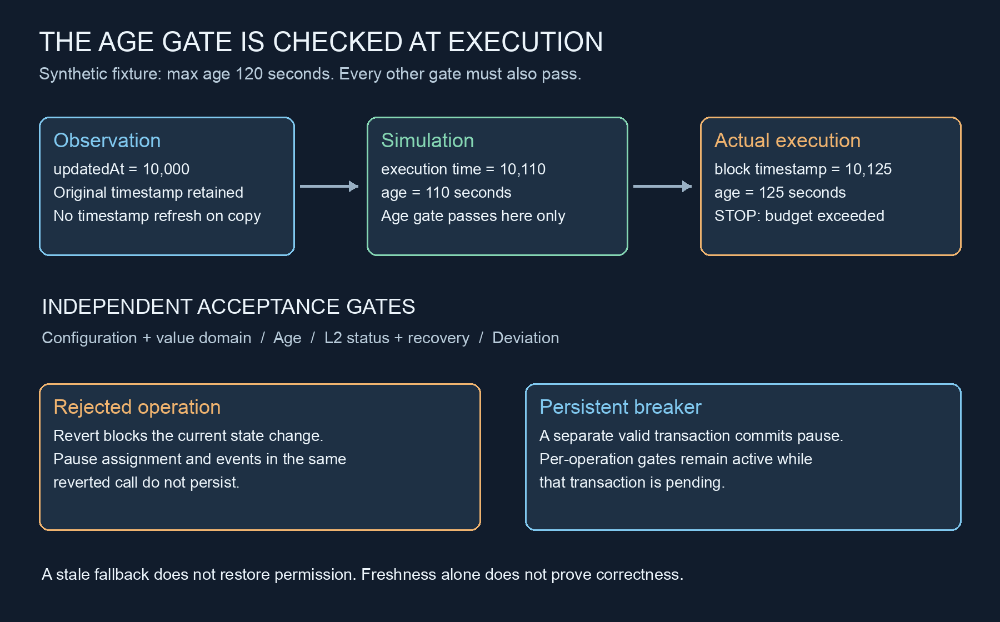
Add a separate L2 availability gate
On a supported rollup, a recent price and an operational sequencer answer different questions. Chainlink's L2 Sequencer Uptime Feeds documentation defines status values and a recovery grace period. The example's one-hour constant is an example, not a universal budget to copy into every deployment.
The sequencer feed's startedAt identifies a status change. It is not the price feed's updatedAt. Keep those two clocks separate. Reject a down status and apply your explicit post-recovery policy before permitting affected price-dependent actions. The documentation also describes an uninitialized zero timestamp on Arbitrum. Handle the relevant chain-specific initialization condition deliberately.
Our fictional L2 fixture waits until elapsed time since recovery is strictly greater than its chosen grace period. Price freshness uses a less-than-or-equal acceptance boundary instead. Document both comparisons. An engineer reading only the words wait until fresh cannot infer them.
The recovery restriction should name its scope. Does it stop liquidation only, or also borrowing and collateral withdrawal? What remains available for users who need to reduce debt? These decisions cannot be inferred from whether the sequencer reports up. A restored transaction path does not establish that every participant had a fair chance to react.
For a composed operation, do not run the uptime check against one network and the valuation against an unrelated deployment. Pin both to the intended execution environment. If your actual system spans chains, this local fixture is insufficient. Message delay and remote observation validity need their own contract.
Deviation and fallback need their own budgets
A recent price can be wrong for your use case. Add a separate deviation policy with a defined reference, normalization and denominator. For example, our synthetic breaker compares a fresh candidate with the last accepted, policy-valid reference and trips when absolute relative change exceeds its configured limit. The reference itself must remain eligible. An indefinitely old reference is not a safety anchor.
Decide what a trip means before coding it. A large move may be real. Automatically clamping the answer to the previous price can freeze the system on a known obsolete valuation. Rejecting new exposure while investigating is different from claiming that the older number is correct. Liquidation fairness and solvency may pull in different directions. The risk owner must resolve that policy.
Chainlink's feed-selection and risk guidance places risk assessment and application safeguards with the consumer. A circuit breaker is one safeguard, not proof that a feed cannot fail. Your freshness limit, deviation rule and economic exposure still require application-specific review.
A fallback must pass its own checks. Record its asset definition, time source, maximum age, liquidity assumptions and shared dependencies with the primary. Two endpoints that depend on the same venue or aggregation path do not provide the independence suggested by their different URLs.
In our fixture, a stale primary and a stale fallback leave borrowing disabled. The code does not keep searching until it finds any number. A valid fallback would be allowed only for explicitly named operations, under a separately approved exposure limit and selection rule. Selecting whichever source gives the user the largest borrowing capacity defeats the purpose of the policy.
There is no universally conservative price direction. Lower collateral value can reduce borrowing capacity, while debt valuation has the opposite role. Liquidation also affects both borrower loss and protocol recovery. Define conservatism per operation and asset role rather than hiding it in a generic minimum-of-two-prices helper.
For a simple hypothetical deviation calculation, compare a normalized reference of 100 with a candidate of 106. The absolute relative change is 6 percent when the denominator is the reference. That is a proposed calculation example, not a reported market move or recommended limit. If the breaker threshold were 5 percent, this candidate would trip it even with age zero. Reversing the denominator changes the result. Store the formula with the threshold so reviewers do not approve one meaning while the implementation enforces another.
A revert does not save an emergency pause
An execution gate and a persistent circuit breaker are separate controls. If a function sets a pause flag, emits an event and then reverts the same call, those attempted effects do not become durable. Solidity's error-handling documentation explains that state-reverting exceptions undo changes in the current call and its subcalls.
The rejected operation is stopped. Future operations are not necessarily paused. Confusing those outcomes can leave an incident process waiting for a flag or event that was never committed. A failed transaction receipt is useful operational evidence, but it is not an emitted onchain pause event.
One design uses an independent transaction to observe a tripped condition and persist the breaker state. That transaction must complete without reverting after its state update. Another relies on an authorized operator to submit a pause through a separate control path. Neither removes the need for per-operation validation while the pause transaction is pending.
Specify who may trip the breaker, which evidence they submit and whether the contract independently verifies the trigger. A permissionless trip can improve response time only when it cannot turn arbitrary caller input into a denial of service. Give resume authority its own policy. Permission to stop should not automatically grant permission to loosen budgets or resume exposure.
The persistent transition needs a policy version, affected operation set, observation reference and reason. Avoid promising that a keeper will act within a particular number of seconds unless you have evidence for that operating commitment. An unavailable keeper must not make stale borrowing succeed.
Rehearse failure as a state transition
The drill record binds a fixture to an expected result. It is not a screenshot of a green test runner. Store the consumer commit, chain configuration, feed identifiers, policy version, simulated execution time, input observations, operation and expected durable effects. Save actual receipts when your team executes the drill.
Here is a proposed acceptance set for the fictional system. These are expected outcomes, not results from a deployed contract or an executed audit:
- Age 120 seconds, all other gates valid: the age gate passes; normal borrowing checks still apply.
- Age 121 seconds: borrowing rejects; debt and transferred balances remain unchanged.
- Timestamp zero or in the future: reject as invalid data before age arithmetic.
- Primary read fails and no approved fallback is available: reject; no default price enters accounting.
- Fresh primary with unexpected scale or asset configuration: reject as a configuration failure.
- Sequencer down, or recovery grace not complete: reject the affected operations even with a fresh price.
- Primary stale and fallback stale: reject; fallback selection does not bypass age validation.
- Fixed-amount repayment through the reviewed price-free path: debt falls without releasing collateral or triggering a swap.
- Pause assignment followed by revert: no persistent pause or event is expected from that reverted call.
- Independent valid breaker transaction: pause persists; a subsequent forbidden operation rejects because the breaker is active.
Inspect effects, not just error text. For a rejected borrow, compare debt, collateral, allowances and token balances as relevant to the implementation. For repayment, verify that the supposedly price-free path did not reach a valuation-dependent callback. External-call failures and caught exceptions need explicit assertions at the actual caller boundary.
Then replay the inclusion-delay timeline with a different execution timestamp. This catches systems whose test helper validates at simulation time and accidentally reuses that permission later. Boundary checks should vary the clock that production actually reads, not an unrelated test variable.
Give the drill an explicit interruption point: the operation has rejected, but no keeper has submitted a persistent pause yet. Verify that the next attempted borrow still fails from its own gate. Then complete the independent pause and check the durable state in a new read. This sequence distinguishes two controls that can otherwise look identical in a demonstration. A team can preserve evidence of both without claiming that a failure event survived the reverted transaction.
Record missing evidence as missing. A mock verifies the consumer's decision against controlled inputs, while a chain fork can expose actual adapter behavior at a retained block. Neither alone proves future feed availability. The reviewer should know which environment produced each result before treating the packet as release evidence.
Resume against evidence, not a green badge
Recovery needs a different rule from rejection. A single fresh update may be insufficient after a prolonged outage or a configuration change. Define the observations required to resume, their spacing, reference validity and any manual approval. Do not count repeated polling of the same round as multiple independent recovery observations.
Use hysteresis where it has a clear purpose. The stop threshold and recovery criterion need not be identical, but both must be documented and bounded. Otherwise a feed hovering at the age limit can toggle permissions repeatedly, frustrating users and making incident ownership unclear.
The incident owner should see observation age and budget together, plus the failing gate, operation set, current head age and breaker state.
Distinguish a tripped condition from a submitted pause transaction and from a confirmed persistent pause. Distinguish a proposed resume from a committed resume in the same way.
Pharos Production's blockchain engineering scope covers contract work and supporting infrastructure, including oracle integration and post-launch monitoring. When stale data can block borrowing or liquidation, make the acceptance request concrete: an operation policy, versioned oracle configuration and a failure-and-recovery drill. The service description supports that scope discussion. It does not establish an incident-response outcome or availability guarantee.
Before release, have the risk owner sign the remaining choices: maximum ages, grace boundaries, fallback permissions, exposure limits and resume authority. Have the engineering reviewer bind those choices to the consumer and its callers. Have the operator rehearse the separate persistent-stop path. Those approvals answer different questions and should not collapse into one deployment checkbox.
A freshness budget is complete only when an expired observation cannot authorize the forbidden transition, allowed exceptions remain narrowly defined and recovery follows recorded evidence. The useful handoff is the matrix plus the drill record. A plausible price and a successful read are only inputs.
More insights to read
- Smart Contract Upgrade Authority: Timelocks, Multisigs, and Emergency Controls
- Smart Contract Release Audit: 8 Repository Artifacts
- Smart Contracts. Their Potential and Real Limitations. Part 1
- Web3. Smart Contracts. Oracles. Part 1
- Smart Contracts. Their Potential and Real Limitations. Part 2
About the author
Dmytro Nasyrov. Photo supplied by the author.
Written by Dmytro Nasyrov PhD, software architect with 24 years of production experience. Dmytro is the founder and CTO of Pharos Production. He works on production software architecture for FinTech, AI, Web3 and blockchain systems.