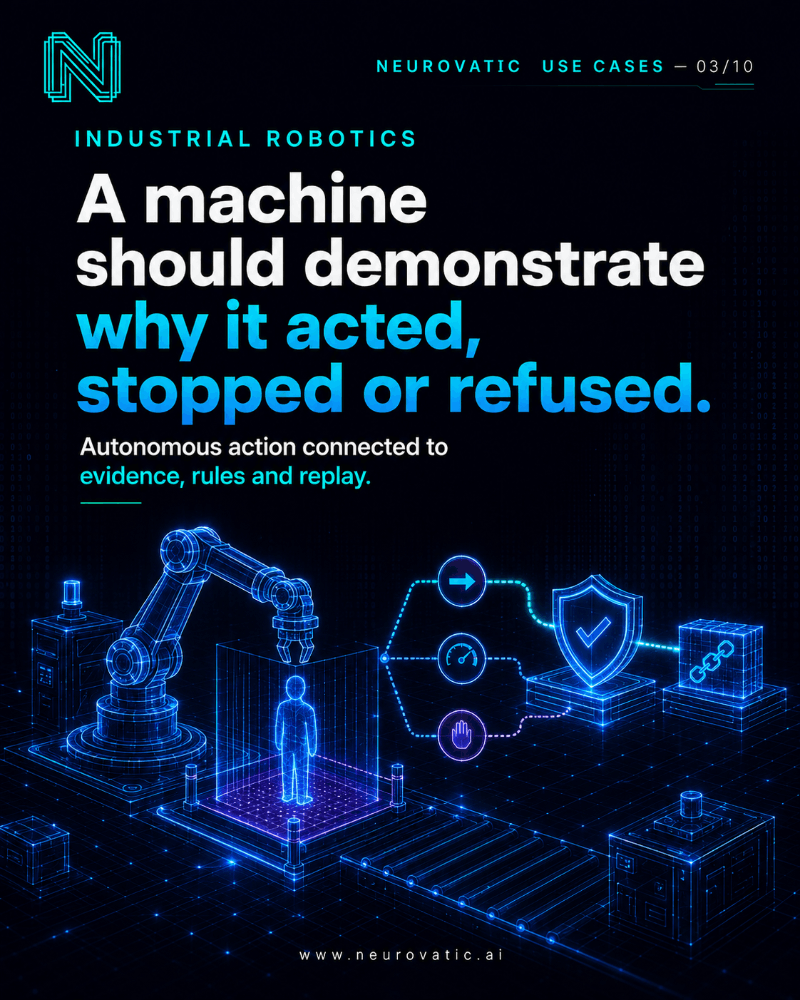
Industrial Robotics - A machine should be able to demonstrate why it acted, stopped or refused.

𝐍𝐄𝐔𝐑𝐎𝐕𝐀𝐓𝐈𝐂 𝐔𝐒𝐄 𝐂𝐀𝐒𝐄 𝟎𝟑/𝟏𝟎
Imagine an industrial robot operating beside human workers.
Its perception system detects that a person, object or vehicle has entered a restricted area. The robot must decide whether to continue, reduce speed, stop immediately or transfer control to a human operator.
A conventional system may preserve sensor logs and an error code. That still may not explain why one particular response was selected.
A NEUROVATIC-enabled workflow could add a verifiable decision layer around the robot’s existing perception and control systems.
𝐈𝐍𝐏𝐔𝐓 — The robot provides its sensor state, operational mode, task context, uncertainty indicators and candidate action.
𝐑𝐄𝐀𝐒𝐎𝐍 — 𝐔𝐍𝐃𝐄𝐂𝐀 structures the causal relationship between the observed environment and the proposed response. It can represent why the detected condition creates a safety risk and how alternative actions would affect that risk.
𝐆𝐎𝐕𝐄𝐑𝐍 — 𝐒𝐈𝐆𝐌𝐀 and 𝐍𝐀𝐆𝐑𝐀 evaluate the action against safety constraints, operational policies, authority limits and mandatory human-intervention conditions. If an action is outside the permitted envelope, the governance layer can reject or escalate it.
𝐀𝐒𝐒𝐔𝐑𝐄 — 𝐀𝐄𝐆𝐈𝐒 cryptographically binds the sensor evidence, evaluated rule set and selected action into an integrity-protected decision package.
𝐏𝐑𝐎𝐕𝐄 — 𝐍𝐏𝐨𝐈 generates proof tied to that specific robotic decision.
𝐑𝐄𝐂𝐎𝐑𝐃 — 𝐍𝐕-𝐂𝐇𝐀𝐈𝐍 preserves the event, reasoning, rule evaluation and outcome so the incident can be replayed during maintenance, investigation or safety review.
NEUROVATIC is not the robot’s motor controller and does not replace certified safety mechanisms.
It is the infrastructure that can connect an autonomous action to its reasoning, governance conditions, evidence identity and audit history.
That distinction matters whenever a machine operates close to people, valuable equipment or critical infrastructure.
-----
This post, including all associated text and visuals, has been generated and assisted by artificial intelligence under the regulatory requirements of the EU AI Act. Powered by NEUROVATIC AI systems.