How to Choose the Right Power Supply for Your Device

Losing or damaging a power supply is a common problem and replacing it correctly is essential. Using the wrong unit can damage the device, reduce its lifespan or create a safety hazard. This article walks through the key specifications and practical considerations for selecting a replacement power supply with confidence.
The information below applies to switchmode power supplies used with consumer electronics, laptops, routers, LED lighting and similar equipment. For specialised or high-power applications, consult a qualified electrician or the device manufacturer.
Step 1: Match Voltage
Voltage is the first specification to check and it must match the original power supply exactly.
- Voltage is measured in volts (V).
- The required voltage is printed on the device's label or on the original power supply.
- Common voltages include 5V, 9V, 12V, 19V and 24V.
- Connecting a power supply with a higher voltage can permanently damage components.
- A lower voltage may cause the device to malfunction, fail to start or operate erratically.
Important: Never substitute a different voltage, even if the plug fits. Voltage mismatch is the leading cause of damage from incorrect replacement power supplies.
Step 2: Check Amps
Current, measured in amps (A), indicates how much power the supply can deliver.
- The device requires a minimum current to operate.
- The replacement power supply must provide at least the same amps as the original.
- A higher amp rating is acceptable, as the device will only draw what it needs.
- A lower amp rating is not acceptable, as the supply may overheat or shut down under load.
Example: If a device requires 12V at 1.5A, a 12V 2A power supply is a suitable replacement. A 12V 1A unit is not adequate.
The power rating in watts (W) can be calculated by multiplying volts by amps (V × A = W). This is useful when comparing supplies with different current specifications.
Step 3: Plug Size and Polarity
The physical plug must match the device's input socket and the polarity must be correct.
Plug Size
- Most consumer devices use a DC barrel jack, commonly 2.1mm or 2.5mm inner diameter.
- Measure the inner diameter of the socket on the device or refer to the original plug.
- Some adapters use removable plugs with interchangeable tips (e.g., 4.5V and 7.5V units from Campad Electronics).
- An incorrect plug size will result in a loose connection or will not fit at all.
Polarity
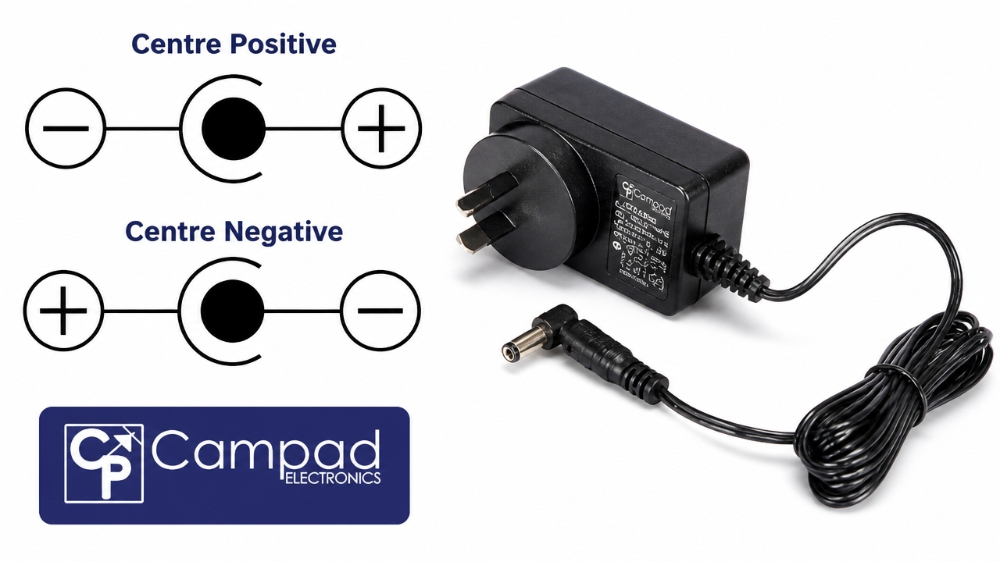
- Polarity indicates the direction of current flow through the plug.
- Most devices use centre-positive polarity, but centre-negative is also used in some audio equipment.
- The polarity symbol is a circle with a dot inside; it is printed on the device and on most power supply labels.
- Reversed polarity can damage the device instantly.
Check both plug size and polarity before purchase. These are commonly overlooked and cause many returns.
Step 4: Quality and Safety
Power supplies are not all equal. Quality affects safety, efficiency and device longevity.
Key quality considerations:
- Switchmode vs. linear: Switchmode power supplies are efficient, compact and produce less heat than linear units. They are suitable for most modern electronics.
- Protection features: Look for units with built-in short-circuit and overvoltage protection. These help protect both the supply and the connected device.
- Ventilation: Some power supplies have metal cases designed for heat dissipation. Others may include built-in fans for higher power applications.
- Warranty: A reasonable warranty indicates manufacturer confidence. Check the warranty terms before purchasing.
Australian electrical standards: Power supplies sold in Australia should be compliant with relevant Australian electrical safety standards and approved units carry the appropriate compliance markings. When buying from a reputable Australian supplier, such as Campad Electronics, these requirements are generally met as part of normal product compliance obligations. This guide does not constitute legal advice; purchasers should verify compliance with applicable regulations before use. See DC Power Supplies In Australia
Step 5: Consider the Form Factor
Power supplies come in different physical formats and the right choice depends on the application.
- Plug pack (wall adapter): Plugs directly into a wall socket. Suitable for low-to-medium power devices (up to around 3A).
- Desktop power supply: Sits on the floor or desk with a separate AC cord. Suitable for higher power requirements (e.g., 24V 10A units).
- Removable plug types: Some units offer interchangeable plugs for different socket types, which is useful for travel.
Choose a format that suits the physical location and the device's power requirement.
Conclusion
Selecting a replacement power supply is straightforward when the key specifications are checked in order. Match the voltage, confirm the current rating is equal or higher, verify plug size and polarity and choose a quality unit from a reputable supplier. Taking these steps prevents damage, ensures reliable operation and extends the life of the device.
A wide range of switchmode power supplies, plug packs and adapters is available from Campad Electronics to suit most common applications. Always check the device's requirements first and seek professional advice if the specifications are unclear.
FAQs
What specs matter most?
The three critical specifications are voltage, current and plug polarity. Voltage must match exactly, current must be equal to or greater than the requirement and polarity must align with the device. Plug size is also essential for a secure connection. All specifications are printed on the original power supply label.
How do I replace a lost power supply?
If the original unit is missing, follow these steps:
- Locate the voltage and current requirements on the device's label or in its user manual.
- Identify the plug size and polarity from the device's input socket.
- Search for a replacement with matching voltage, equal or higher current and correct plug size and polarity.
- Consider the form factor (plug pack vs. desktop unit) based on the location and power level.
- Purchase from a reputable supplier who stocks compliant units.
The product range at Campad Electronics covers common voltages from 4.5V through 48V, with various amp ratings and plug configurations, making it easier to find a suitable match for most consumer devices.
Can I use a power supply with a higher amp rating than the original?
Yes. A higher amp rating is safe because the device only draws the current it needs. For example, a 12V 2A supply can replace a 12V 1.5A unit. The supply will not force extra current into the device.
What happens if the voltage is slightly off?
Even a small voltage mismatch can cause problems. A higher voltage can damage components permanently. A lower voltage may cause erratic operation or failure to start. Always match the voltage exactly.
How do I determine the plug size if the original is missing?
Measure the inner diameter of the device’s input socket with a ruler or calliper. Common sizes are 2.1mm and 2.5mm. If you cannot measure, check the device’s manual or contact the manufacturer. A plug that is too small will be loose; one that is too large will not fit.
What does centre-positive vs. centre-negative mean?
Polarity defines the direction of current flow through the plug. Centre-positive means the inner pin is positive and the outer barrel is negative. Centre-negative is the reverse, often found in audio equipment. The symbol, a circle with a dot, appears on the device and the power supply label. Reversed polarity can destroy the device instantly.
Are switchmode and linear power supplies interchangeable?
In most consumer electronics, yes, provided voltage, current, plug size and polarity match. Switchmode units are more efficient, lighter and generate less heat. Linear units are heavier and less efficient but may be preferred in some audio applications. Always check the device’s requirements before substituting.
How do I know if a power supply is safe to use in Australia?
Purchase from a reputable Australian supplier. Approved units carry compliance markings and meet relevant electrical safety standards. This guide is not legal advice; verify that any unit you buy complies with applicable regulations before use.
What if the replacement power supply has a removable plug tip?
Some adapters include interchangeable tips for different socket sizes. Ensure the tip you select matches the device’s socket diameter and that the polarity setting is correct before connecting. A loose or incorrect tip can cause intermittent power loss or damage.
Can I use a desktop power supply instead of a plug pack?
Yes, if the voltage, current, plug size and polarity match. Desktop units are suitable for higher power requirements, e.g. 24V 10A and are often more stable under load. Plug packs work for low-to-medium power devices up to around 3A. Choose based on the device’s power level and physical setup.
What protection features should I look for?
Look for built-in short-circuit and overvoltage protection. These prevent damage to both the supply and the connected device if a fault occurs. Units with metal cases or fans may provide better heat dissipation for high-power applications.
What does wattage (W) mean and does it matter?
Wattage equals volts multiplied by amps (V × A = W). It indicates total power output. When comparing supplies, the wattage of the replacement must be equal to or greater than the device’s requirement and the voltage must match. For example, a 12V 1.5A device needs at least 18W.
Why does a lower amp supply fail under load?
A lower amp rating means the supply cannot deliver enough current. Under load, it may overheat, shut down or provide unstable power. This can damage the device or shorten its lifespan. Always meet or exceed the original amp rating.