Crypto Casino Withdrawals: Preserve the Broadcast Record Before Retrying

The withdrawal whose reply never arrived
The cashier sent a withdrawal instruction and the connection closed before a response arrived. The player's balance still shows a reservation. Support sees a timeout and has a retry button. The first question is whether the original instruction reached a component that can still move funds. Until someone can answer it, keep the withdrawal open under its original identity and stop a second payout from being created.
A timeout records what the caller observed. The custody service may have accepted the request, queued it for signing or sent a signed transaction to the network. It might also have received nothing. A timeout alone cannot distinguish those cases. The same uncertainty applies when a worker crashes after sending a request but before saving the response. Restarting the worker restores the ability to process work. The outcome of the old work still needs evidence.
Start with two things that already belong to the withdrawal: the durable operation ID and the original financial instruction. Preserve the ledger reservation, the approved destination and the asset on its selected network. Find the connector reference sent with the request. If that reference can be recovered only from a lost reply, the integration has an evidence gap at the point where the operator needs it most.
This is an acceptance problem for Gambit Stream's crypto payment integration for casinos. An operator adding withdrawals to an existing account system needs to agree who signs and who can resolve an ambiguous result. The recovery record below is a proposed design. W-116 and every observation attached to it are fictional.
Give each part of the withdrawal its own evidence
Keep a durable withdrawal record and append observations to it. Store the minimum facts needed to search and correlate records. Link to restricted evidence when the underlying request contains player data or signing material. The cashier should retain a reference to the approved instruction even when several connector attempts or chain transactions eventually relate to it.
Approval. Save the withdrawal ID, approval revision and policy result before dispatch. Bind them to the amount in base units, the network, the asset identity and a reference to the approved destination. Record the reservation or other authorized ledger treatment at this point. A reviewer should be able to detect a destination change by comparing the approved revision to the submitted one.
Dispatch. Save the receiving workspace or connector route, the external operation reference and the request identity before the call leaves the worker. An attempt ID helps reconstruct a timeout. The stable operation identity joins that attempt to the original approval. Save when the worker began dispatch and when it lost the response. A queued job with a saved reference still needs an accurate state showing whether dispatch began.
Signing. Retain a signer or custody operation reference and its observed state. When a policy permits retaining a derived transaction hash before submission, label it as derived and save the network with it. A signature or derived hash can exist before any successful broadcast. Store signed payloads only where the custody design permits them. Recovery tickets should reference the restricted record without copying keys or payloads into a shared channel.
Broadcast. Record the source of the submission evidence, its observation time and any transaction reference returned. The source could be the provider's status record or a response from an authorized node. Preserve the original evidence if a replacement later creates another hash. A provider state indicating broadcast in progress calls for further observation under the provider's contract.
Chain observation. Save the endpoint, network, lookup method and time together with the result. When inclusion is visible, retain the block identity and execution outcome. For a token transfer or batch payout, identify the specific event or output that matches the approved withdrawal. An included transaction can contain several transfers, so a hash by itself can leave allocation open.
Accounting. Record the reservation, principal posting and fee handling as distinct fields. Name the action that closes the ledger exception under the operator's policy. The reviewer should be able to retrieve the matching journal reference even if the cashier and custodian use different status words. Closure requires the agreed chain evidence and the corresponding accounting effect.
Work W-116 as an exception across a shift change
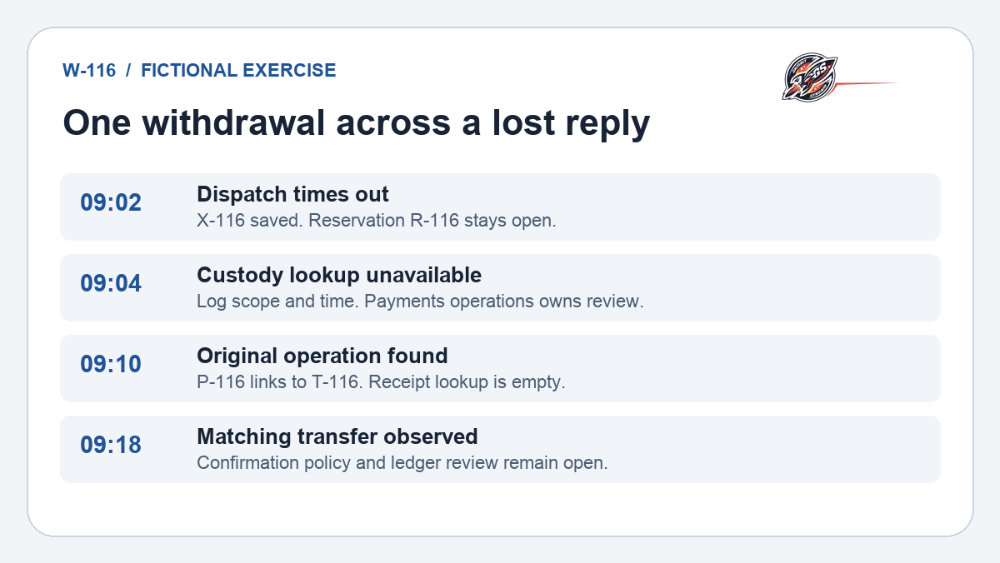
Assume the operator retains its account ledger and uses an external custody connector. The fictional W-116 approves 125 units of a token on route N-A. The approved destination is stored as restricted reference D-116. Approval revision A-3 and reservation R-116 were committed before the connector job began. The unit and route labels are placeholders. There is no usable address, network endpoint or transaction hash in the example.
At 09:02 UTC the dispatcher saves external reference X-116 and attempt A-116. The request begins, then times out. The dispatcher appends the timeout and marks the outcome unresolved. It leaves R-116 in place under the exercise's proposed reservation policy. The next scheduled worker can pick up the observation task. Its authority covers read-only lookups while dispatch stays paused.
The correct custody workspace is unavailable for lookup at 09:04. The operator records the error with the workspace reference and time. The incident owner, payments operations, agrees to check again at 09:10. That time belongs to this exercise. A real checkpoint depends on the connector's observed availability, the operator's escalation agreement and the age of the reservation.
When lookup resumes at 09:10, it returns provider operation P-116 against X-116. It reports a signed transaction and provides reference T-116. The team records the provider's exact state and the separately observed chain result. The first receipt lookup is empty. Payments operations updates the handoff to say that an existing provider operation was found and inclusion remains unverified. The new evidence narrows the search without opening another payout.
At 09:18 the fictional chain observer returns a receipt for T-116 and a matching transfer from the expected token contract to D-116. For this fixture the receipt has a successful execution status and the amount matches the approved base-unit value. The record gains a block reference and an event position. The operator's confirmation condition has yet to be evaluated, so accounting stays open. A subsequent review can close it after checking that condition and matching the ledger posting.
Here is the record an incoming operator should see before that last review.
Instruction. W-116, approval A-3, route N-A, 125 token units and restricted destination D-116.
Existing financial commitment. R-116 remains reserved. No new approval or payout order has been issued in the example.
Connector history. X-116 links A-116's timeout to P-116. The initial failed lookup and later positive result both remain in the journal.
Network observation. T-116 was observed in a block at 09:18 UTC with a matching transfer. The earlier empty receipt remains in the timeline. Confirmation policy review is pending.
Decision and owner. Keep dispatch paused. Payments operations owns the chain-policy check and ledger reconciliation. The next update should identify the journal effect or state the evidence still missing.
A support agent can explain that the original withdrawal is being checked without exposing a destination or promising a time of arrival. If the player opens a second ticket, attach it to W-116 so both requests reach the same investigation. The player-facing label can remain simple while the operating record preserves the more specific reason for delay.
Read a lookup in the scope where it ran
An empty result is an observation with a narrow meaning. In the EIP-1474 remote procedure call specification, Paul Bouchon and Erik Marks write "Transaction receipts are unavailable for pending transactions." That explains why an Ethereum receipt lookup can be empty while the original attempt is still relevant. Record whether the query was by hash, whether the endpoint was on the approved network and whether the node returned a valid empty result or an error.
An Ethereum transaction lookup can help identify an observed pending transaction. A receipt carries evidence about execution in a block. For an expected token payout, verify the transfer against the approved contract, destination and amount. The ERC-20 specification defines the Transfer event. The transaction's top-level destination can be a token contract or another contract handling several transfers. A successful execution status alone leaves the payment match to be verified.
Other routes expose different evidence. Bitcoin Core's raw transaction lookup documentation explains how the mempool, transaction index and optional block reference affect what the node can return. A wallet-aware lookup may be a better match for a transaction owned by that wallet. Ask which node or wallet was searched and what history it can see. A result from one endpoint is bounded by that endpoint's capabilities.
Positive evidence also needs context. A custody status indicating broadcast in progress describes an action under way. A transaction hash in a custody record may identify a signed payload the operator should investigate. An included transaction establishes a chain observation at a particular block. The acceptance contract should state which of these changes the cashier's workflow and which evidence allows accounting closure. If a chain reorganization changes the relevant inclusion, retain the previous observation and apply the agreed exception policy to the new one.
Define what would permit another action
Write the branches with the operator before enabling a recovery button. Give each branch a required fact and a decision owner. Label the original withdrawal so that different people can examine the same case without creating competing instructions.
Dispatch was demonstrably prevented. The dispatch journal and the component controlling release both show that the attempt could never reach a sender. Check whether a queued instruction remains eligible to run. Clear or fence that work under the approved procedure before authorizing a later attempt on the same withdrawal. A local job state needs this corroboration when another worker may already have taken ownership.
The original operation exists. A provider lookup returns the operation linked to the original external reference. Continue observation on that operation and preserve the reservation treatment. If a later callback reports completion, compare its workspace and operation identity to the case. Apply the appropriate state change once, regardless of how many workers saw the result.
The provider reports no record within a bounded lookup. Record the searched workspace, operation reference and available history. Check the connector contract for read consistency and request retention. Ask the designated owner whether that lookup can establish absence in this situation. While its coverage remains uncertain, keep the outcome unresolved. Using a fresh external reference would remove a useful duplicate control precisely when evidence is weak.
The provider supports an idempotent retry under the original identity. Verify the request parameters, scope and applicable lifetime before using the documented path. One concrete design example is Fireblocks' transaction creation endpoint. It documents a caller-supplied external transaction ID and rejection of subsequent creations with that same ID. It also offers a lookup by external transaction ID. That combination gives an operator an avenue to investigate a missing reply. Each connector still needs its own scope and retention checked.
The same transaction or a replacement is under review. Distinguish repeating an API request, resubmitting the exact signed payload under an approved procedure and constructing a replacement transaction. They have different effects and authority requirements. An authorized replacement should retain the predecessor and successor hashes against the same financial instruction. Verify chain-specific conflict rules through the custody policy. A new payment instruction with different inputs or a new nonce can represent a separate economic effect.
Sources disagree. Preserve both observations and their scope. A late webhook and a node lookup can cover different stages or networks. Send the discrepancy to the owner of the disputed evidence with the original identifier and the two recorded results. Set a follow-up time. Keep the incident in a visible queue until the evidence supports an action.
Design the dispatch journal around the point where ownership can change. For example, a worker that acquires an outbox item should record its claim before calling the connector. An expired worker lease can let a second worker take over observation. It should carry no implicit permission to issue a fresh payout. A dispatcher with an uncertain outcome needs a compare-and-set or equivalent guard so an operator decision and an automatic replay cannot both release work. The guard belongs at the boundary that actually sends the request.
Use the connector's operation reference where the next owner can retrieve it after a deployment or failover. A request timestamp from the application log is useful during an incident. It becomes harder to use as a join key if separate workers round the time differently or if concurrent operations reach the same account. Preserve the source clock and observed time alongside stable identifiers. That lets the next reviewer tell an old observation from a new one without ordering two systems' events by timestamps alone.
A useful interface can surface these branches as status and evidence fields next to the withdrawal. Give operators a direct route to the lookup record before offering recovery controls. A manual correction should have its own approval record. The workflow should make the existing operation easy to find even when the original connector is unavailable.
Reconcile the one approved financial effect
A chain observer and a cashier ledger answer different questions. The observer can identify what the network recorded. The ledger accounts for the reservation and the approved principal under the operator's posting rules. The reconciliation record joins them through W-116 and the specific transfer. A custody fee may use a different asset or appear in a separate record. Keep it outside the principal comparison and apply the operator's agreed fee treatment.
For a batch transaction, preserve the reference that distinguishes W-116's transfer from the other payments. Use the relevant event position or output identity and verify it against the approved destination and amount. Two withdrawals of the same amount can appear in one batch. Matching on amount and hash would leave the system unable to show which withdrawal each transfer satisfied.
The journal can enforce a single principal posting per withdrawal identity. Its durable key should survive repeated webhooks and a replayed worker job. If accounting receives the same chain evidence again, the review should show the existing posting and its source. If the evidence changes, process it through the defined exception path so a correction remains attributable to an earlier observation. Keep the previous evidence accessible during an incident review.
Look closely at what happens to the reservation after a timeout. Releasing it can let the player spend funds while a payout remains possible. Holding it forever creates a different problem for the player and operations team. Give the unresolved item a named owner and a defined escalation path. The operator should be able to ask for the oldest unresolved reservation by route and see the next planned review without opening the connector's logs.
A mismatch in the amount or asset sends the case to reconciliation even when the status looks complete. For example, an observed transfer for a different contract on N-A fails the approved asset match. Preserve that result and the conflicting evidence. A separate correction can be considered only after the owner has established what happened to the original instruction.
Test the record with synthetic faults
Before accepting a casino cashier integration, have a reviewer run the same fictional approval through deliberate failure branches in an isolated test environment. Use test doubles or the agreed sandbox and make clear which system produced each observation. A model record filled in by hand can define the expected behavior. An acceptance result needs saved observations from an actual run. The cases below are proposed.
Lost response after acceptance. Let a connector double create an operation for X-116, then drop the response. Restore the read endpoint and look up the original reference. The evidence should show a single provider operation, an unresolved interval and the same cashier reservation. A new external reference or second principal posting fails the case.
Crash before and after dispatch. Stop the worker in two different places. Before dispatch, verify how the release mechanism proves that no component can still send the instruction. After dispatch, verify that recovery stays paused while the outcome is uncertain. Save the two trace histories so the reviewer can tell which branch the worker took.
Signed with an empty receipt. Return a known signed transaction reference and an empty receipt on the selected route. The record should contain the positive signing evidence and the bounded empty result. Check that the case remains open and that support sees a pending outcome. Then inject a matching inclusion and observe the next decision separately.
Wrong route and wrong transfer. Simulate a lookup on the wrong network, then an included transaction on the right network with a transfer from a different token contract. Neither result should close W-116. Save the expected identity, the observed identity and the mismatch reason in each run.
Two workers and a late callback. Allow two workers to observe the same provider result and then deliver a delayed callback for the original attempt. Inspect the ledger and exception queue after all events settle. They should show one principal effect and a case history that preserves the late delivery. A test that checks the latest UI label alone could miss duplicate journal activity.
Replacement and changed inclusion. Supply a permitted replacement link, followed by a change in chain inclusion under the chosen route's model. The reviewer should be able to retrieve both transaction identities and all earlier observations. Verify that the reservation and any journal correction follow the agreed policy, including reopening a case if prior closure evidence is no longer sufficient.
Operator handoff during lookup outage. End one simulated shift while the custody lookup is still unavailable. Give the next operator only the permitted evidence record and access to the specified read tools. They should identify W-116, its current reservation and the unanswered question without asking which new payout to create.
Record the fixture version, the expected transition and the observed transition for every case that runs. Attach the relevant journal evidence and a decision from the owner. If the sandbox cannot reproduce a failure boundary, mark that case unrun and state what evidence is missing. An acceptance reviewer can then decide whether to restrict the release or request a different test arrangement.
What the handoff must answer
The recovery record should let an incoming operator answer four questions. Which instruction was approved? What evidence exists for signing, broadcast and chain observation? Which financial effect remains reserved or posted? Who can authorize the next action after checking the outstanding evidence?
W-116 stays attached to the original approval throughout the example. The earlier timeout remains part of its history even after a matching transfer is observed. The next decision concerns confirmation and accounting. Preserving that distinction keeps a missing connector response from turning into a second withdrawal.
More insights to read
- How to Assign Blockchain Recovery Ownership Before Launch
- The Payment Recovery Fieldbook: Identity, Replay and Reconciliation
- Blockchain Ledger Integration Hub: Contracts and Acceptance Evidence
- How to Specify Casino Provider Onboarding Acceptance
- Sportsbook iFrame Integration: Test Reconnects Against the Original Wallet Operation
About the author

Written by Dmytro Nasyrov PhD, software architect with 24 years of production experience. Dmytro is the founder of Gambit Stream. His writing covers software scope, integration boundaries and operating ownership.