Web3 Search Intent: Map Buyer Questions Beyond the Docs

A founder searching for an embedded wallet provider opens a page that explains how to create a wallet set. The example works for an engineer who already has sandbox access. The founder still needs to know who can authorize a production transaction, what their team must operate and which decisions can wait until a pilot. All three questions concern the same wallet product. None can be answered by the presence of a working code sample alone.
A Web3 SEO content strategy can start with a plain question-to-page map. For each question, record the task, the current URL, the missing answer, the page that should own the answer, the editor and the next useful link. Take one pass through the existing site before proposing a new page. If the right answer is already published, improve the route to it. If the answer changes depending on how the product is configured, put the decision boundary where a buyer can see it.
Consider a fictional vendor called Harbor Wallet Tools. Its website has a wallet overview, a developer quickstart and a generic contact page. An engineer can use the quickstart to understand the first sandbox task. A product lead who wants to scope a pilot sees a broad invitation to book a call. The missing piece is an evaluation page that separates signing authority, handoff evidence and the limits of a proposed trial.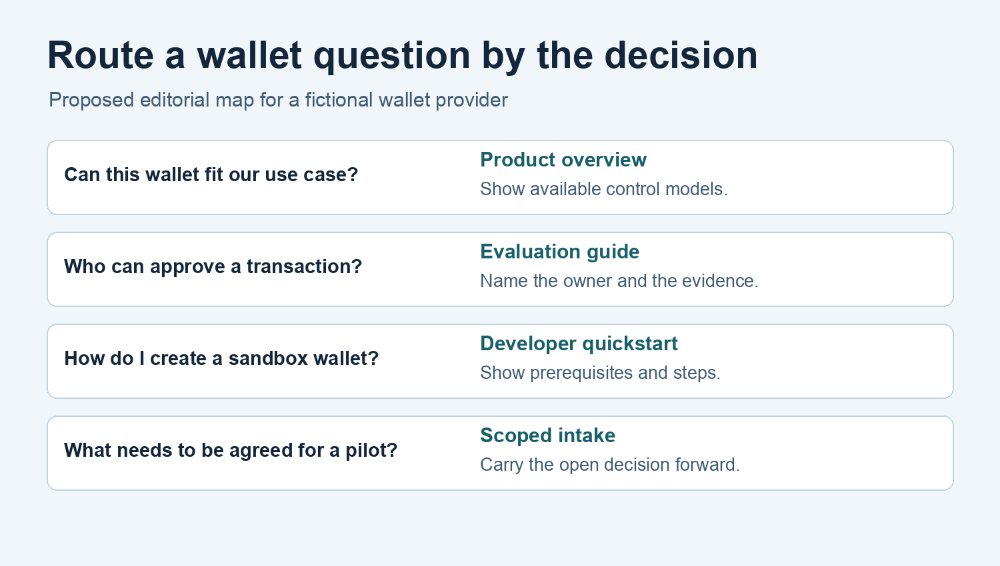
Read the question as a task
Take the phrase "developer-controlled wallet." A developer could be looking for the prerequisites to create one. A buyer could be trying to determine whether that model is suitable for a wallet operated by their company. The query phrase is identical. The answers can share a definition and still serve different tasks.
Look for the action implied by the rest of the question. "Create," "configure" and "troubleshoot" often point to implementation. "Compare," "who owns" and "what is included" point toward an evaluation or procurement decision. "Supported networks" is ambiguous. A technical reader may need the exact network identifier for an API call. An evaluator may need to distinguish sandbox availability from production support before putting a network in the pilot scope. The modifier gives a clue. The consequence of an incomplete answer gives a better one.
Separate three things in your working notes. First, record the wording the person used. Second, state the decision they need to make. Third, name the smallest piece of evidence that would let them make it. A search for "wallet signing" could produce a list of code samples, product pages and explanations. The question "Can the merchant pause its own signing workflow during an incident?" has a more specific evidence requirement. It needs a description of who has that capability, the conditions that apply and where the approved procedure lives.
Google Search Central asks, "Does your site have a primary purpose or focus?" in its guidance on helpful content. The question also works at the page level as an editorial prompt. A quickstart that acquires several paragraphs of sales copy may become slower to use. A commercial page that copies half a quickstart may still leave an evaluator unclear about the pilot. Name the page's primary job before adding more words.
Circle provides a public example of the split. Its Wallets overview describes several control models. Its developer-controlled wallet quickstart takes a developer through creating a wallet set and a wallet, with prerequisites that include an API key and a registered entity secret. The pages share vocabulary because they describe the same product family. They differ in what a reader can do after reading them. Harbor is a separate fictional example. The routing exercise below does not assign Circle's setup or support arrangements to Harbor.
Inventory what the site can already answer
Open the pages a new visitor would plausibly reach. Read them from the first screen through the next link. Include the main product navigation, the docs index and any page that a salesperson routinely shares. A URL inventory tells you that the pages exist. The useful question is which parts of the buying or implementation task those pages actually finish.
For each page, save a short note. Write the audience, the existing answer, the evidence backing it and the action available at the end. A product page may define the wallet types without saying which party can approve a transaction under each configuration. A quickstart may show a testnet flow and omit any discussion of production responsibilities. Those can be sensible boundaries. The gap appears when no other public page tells a buyer how to resolve the open question.
Check the wording across page types before assigning new work. If the product overview refers to "customer control" and the docs distinguish signing approval from initiating a request, ask product and engineering whether they mean the same thing. Do the check before a writer expands "customer control" into a promise. The implementation guide may use narrower language for a reason. Mark unclear statements as awaiting review and name the decision owner.
Include important public pages that do not usually appear in a content audit. An updated network support reference, a product changelog and a public integration limitations page can all answer questions better than new marketing copy. If the source of truth is a support table, use that table as the destination. Give the evaluator enough context to understand why it matters and let the owning team maintain the changing details in one place.
Put each question on a page you can maintain
This map is for the fictional Harbor team. The paths are illustrative. Each record describes what the team would have to verify before it could publish the proposed copy.
Compare wallet control models before shortlisting
Current URL /wallets
Missing answer or evidence Plain-language control distinction for the supported configurations
Preferred page Wallet overview
Editor Product marketing with engineering review
Next useful link Evaluate signing and handoff
Create a first sandbox wallet
Current URL /docs/quickstart
Missing answer or evidence Existing task is covered if prerequisites and expected output are current
Preferred page Keep the quickstart
Editor Developer documentation
Next useful link Sandbox troubleshooting
Determine who can approve a production transaction
Current URL /docs/quickstart
Missing answer or evidence Approved control and ownership table for the proposed configuration
Preferred page Wallet evaluation guide
Editor Product and security
Next useful link Read the relevant authorization reference
Confirm whether a named network is supported in the target environment
Current URL /wallets
Missing answer or evidence Current support by network and environment
Preferred page Supported networks reference
Editor Product operations
Next useful link View the sandbox setup for a supported network
Decide what to include in a pilot
Current URL /contact
Missing answer or evidence In-scope workflow, acceptance evidence and named owners
Preferred page Wallet evaluation guide
Editor Solutions lead
Next useful link Request a scoped pilot
Find who handles access recovery and escalation
Current URL /contact
Missing answer or evidence Published support boundary or an explicit item to agree during scoping
Preferred page Wallet evaluation guide
Editor Support owner and product
Next useful link Send the recovery requirements with the pilot brief
Start a scoped conversation
Current URL /contact
Missing answer or evidence Fields for network, environment, signing model and unresolved constraints
Preferred page Pilot intake section
Editor Solutions lead
Next useful link Open the request form
The map changes the backlog. Harbor would keep its quickstart and add a contextual route from the wallet overview to the evaluation guide. It would add one evaluation guide because multiple procurement questions share a decision and a maintainer. It would give supported networks their own reference only if that list is already meaningful, needs frequent updates and has a team that can keep it correct. The request form can stay on the current contact URL if it can collect the necessary details without sending readers through an unrelated sales page.
The signing and recovery rows illustrate why a query list alone is insufficient. A writer can generate headings for both in minutes. Neither heading provides the information buyers need until the relevant owner verifies the underlying boundary. In the map, an unanswered requirement stays visible with an editor and a source. If the available terms vary by configuration or agreement, the page can describe what to ask and what to check during scoping. It should leave room for the answer to vary.
Keep the quickstart useful when a buyer lands there
A technical page sometimes makes a strong first impression with a buyer. They may read it to see what the vendor documents publicly or how much work their engineers will inherit. Keep that route open. A short link in context can guide the reader to the evaluation guide without changing the technical sequence. The line after the prerequisites, for example, can point to the control models for readers deciding which setup to use. Once the reader begins a procedure, the links should help complete or diagnose it.
The evaluation guide can send a technical reviewer in the other direction. Suppose a product lead chooses a sandbox pilot that includes a single approved test workflow. After the product and security owners confirm the scope, the guide can link to the exact quickstart or reference section that an engineer needs to inspect. The next step is specific enough to hand off. A general "read the docs" link asks the reader to repeat the navigation work.
Google Search Central's link guidance explains how to make links crawlable and use meaningful anchor text. In Harbor's proposed design, "Create your first sandbox wallet" points to the implementation task and "Review signing authority and recovery" points to an evaluation section. These links say what waits on the other page. Inspect the rendered navigation after shipping. A label in a planning sheet does not establish that the public page exposes a usable link.
Avoid mirroring the same responsibility table on every URL. When a fact changes, one copy can lag behind the others and make a buying conversation harder. Choose a source of truth. A product page can summarize the distinction and give a direct link to it. A quickstart can state what is necessary for the current task. An evaluation page can explain what evidence the buyer should request for the intended use. Maintain each representation at the level needed for that page's job.
Decide when the gap needs a new page
Start by comparing the candidate page job with the strongest existing page. If both lead to the same decision, serve the same reader and rely on the same evidence, revise the existing page. A search modifier such as "enterprise," "platform" or "infrastructure" is not enough on its own to justify another URL. Ask what the reader would learn from the new page that they could not get from the current one.
A new page earns its place when a distinct task needs a durable answer, there is evidence to support the answer and someone can maintain it. In Harbor's case the evaluation guide would satisfy that test only after product, support and security agree on what the guide may say. An editor could publish a smaller guide with a responsibility checklist if the company has enough verified facts to make it useful. Publishing complete-looking pages around unresolved policies can leave prospects with more ambiguity and give the sales team claims it then has to correct.
There is also a case for adding a section. An overview might already handle the basic control model decision. A section about what a pilot includes may fit on that page when the available scope is simple. If the pilot requires a cross-team handoff, several prerequisite decisions and references an integration owner must maintain, a guide gives readers a clearer destination. The choice depends on the work they need to complete, the stability of the material and the owner's capacity to revise it.
Use separate versions only for a meaningful difference. A sandbox walkthrough can be distinct from production readiness instructions if the steps, risks and acceptance evidence differ. Two commercial pages that swap "wallet as a service" for "embedded wallet provider" and leave the rest intact create little value. Put common wording variants in the same research cluster until the evidence shows a separate reader task.
Gather question evidence from search, sales and support
Use the Search Console performance report to inspect available query and page data together. A docs URL that receives impressions for an evaluation phrase gives you a starting point to investigate. Check the result and the linked page. The impression does not tell you whether someone found the answer, and an aggregate figure is not a count of buyers. Some searches are anonymized in the report, so the query table cannot serve as a complete inventory of the audience's questions.
Add what your team hears before a deal or integration. Ask sales for recurring scoping questions and support for the requests that follow an attempted setup. Strip customer identifiers and confidential details from the working summary. A precise question such as "Who can stop a signing flow if our credentials are suspected to be compromised?" is actionable even if nobody has measured how often those exact words appear in search. It tells the team what decision it may need to support and who should review the answer.
Harbor could review available question sources together at the start of a planning cycle. The docs maintainer highlights tasks with known prerequisites and predictable failure points. The solutions lead brings questions that delayed a pilot decision. Product operations checks whether a public capability table already answers them. The editor groups questions that share the same job and assigns a preferred destination for each group. Disagreements about the answer go to the owner of the capability rather than into an unreviewed draft.
When you have no access to analytics or customer conversations, write down what evidence is missing. You can still inspect public results and current URLs, and label candidate queries as research hypotheses. Start with the highest-consequence gaps you can verify from existing documentation. Prioritize a question based on the decision it controls, the evidence you can publish and the person who can maintain it. Keep observed search demand in a separate column so it cannot be confused with editorial priority.
Test the route with an actual page and a proposed decision
Write an acceptance sentence for each changed page. For Harbor's quickstart, the sentence might say that a reader can identify the sandbox prerequisites, create the first wallet and recognize the expected output. For the evaluation guide, it could say that a buyer can distinguish the supported control models, see the proposed boundaries of a pilot and identify what needs explicit approval. For the intake page, the reader should be able to send their use case and open constraints without first choosing a solution the guide has not established.
Ask a colleague to start from the currently visible result or a plausible entry URL. Give them the task without telling them which page should answer it. Let them record where they went, what evidence they found and what they still had to infer. If a buyer ends at a code example and cannot tell who approves a production action, that path remains open work even if the quickstart is technically correct. If the evaluation guide answers the question but the product page links past it to a generic sales form, fix the route first.
Check the implementation route after changing the commercial copy. The engineer should still see prerequisites before steps and expected output after the relevant step. The buyer should be able to open the scope material without exposing credentials, opening a test environment or beginning a procedure. Walk both paths again after a significant change in product capability or ownership. Record the URL, the dated source, the tester's task and any unresolved question in the map.
Choose a modest success signal for each route. Available search reports can help identify which pages appear for the terms you can observe. Navigation data, where available and appropriately collected, can help show whether users follow the link to the intended next page. A qualified pilot request supplies a different kind of evidence if the prospect identifies a specific workflow and the relevant open constraints. Keep these signals separate. A new internal link, an impression and a scoped inquiry describe different events.
Put the ownership decision in the release notes
Suppose Harbor adds a new signing configuration after the evaluation guide goes live. The release ticket should identify every page that uses the old distinction. An engineer can check the reference and quickstart. The product owner can check the explanation of control in the evaluation guide. The solutions lead can make sure the intake form still captures the conditions needed to scope a trial. A search editor can verify that the existing links still lead to those answers. The team should agree which page gets the precise rule and which pages simply point to it.
Treat a disputed statement as a publishing dependency. If the provider can confirm that a network is supported in the sandbox but cannot yet confirm production support, keep those entries separate in the reference. The overview can tell buyers where to check the environment. The intake form can capture production support as an open requirement. The language should be consistent without forcing every page to repeat the whole matrix.
If the change gives buyers a genuinely new decision, add a row to the map before creating a page. A new feature can reuse the current evaluation guide when it changes one option in the same decision. A separate reference makes more sense when the evidence needs its own updates and has a different owner. Save the review trigger next to the row. A capability release, a change in support terms or a handoff to another team can all make an answer stale even when its URL still works.
Make the pilot request carry the open questions
A useful evaluation page ends where a buyer can act. Harbor's proposed form asks for the use case, intended network, target environment, preferred control model if known and an unresolved requirement. It tells the prospect to leave unknown fields open. It avoids asking for wallet credentials, private keys or confidential production logs. The form should give the solutions lead enough context to decide who needs to join the next conversation.
Carry the responsibility fields forward into the pilot discussion. If signing approval is a condition of proceeding, record who must confirm it and what document or agreed test will show the answer. If recovery is a gating question, clarify who owns escalation and what evidence must be available at the handoff. Where the public guide can only outline available models, the scoped pilot is where the buyer and vendor can document the selected one. A page should make that transition obvious.
For teams building a wider Web3 SEO and page strategy with TopClick, the useful starting input is the current set of product, documentation and intake URLs. Add examples of the commercial questions the site struggles to answer and the implementation tasks it already supports. A proposed editorial scope can then distinguish pages to keep, links to fix and answers that need a new owner or new evidence. Use the map again when product scope changes so the next published answer stays attached to a team that can verify it.
More insights to read
- SEO, GEO and AEO: Defining the scope of work
- SEO audit vs retainer
- Performance report for Search results
- Create a developer-controlled wallet
- Creating helpful, reliable, people-first content
About the author

Written by Dmytro Nasyrov PhD, software architect with 24 years of production experience. Dmytro is the CEO of TopClick.