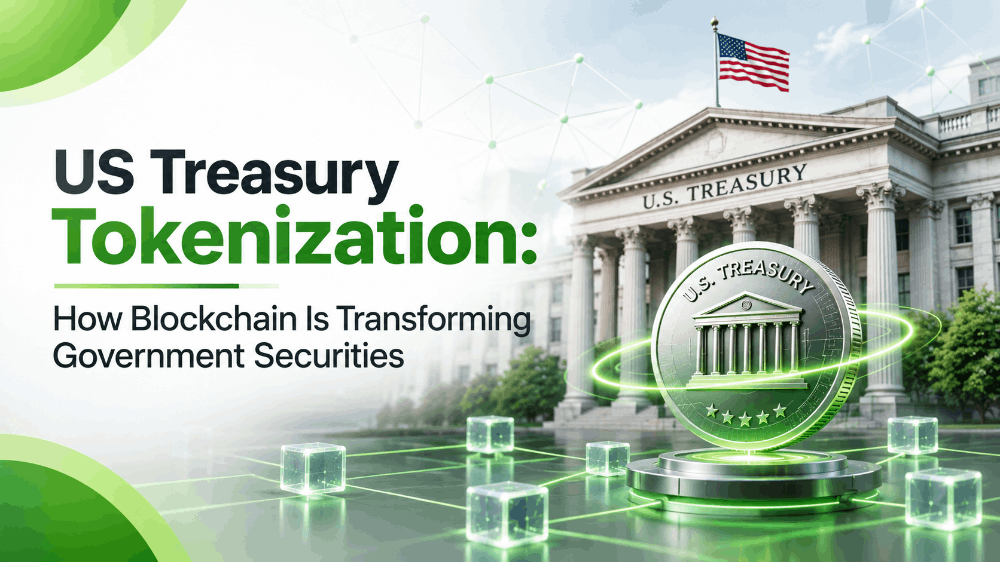
US Treasury Tokenization: How Blockchain Is Transforming Government Securities

The financial industry is gradually exploring new ways to issue, manage, and transfer traditional investment assets. One development attracting considerable attention is the tokenization of US Treasury securities. By bringing government securities onto blockchain networks, financial institutions and fintech companies are exploring new approaches to asset ownership, settlement, transparency, and investment management.
US Treasury bills, notes, and bonds have traditionally been issued and managed through established financial infrastructure. Tokenization introduces another way to represent these assets digitally, potentially making certain processes more efficient while creating opportunities for new financial products.
But what exactly is Treasury tokenization, how does it work, and why are financial institutions paying attention to it?
Let's explore.
What Is US Treasury Tokenization?
US Treasury tokenization refers to representing Treasury-related financial interests through digital tokens recorded on a blockchain.
These tokens may represent ownership interests in a fund holding Treasury securities, beneficial interests, or other legally structured claims connected to government debt instruments. The exact rights depend on the product's legal and operational structure.
For example, a financial institution could create a blockchain-based investment product backed by short-term US Treasury bills. Eligible investors could acquire digital tokens representing their interests in that product, while the underlying securities remain held through the appropriate custody arrangements.
This approach combines traditional financial assets with blockchain-based infrastructure.
It is important to understand that tokenization does not automatically make someone a direct owner of a Treasury security. The legal rights associated with each token depend on the issuer, offering documents, custody arrangements, and applicable securities regulations.
How Does Treasury Tokenization Work?
A tokenized Treasury product typically involves several interconnected components. These include the underlying financial assets, legal structure, blockchain infrastructure, smart contracts, custody arrangements, and investor management systems.
Here is how the general process works:
1. Selecting the Underlying Treasury Assets
The process begins with identifying the Treasury securities that will support the investment product.
These may include:
- US Treasury bills
- US Treasury notes
- US Treasury bonds
- Short-term government securities
The issuer establishes the legal and financial structure of the product and determines how investors will receive economic exposure to the underlying assets.
2. Establishing Custody and Asset Management
The underlying Treasury securities need to be held and managed through appropriate financial institutions and custody arrangements.
This is an important step because blockchain records alone do not establish legal ownership of the underlying government securities.
Asset managers and custodians oversee the traditional financial components, while the blockchain infrastructure supports the digital representation and transfer of interests.
3. Creating Digital Tokens
Once the legal structure and asset arrangements are established, digital tokens can be issued on a selected blockchain network.
Smart contracts define how tokens are created, transferred, and redeemed, subject to the product's terms and applicable regulations.
For example, a permissioned tokenization model may restrict transfers to verified and eligible investors.
4. Investor Onboarding and Compliance
Tokenized Treasury products may involve securities regulations, investor eligibility requirements, and financial compliance obligations.
Platforms can integrate features such as:
- Know Your Customer (KYC) verification
- Anti-Money Laundering (AML) screening
- Investor accreditation checks, where applicable
- Transaction monitoring
- Permission-based token transfers
These controls help ensure that the digital investment environment operates according to the applicable legal and regulatory framework.
5. Managing Transfers and Redemptions
After issuance, eligible investors may be able to transfer their tokens through supported platforms.
Depending on the product structure, smart contracts can automate certain administrative processes, including transfer restrictions, distribution calculations, and redemption workflows.
The actual redemption process still depends on the underlying asset structure, fund terms, liquidity arrangements, and operational procedures.
Why Are Financial Institutions Exploring Tokenized US Treasury Securities?
Treasury tokenization is attracting interest because it combines an established financial asset category with programmable digital infrastructure.
Several potential benefits are driving this exploration.
1. Improved Settlement Efficiency
Traditional securities transactions often involve multiple intermediaries and settlement processes.
Blockchain-based infrastructure can potentially simplify certain transaction workflows by maintaining shared transaction records and automating eligible processes through smart contracts.
The actual settlement speed depends on the blockchain, payment arrangements, custody infrastructure, and regulatory requirements.
2. Greater Transparency
Blockchain networks maintain transaction records that can be independently verified by authorized participants or, depending on the network, publicly viewed.
This can improve transaction traceability and make certain administrative activities easier to monitor.
However, blockchain transparency does not automatically provide complete visibility into off-chain assets, liabilities, or legal ownership records.
3. Programmable Financial Products
One of the most interesting possibilities is the ability to incorporate financial rules directly into smart contracts.
For instance, a tokenized Treasury product could use programmable logic for:
- Investor eligibility management
- Transfer restrictions
- Distribution calculations
- Subscription and redemption workflows
- Automated transaction validation
This creates opportunities to build more flexible digital financial products.
4. Access to New Financial Infrastructure
Tokenization can support new ways of distributing and managing investment products.
Depending on regulatory approval and product design, eligible investors may interact with digital investment platforms rather than relying entirely on conventional financial interfaces.
This does not mean every tokenized Treasury product is available to retail investors. Access depends on the offering structure and investor eligibility requirements.
Real-World Examples of Treasury Tokenization
Several financial technology companies and asset managers have already introduced blockchain-based products connected to traditional financial assets.
Some notable examples include:
1. BlackRock BUIDL
BlackRock's USD Institutional Digital Liquidity Fund, commonly known as BUIDL, is one of the prominent examples of institutional tokenized financial products.
The fund invests in cash, US Treasury bills, and repurchase agreements, among other permitted assets.
It demonstrates how established asset management businesses can use blockchain infrastructure to represent fund interests digitally.
2. Franklin Templeton
Franklin Templeton has explored blockchain-based financial products through its tokenized money market fund initiatives.
Its OnChain US Government Money Fund (FOBXX) is an example of a government money market fund using blockchain-integrated infrastructure.
The initiative illustrates how traditional asset managers can combine established investment products with digital asset technology.
3. Ondo Finance
Ondo Finance has developed tokenized products designed to provide eligible investors with blockchain-based exposure to traditional financial assets, including US Treasury-related investment products.
Its offerings demonstrate how specialized digital asset platforms are exploring new distribution models for traditional financial instruments.
These examples show that Treasury-related tokenization is moving beyond theoretical discussions and into real financial product development.
What Technology Is Required to Build a Treasury Tokenization Platform?
Launching a tokenized Treasury investment platform requires more than deploying a smart contract. It involves developing an integrated financial technology environment that connects blockchain infrastructure with traditional investment operations.
Some of the essential technology components include:
1. Blockchain Infrastructure
The platform needs a suitable blockchain network to support token issuance, transaction processing, and digital asset management.
The selection depends on factors such as transaction costs, network security, interoperability, privacy requirements, and institutional preferences.
2. Smart Contract Development
Smart contracts manage the programmable logic behind digital tokens.
They may handle token issuance, transfers, investor restrictions, redemption conditions, and other predefined operations.
Security audits and careful testing are essential before deploying financial smart contracts.
3. Investor Management Dashboard
A well-designed dashboard allows eligible investors and administrators to interact with the platform.
Common features include:
- Investor registration and verification
- Investment portfolio tracking
- Token balance management
- Transaction history
- Subscription and redemption requests
- Administrative reporting
4. Custody and Wallet Integration
Secure custody arrangements are essential for managing digital assets.
Depending on the platform's structure, developers may integrate institutional custody providers, secure wallet infrastructure, multi-signature authorization, and transaction approval workflows.
5. Compliance and Reporting Infrastructure
Financial platforms need systems that support applicable regulatory obligations.
This may include investor verification, transaction monitoring, audit trails, reporting functionality, and integration with compliance service providers.
Businesses planning such platforms can also explore broader RWA tokenization platform development services to understand how blockchain infrastructure, smart contracts, investor management, and digital asset workflows can be brought together in a single solution.
Challenges of US Treasury Tokenization
Despite its potential, Treasury tokenization still faces several challenges.
1. Regulatory Complexity
Tokenized Treasury products may fall under securities, investment company, broker-dealer, custody, and other financial regulations depending on their structure and activities.
Businesses must understand the applicable regulatory framework before launching a product.
2. Liquidity Management
A tokenized asset is not automatically liquid.
The availability of buyers, redemption mechanisms, trading venues, and market-making arrangements determines how easily investors can exit their positions.
3. Custody and Security
Tokenized products involve both traditional financial asset custody and digital asset security.
Organizations need appropriate safeguards for private keys, smart contracts, investor accounts, and underlying securities.
4. Interoperability
Different blockchain networks may use different token standards and technical architectures.
Moving digital assets between networks while preserving legal rights, compliance controls, and transaction integrity remains a significant infrastructure challenge.
What Is the Future of US Treasury Tokenization?
Treasury tokenization could become an important part of the broader transformation of financial markets.
As institutional adoption develops, financial companies may explore additional applications involving collateral management, digital investment funds, automated settlement, and integration with regulated digital asset platforms.
Another interesting possibility is the use of tokenized Treasury-related products within decentralized finance. However, this requires careful consideration of investor eligibility, counterparty risks, custody, and the legal restrictions associated with the underlying investment product.
The long-term opportunity will depend on regulatory clarity, institutional participation, technology maturity, and the ability to connect blockchain-based systems with existing financial infrastructure.
Final Thoughts
US Treasury tokenization represents an important development in the convergence of traditional finance and blockchain technology.
By combining established government securities with digital asset infrastructure, financial institutions are exploring new ways to manage investment products, automate financial operations, and improve transaction transparency.
However, successful implementation requires much more than token creation. Legal structuring, custody, investor protection, compliance, smart contract security, and reliable financial infrastructure all play an important role.
As the market develops, companies that understand both traditional financial operations and blockchain technology will be better positioned to participate in the next phase of digital securities innovation.
Frequently Asked Questions (FAQs)
1. What is US Treasury tokenization?
US Treasury tokenization is the process of representing interests in US government securities, such as Treasury bills, notes, or bonds, through digital tokens recorded on a blockchain. It allows financial institutions to explore blockchain-based issuance, ownership records, transfers, and investment management.
2. How does tokenization of US Treasury bills work?
Tokenization generally involves establishing a legal investment structure, holding the underlying Treasury securities through appropriate custody arrangements, and issuing digital tokens that represent investor interests. Smart contracts can help manage issuance, transfers, investor restrictions, and redemption workflows.
3. What are the benefits of tokenized US Treasury securities?
Tokenized Treasury securities can offer several potential benefits, including improved transaction transparency, more efficient settlement workflows, programmable financial operations, and integration with digital investment platforms. Actual benefits depend on the product structure and supporting infrastructure.
4. Is investing in tokenized US Treasury bonds safe?
Tokenization does not eliminate investment risks. Investors should consider the underlying securities, issuer reliability, custody arrangements, smart contract security, liquidity, and legal rights associated with the tokens. A tokenized investment product is not automatically equivalent to directly holding US Treasury securities.
5. What is the difference between traditional Treasury bills and tokenized Treasury bills?
Traditional Treasury bills are issued and managed through established financial market infrastructure. Tokenized Treasury products use blockchain-based tokens to represent ownership interests or other legally defined claims connected to Treasury investments. The underlying financial asset and investor rights depend on the product's legal structure.
6. What blockchain networks can be used for Treasury tokenization?
Ethereum, Stellar, Polygon, and other blockchain networks can support different types of tokenization applications. The appropriate network depends on transaction costs, scalability, security, privacy, interoperability, and institutional requirements.
7. How are smart contracts used in Treasury tokenization platforms?
Smart contracts automate predefined operations such as token issuance, transfers, investor eligibility restrictions, transaction validation, and redemption workflows. They can reduce manual processes while providing programmable controls for digital financial products.
8. What regulatory requirements apply to tokenized US Treasury securities?
Regulatory requirements depend on the product structure and activities involved. Tokenized Treasury products may be subject to US securities laws, investment company regulations, broker-dealer requirements, custody rules, and applicable KYC and AML obligations. Businesses should obtain appropriate legal and compliance guidance before launching such platforms.
9. Can tokenized US Treasury assets be used as collateral in DeFi?
Certain tokenized Treasury-related products may be integrated into decentralized finance applications for lending and collateral management. However, this depends on the product's legal terms, transfer restrictions, investor eligibility, platform requirements, and regulatory considerations.
10. How can businesses develop a US Treasury tokenization platform?
Businesses typically need blockchain infrastructure, smart contract development, digital asset custody integration, investor onboarding, compliance workflows, and asset management dashboards. Working with an experienced RWA tokenization development company can help bring these technical components together while supporting the project's operational and regulatory requirements.