Building What Lasts

Why Strong Infrastructure Matters More Than Hype in Web3

The visible layer is what most people notice first, token launches, marketing campaigns, price movements, and headline announcements. The invisible layer is where the real work happens: infrastructure design, liquidity architecture, security testing, incentive modeling, and system stress simulations.
Long-term success in Web3 does not emerge from visibility alone. It is built on foundations that are engineered to perform under pressure.
The Difference Between Launching and Building
Launching a product is an event.
Building a system is a process.
A decentralized exchange, protocol, or financial application must coordinate multiple moving parts simultaneously:
- Smart contract reliability
- Liquidity depth and routing efficiency
- Incentive alignment between users and the protocol
- Risk management mechanisms
- Governance design
- Security audits and adversarial testing
If any of these elements are misaligned, the system may function temporarily but struggle under volatility or high usage.
Strong infrastructure anticipates stress before it arrives.
Incentive Alignment as a Structural Requirement
One of the most underestimated factors in decentralized systems is incentive design.
Participants, whether liquidity providers, traders, validators, or contributors, respond to economic signals. If incentives are short-term or mispriced, capital becomes unstable. If rewards outweigh sustainability, the model becomes fragile.
Well-designed systems ensure:
- Contribution is rewarded proportionally
- Liquidity is retained, not rented
- Utility supports token value, not speculation alone
- Risk exposure is transparent and measurable
When incentives are aligned, participation becomes structural rather than opportunistic.
Liquidity and Execution: The Core of Market Integrity
For financial protocols, liquidity is not merely a feature, it is the backbone.
Shallow liquidity increases slippage.
Poor execution degrades trust.
Unmanaged leverage magnifies systemic risk.
Professional-grade infrastructure requires:
- Deep liquidity provisioning strategies
- Smart routing mechanisms
- Real-time risk monitoring
- Automated safeguards
These elements operate quietly in the background, but they determine whether a protocol can withstand volatility.
Why Quiet Phases Matter
Periods of low public visibility often signal active refinement.
During these phases, teams may be:
- Stress-testing contracts
- Refining matching engines
- Adjusting tokenomics
- Conducting internal security reviews
- Simulating extreme market conditions
Rushing to market without completing these steps can generate short-term attention but long-term instability.
In contrast, deliberate preparation strengthens resilience.
From Hype Cycles to Durable Systems
Web3 is gradually transitioning from experimentation to structured growth. As the industry matures, evaluation standards are also rising.
Sustainable protocols are no longer judged solely by launch metrics. They are assessed by:
- Security track record
- Economic sustainability
- Transparency of design
- Adaptability to changing conditions
- Longevity of participation
The strongest platforms treat launch as validation, not as the starting point of development.
Conclusion
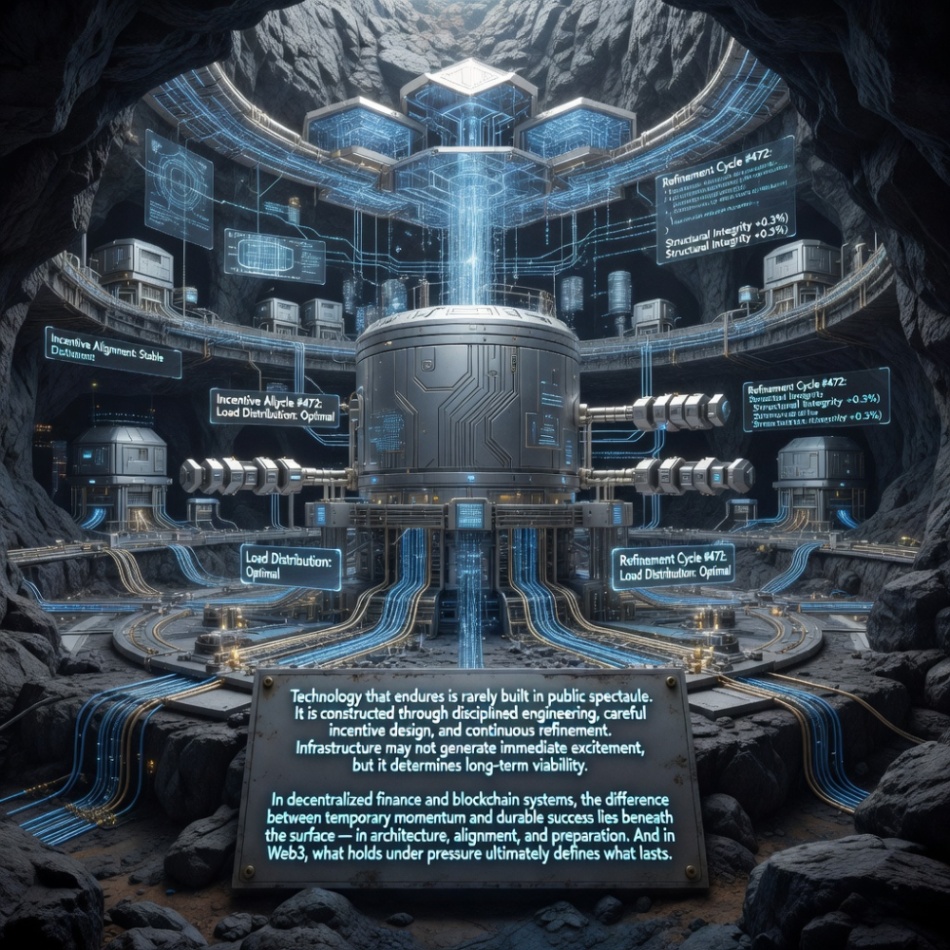
Technology that endures is rarely built in public spectacle. It is constructed through disciplined engineering, careful incentive design, and continuous refinement.
Infrastructure may not generate immediate excitement, but it determines long-term viability.
In decentralized finance and blockchain systems, the difference between temporary momentum and durable success lies beneath the surface, in architecture, alignment, and preparation.
And in Web3, what holds under pressure ultimately defines what lasts.
I’d honestly love your take on this.
You’ve always looked at things from a sharper angle than most, so your perspective would really add depth to the conversation. Drop a comment with what you agree with, what you challenge, or even where you think the blind spots are. The real value isn’t in posting, it’s in the dialogue that follows.
If you want to explore the topic deeper before replying, here are a few solid starting points for research:
- World Economic Forum – AI, digital trust, and data governance reports
- https://www.weforum.org
- MIT Technology Review – In-depth analysis on AI infrastructure and digital ownership
- https://www.technologyreview.com
- Ethereum Foundation – Resources on decentralization and programmable systems
- https://ethereum.org
- OECD – AI principles and policy frameworks
- https://www.oecd.org/ai
Take a look, then come back and share your thoughts. I’m genuinely curious where you stand on it.
#AI #Web3 #DigitalOwnership #Blockchain #DecentralizedAI #OnChain #OpenInfrastructure