TradFi is evolving

Good morning/evening
How Cryptocurrency Is Changing the Global Financial System
For decades, the global financial system has relied on a familiar structure. Banks act as intermediaries, governments regulate the flow of money, and international transfers move through layers of institutions that verify and process transactions. While this system has supported global commerce for generations, it is also slow, expensive, and often inaccessible to millions of people.
Bitcoin was built to disrupt that system.
It was created as an alternative to banks, the same institutions that had a monopoly on your money for years. But what’s interesting now is that instead of crypto replacing the system entirely, the two are starting to merge.They couldn’t beat it, so they joined it.I talk about this a lot because it does on one hand legitimise crypto. More and more banks and institutions are now offering crypto services, although often only to their high networth clients. Still, the shift is happening and now it’s becoming impossible to ignore.There’s even talk of using Bitcoin as collateral for loans and mortgages one day.
But honestly, I’ll stick with DeFi. With decentralized finance, the platforms don’t close at the end of the business day. They don’t rely on outdated infrastructure or approval from intermediaries. As long as you have internet access and a digital wallet, you can transact, trade, lend, or borrow wherever and whenever you want with no permission needed!
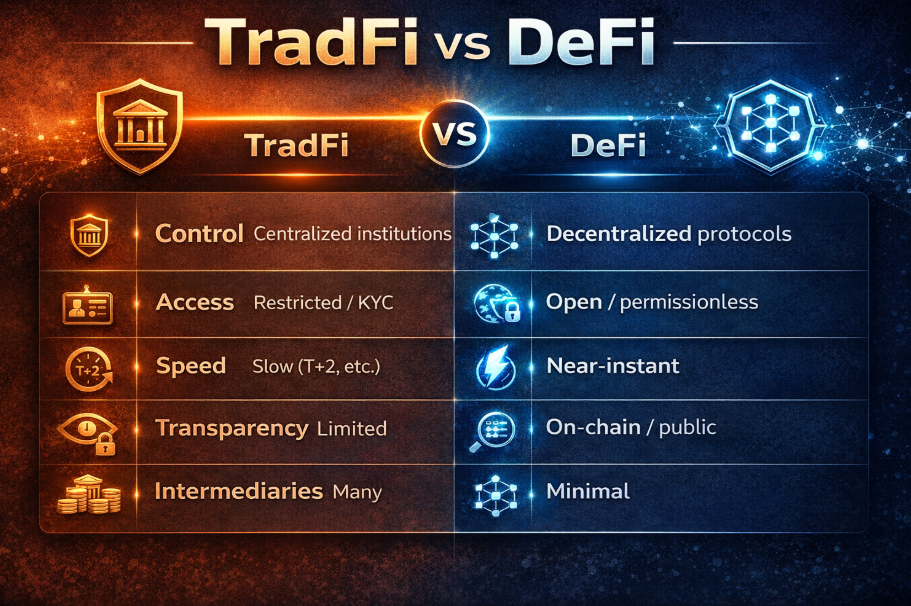
How Blockchain Outperforms Traditional Finance
TradFi is built on layers, banks, clearing houses, payment processors. Every step adds time, cost, and friction and blockchain strips all of that away.There are no middlemen deciding who can or can’t transact because there are no business hours or borders.
Speed
Traditional cross-border payments can take 3–5 business days to settle. Blockchain transactions can settle in minutes, sometimes seconds, 24/7, 365 days a year.
Cost
Bank transfers, especially internationally, can cost anywhere from 2–7% once fees and exchange rates are factored in. Blockchain reduces this dramatically, making global transfers far more efficient.
Control
No more chasing banks to find out where your money is. No waiting for approvals. On-chain transactions are transparent, traceable, and final. Once it’s done, it’s done even if you do make a mistake!
If you read any of my posts on the bank losing my money, you will know that it tooks months for them to find it and really I have no idea how they could manage to lose it in the first place, it was an internal transfer from one account to another, all whilst Bitcoin was at a good price to buy at around 20k and that is what the money was earmarked for, but I did eventually get it back with a little compensation and yes I did eventually get Bitcoin with it.
TradFi Is Catching Up
The irony is that the very institutions crypto was designed to disrupt are now adopting the technology behind it.
Major players are already moving in,
- JPMorgan Chase
- Visa
- PayPal
- Stripe
They’re exploring blockchain, integrating stablecoins, and experimenting with tokenization of real world assets, so in many ways the banks are playing catch up because crypto has already shown what’s possible with faster payments, open access and programmable money. Now TradFi is trying to retrofit those ideas into their own systems.
Even stablecoins, which are becoming a major focus for institutions, are essentially a bridge between the old system and the new one. They allow banks to move money faster, but still within a framework they can control.
Financial Access Is Changing
One of the biggest shifts crypto brings is access.You don’t need a bank account to use crypto. You don’t need permission. You don’t need to meet minimum balance requirements or pass through layers of bureaucracy. For people in parts of the world where banking infrastructure is limited or non-existent this is a big deal.All you need is a smartphone and internet access.That alone challenges one of the core assumptions of traditional finance that banks are necessary gatekeepers.
Institutions Are All In (Whether They Admit It or Not)
It’s actually surprising how quickly things have changed. It was not that long ago, crypto was dismissed as a niche experiment. Now major financial firms are offering ETFs, custody services, and crypto investment products. Some are even holding digital assets on their balance sheets as part of their treasury strategies, It moves crypto from the edge of finance into the mainstream and legitimises crypto to some degree but it also brings something else with it, regulation.As crypto becomes more integrated into the global financial system, governments and regulators will want more control. That’s inevitable and not necessarily a good thing.
So What Happens Next?
The reality is, crypto probably won’t completely replace banks, but it is forcing them to evolve.Banks are now using blockchain technology to fix their own inefficiencies which are many with faster settlements, reduced costs, improved transparency. At the same time, decentralized systems continue to push boundaries, offering alternatives that don’t rely on centralized control and moving to some sort of hybrid system where traditional finance and crypto coexist, competing, and influencing each other. But people have a choice and that is the important thing
Crypto is not just changing finance it is highlighting just how outdated the system is and if you can't beat em join them!
What are your thoughts? Do you think this is a good thing or not?
As always, thank you for reading and please feel free to comment.