Who Really Owns Your Data? A Different Approach to Blockchain Storage

Blockchain applications are often described as decentralized because some part of their data or logic exists on a blockchain.
But storing information on-chain does not automatically give users control over it.
In many blockchain applications, user data is governed by smart contracts written and deployed by third parties. Those contracts decide who may create, modify, retrieve, or remove information. If the contract contains an exploit, an administrative override, a race condition, or simply poorly designed permissions, the user may have less control than the word “decentralized” suggests.
The Contractless blockchain takes a different approach.
Contractless data storage is designed around a straightforward rule:
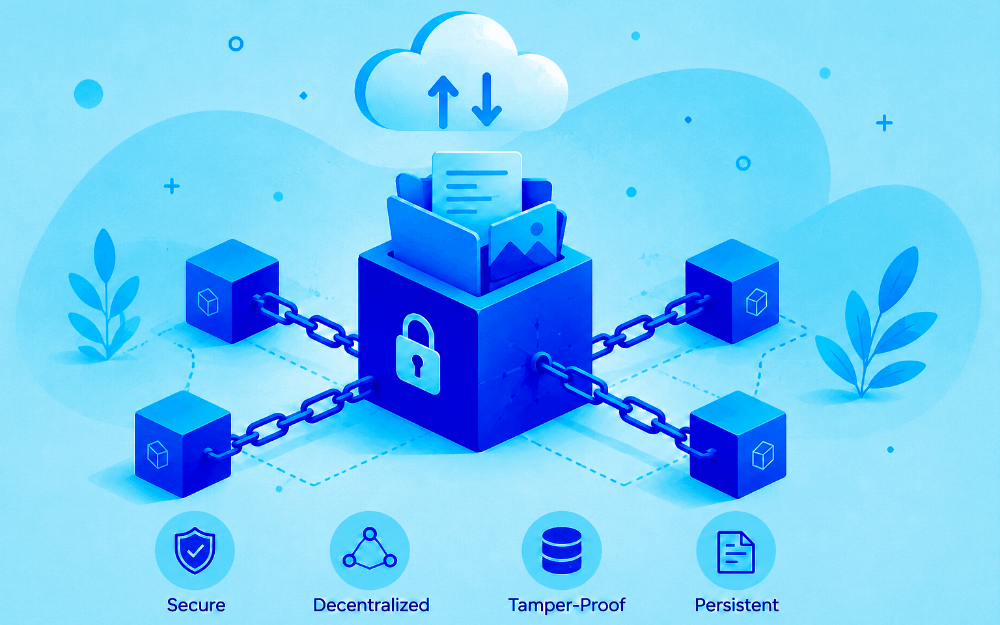
Data stored under a wallet address can only be changed or deleted by the holder of that wallet.
There is no contract administrator. There is no upgradeable ownership function. There is no application operator with a hidden permission that can rewrite the user’s records.
The wallet holder owns the data.

⚠️ The Problems With Existing Blockchain Storage
Many blockchain applications rely on smart contracts for both data storage and application logic. This can provide powerful functionality, but it also introduces substantial complexity.
Every additional function, permission, contract interaction, and state transition creates another place where something can go wrong.
Smart Contract Exploits
A smart contract is software, and software can contain bugs.
A contract may incorrectly validate ownership, mishandle permissions, expose an administrative function, or allow an unexpected sequence of calls. When those mistakes govern financial assets or important user records, the consequences can be severe.
A user may technically “own” an account or token while the contract controlling it still contains logic capable of freezing, redirecting, modifying, or destroying it.
Even when developers act honestly, the contract itself may not behave as intended.
Race Conditions and State Conflicts
Blockchain applications often involve multiple transactions attempting to modify shared state.
The application must correctly determine:
- Which update happened first
- Whether a previous state is still valid
- Whether two operations conflict
- Whether a user still has permission to perform an action
- Whether an external contract changed during execution
- Whether data observed earlier remains valid when the transaction completes
These conditions can create subtle race conditions.
The more contracts and shared resources involved, the harder it becomes for users to understand what they actually authorized and what the final result will be.
Administrative Control
Some applications retain administrative keys that can upgrade contracts, alter permissions, pause activity, or replace implementation logic.
These controls may exist for legitimate reasons, such as fixing bugs. However, they also mean the application is not entirely controlled by its users.
If an administrator can change the rules governing user data, then the administrator remains an authority over that data.
Application-Owned Data
Traditional platforms normally store user information in company-controlled databases. Some blockchain applications reproduce this model on-chain by placing user records under a contract controlled by the application.
The storage may be distributed, but control over the data is not necessarily distributed.
Users are still relying on someone else’s program to grant them access to their own information.

🔐 How Contractless Storage Works Differently
Contractless does not use smart contracts.
Instead, it provides dedicated transaction types for storing typed data directly under a wallet address.
Supported values include:
- Boolean values
- Unsigned integers
- Signed integers
- Strings
- Application-defined keys
Every storage update is signed by the wallet holding the data. Network validation confirms that the signature belongs to the address under which the value will be stored.
A third party cannot modify another user’s records merely because it created the application, introduced the storage key, or operates the interface used to submit the transaction.
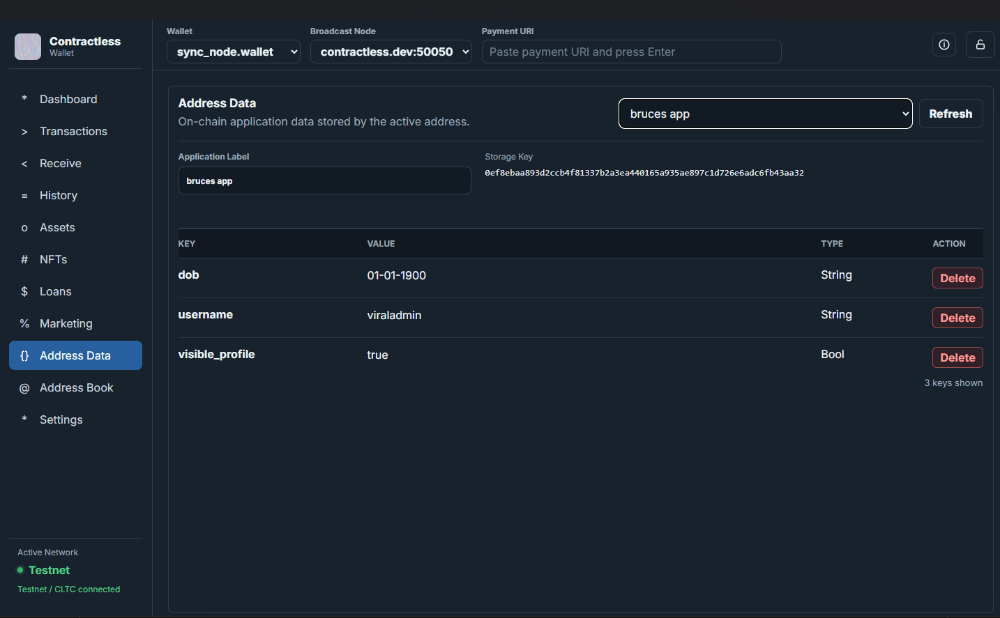
The Application Storage Key
Contractless uses a storage key to group related information.
This key can act as an application identifier. For example, a social platform might use one storage key for all user profile data associated with that platform.
Under that storage key, a wallet could record values such as:
username = bruce
active = true
age = 42
bio = Blockchain developer and artist
The application can retrieve and interpret those values, but it does not own them.
The storage key identifies the application context. It does not give the application creator permission to modify user data.
Wallet-Controlled Updates
Only the wallet associated with a record can create, update, or delete values stored under that address.
An application can:
- Provide a user interface
- Suggest fields and formats
- Read public records
- Construct unsigned transactions
- Submit signed transactions for broadcast
It cannot silently change the user’s data.
The user’s wallet must sign every state-changing transaction.
Deleting Stored Values
Users may also submit transactions that remove values from the active storage state.
It is important to distinguish active state from blockchain history. A deletion removes the value from current application storage, but it does not erase the historical transactions from the blockchain.
That distinction preserves blockchain auditability while still allowing users to control which values remain active.
For this reason, Contractless storage must only be used for public information. Passwords, private keys, personal secrets, authentication tokens, and other sensitive information should never be stored on-chain.

🧩 Storage Without Smart Contracts
Removing smart contracts eliminates an entire category of contract-level permissions and exploits.
There is no application contract that can unexpectedly assume control over a user’s records.
There is no contract owner who can upgrade the storage rules. There is no shared contract balance waiting to be drained.
However, this design comes with an important limitation:
Contractless decentralizes data ownership, but it does not automatically decentralize application logic.
An application may still operate a centralized website, API, matchmaking service, recommendation engine, or moderation system.
The blockchain can verify who owns and updates the data. It cannot guarantee that every application interprets that data fairly.
A platform could still:
- Hide certain records from its interface
- Rank users through a private algorithm
- Operate a centralized matching service
- Refuse to display valid data
- Shut down its website or API
The difference is that shutting down the application does not take ownership of the user’s data with it.
Another developer could build a new interface that reads the same on-chain records. Users could continue changing their information through their own wallets. The original platform would not possess an exclusive database holding everyone captive.

🤝 Loan and Swap Matchmaking
Contractless already supports peer-to-peer loans and swaps, but it intentionally does not provide a built-in matchmaking authority.
Blockchain data storage creates a foundation for independent developers to build those services.
A matchmaking application could let users publish information such as:
- Assets available for swapping
- Assets they want to receive
- Loan amounts requested
- Collateral being offered
- Preferred payment schedules
- Lending terms
- Availability status
The application could match compatible users and help construct the appropriate transactions.
The matching logic might remain centralized, but neither party would need to surrender ownership of their profile or offer data. The application would read user-controlled records and coordinate transactions that the participants must independently sign.
Competing matchmaking services could interpret the same public information in different ways without requiring users to recreate their identities and records inside every platform.

🖼️ NFT and RWA Platforms
NFT and real-world asset platforms can use Contractless storage to record user-controlled public information associated with their services.
Potential records might include:
- Creator profiles
- Collection preferences
- Public verification information
- Listing preferences
- Display settings
- Marketplace availability
- Public asset descriptions
The NFT or RWA remains governed by its native transaction history, while supplementary application data remains controlled by the wallet that created it.
If one marketplace disappears, another platform can still read the blockchain and build a compatible interface around the same assets and user records.

💬 Social Platforms and User Profiles
Social applications are another natural use case.
A wallet could maintain a public profile containing:
- Username
- Display name
- Biography
- Public website
- Interests
- Account status
- Application preferences
Different applications could read the same profile while presenting it through completely different interfaces.
Users would no longer need to depend entirely on a company-controlled database to preserve their identity. A platform could close, change direction, or remove its frontend without gaining the ability to rewrite the user’s underlying records.
This does not make moderation or content discovery automatically decentralized. Those remain application-level decisions. It does, however, separate control of the user’s data from control of the interface.

🛠️ Applications Built Around User-Owned Data
Contractless storage can support many additional public-data applications:
- Public directories
- Reputation systems
- Creator profiles
- Game character information
- Community membership records
- Public certifications
- Product registries
- Voting preferences
- Event participation
- Application settings
- Decentralized identity components
Not every piece of data belongs on a blockchain.
Storage is permanent in historical terms, publicly visible, and requires transaction fees. Large files should generally be hosted elsewhere, with the blockchain storing identifiers, hashes, ownership records, or other compact values.
Contractless storage is best suited to information that benefits from public verification and direct user ownership.

⚖️ What Applications Should Not Store
User ownership does not make every kind of record appropriate for this system.
Applications should never use wallet-controlled storage for values that users must not be able to alter themselves.
Examples include:
- Account balances maintained by an application
- Proof that a user paid an off-chain invoice
- Administrative permissions
- Private authentication records
- Secret access credentials
- Unencrypted personal information
- Records whose integrity depends on a third-party authority
If an application treats a user-controlled value as authoritative proof of something the user should not be allowed to declare, the application is incorrectly designed.
Contractless guarantees that the wallet holder controls the record. Applications must account for that guarantee instead of pretending the record came from an independent authority.

🌐 A Foundation, Not a Hosted Platform
Contractless data storage is not a complete application platform by itself.
It does not host websites, run arbitrary smart contracts, provide private databases, or decide how an application should interpret stored information.
It provides something more focused:
- Public typed storage
- Wallet-controlled updates
- Wallet-controlled deletion from active state
- Cryptographic ownership
- On-chain history
- Application-specific grouping
- Independent data retrieval
Developers remain free to build the logic and interface that make the information useful.
The blockchain establishes ownership. The application supplies the experience.

🚀 Data That Leaves With the User
Most platforms make users create an account and place their information inside a database the platform owns.
Many blockchain applications replace that database with a smart contract but still leave control in the hands of contract logic and administrators.
Contractless takes a more direct position:
The application may use the data, but the wallet holder owns it.
Only the wallet holder can change it. Only the wallet holder can delete it from active storage.
No application creator, contract administrator, or third party receives authority over it.
That does not make every application fully decentralized. Interfaces, matchmaking systems, search tools, and moderation services may still rely on centralized logic.
But it creates a foundation where centralized logic does not require centralized ownership of user data.
And that distinction may be one of the most important steps toward applications that are genuinely built around their users.

💬 Interested in Contractless Data Storage?
Contractless is currently in testnet development.
If you are interested in decentralized storage or running a Contractless testnet node, check out our source code, docs and whitepaper which can all be found at:
https://contractless.dev/contractless/Contractless