Teaching Old Bitcoin New Tricks

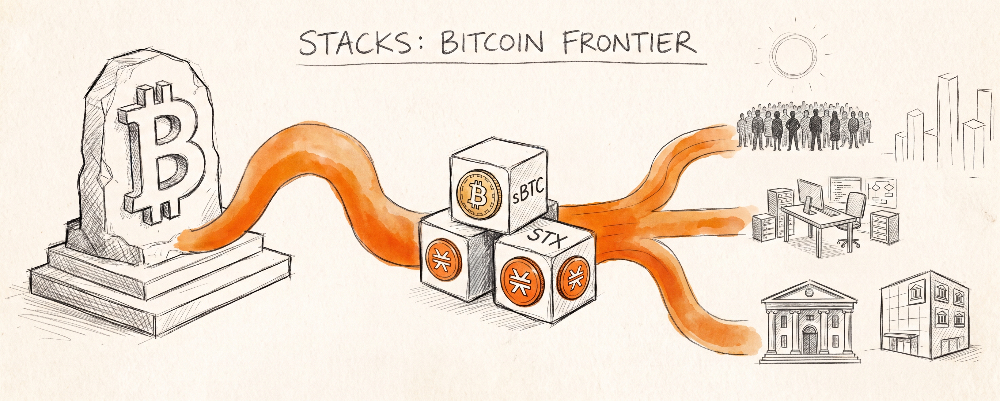
Attempts to utilize Bitcoin in decentralized finance (DeFi) have typically required users to rely on wrapped assets (like wBTC), which involve trusting centralized custodians to hold the native Bitcoin and issue a tokenized equivalent on a different blockchain. The collapse of several centralized custodians in 2022 highlighted the systemic risks of this model.
Currently, the developer ecosystem is focused on a different approach: scaling Bitcoin through Layer 2 networks and trust-minimized infrastructure. The Stacks ecosystem is a primary driver of this shift. Through the deployment of sBTC, the implementation of Bitcoin staking on the @Stacks layer, and a strategic leadership realignment at Stacks Labs, the infrastructure required to make Bitcoin a productive asset is moving from the testing phase into live production.
Solving the "Bitcoin Write Problem" with sBTC
The core friction in Bitcoin DeFi is the "Bitcoin write problem." While auxiliary networks can easily read data from the Bitcoin blockchain to verify transactions, writing complex smart contracts back to the base layer is restricted by design.
To enable Bitcoin to interact with smart contracts without relying on a centralized corporate custodian, the Stacks ecosystem developed sBTC.
sBTC is a trust-minimized, non-custodial form of pegged Bitcoin designed to operate on the Stacks smart contract layer while inheriting 100% of Bitcoin's finality. Rather than a single corporation holding the underlying BTC, the peg is maintained by a decentralized, open-membership network of participants known as "Stackers."
When a user wants to peg-in, they send their native BTC to a threshold-signature wallet controlled by these Stackers. Stacks' consensus mechanism, Proof of Transfer (PoX), verifies the transaction and mints sBTC at a 1:1 ratio on the Stacks network. To peg-out and redeem the native BTC, a decentralized consensus of at least 70% of Stackers must cryptographically sign the transaction.
This model benefits significantly from the recent Stacks Nakamoto upgrade, which decoupled Stacks block production from Bitcoin’s block times. As a result, sBTC transactions on Stacks can settle in seconds rather than ten minutes, enabling the speed required for functional DeFi applications without compromising the security anchor of the Bitcoin base layer.
Further Reading: To examine the game theory securing the decentralized peg, the threshold signature mechanics, and how the Nakamoto Upgrade facilitates this architecture, read the technical breakdown by Xverse: What Is sBTC? A Guide to Non-Custodial Native Bitcoin DeFi. From the community: https://x.com/stacy_muur/status/2068004249238458855?s=20
The Mechanics of Bitcoin Staking and the Protocol Bond
Traditionally, "staking" on Bitcoin has not been possible. Because Bitcoin operates on a Proof of Work consensus mechanism, network security is provided by miners expending computational energy, not by users locking up capital.
Stacks introduces a mechanism to earn native Bitcoin yield through its consensus model, Proof of Transfer (PoX). In PoX, Stacks miners do not burn electricity to mine $STX (the native Stacks token); instead, they bid native Bitcoin for the right to mine $STX. The protocol then distributes this bid Bitcoin directly to network participants who lock up their assets to secure the chain.
This model was recently formalized for institutional participants through the introduction of the Bitcoin Staking Genesis Bond.
The Genesis Bond introduced a self-custodial model allowing participants to earn native BTC yield while maintaining complete control of their principal. Using standard Bitcoin timelock scripts on the base layer, the participant's BTC is never bridged, wrapped, or controlled by a smart contract. To secure a bond, the participant locks their BTC alongside a smaller ratio of STX (approximately 5% of the BTC value). In exchange for providing this capacity, they are prioritized by the protocol to receive the Bitcoin bid by Stacks miners, targeting an APY of roughly 3%, paid weekly.
Further Reading: For a deeper understanding of the smart contract architecture, how Bitcoin timelocks function, and the mechanics of earning yield without relinquishing private keys, review the official documentation: Bitcoin Staking Genesis Bond: How It Works. From the community: https://x.com/reubs_btc/status/2087457056831799550?s=20
Analyzing the Early Data: The 14-Day Bond Recap
The transition of Bitcoin staking from a theoretical whitepaper concept to a live production environment occurred with the launch of the Genesis Bond on September 10, 2026. The initial data provides a verifiable look at how the protocol handles institutional capital and yield distribution under live conditions.
According to the 14-day recap published by Stacks Labs, the Genesis Bond operated precisely as designed. The initial cohort was deliberately sized to test the infrastructure before scaling, with four major institutions participating: UTXO Management, 21Shares, HashKey (via the self-custodial path using enterprise infrastructure like Fireblocks), and Sypher Capital (via liquid staking).
In the first two weeks, participants bonded a total of 230 BTC and 3.57 million $STX. The protocol successfully distributed 0.28 BTC in rewards.
The flow of funds validated the PoX distribution model: Stacks miners committed BTC, the protocol collected it, and the bonded participants were paid first to support the target APY. The remaining 85% of the miner-committed BTC was distributed to standard STX stakers, while 15% was directed to a reserve fund designed to backstop future bond payouts if mining activity fluctuates.
This two-week period served as a critical proof-of-concept, demonstrating that self-custodial enterprise infrastructure can integrate cleanly with Stacks' native yield mechanics, clearing the way for increased capacity in subsequent bonding periods.
Further Reading: To review the exact distribution metrics, the institutional participants involved, and the implications for Bonding Period 2, read the full report: Bitcoin Staking on Stacks Early Data: 14-day Bond Recap.
Pooled Bitcoin Staking
While the self-custodial Protocol Bond is designed for institutional capital (currently requiring a 50+ BTC minimum during the bootstrap phase), the network also supports pathways for smaller holders to participate in network consensus.
Pooled Bitcoin Staking provides access to the same miner-generated yield without the high capital requirements. While the institutional self-custodial path utilizes a base-layer timelock, the pooled path operates on the Stacks layer using sBTC.
Through platforms like StackingDAO and Fast Pool, users can deposit smaller amounts of capital into a liquid staking pool. This aggregated capital is secured by the same decentralized signer set and 70% threshold consensus that secures sBTC. By pooling resources, retail participants collectively meet the capacity requirements to interface with the PoX consensus mechanism.
The yield generation remains identical: the rewards are sourced from Stacks miners bidding for STX. The pool simply aggregates these rewards and distributes them proportionally to the depositors. This mechanism ensures that the financial utilities being built on Stacks are not restricted solely to enterprise participants.
Further Reading: To understand the structural differences between self-custodial bonds and liquid pools, and to evaluate the trust assumptions involved in pooled staking, refer to the ecosystem guide: Pooled Bitcoin Staking on Stacks: How It Works.
Dual Stacking
For users ready to interact with these systems, the primary interface is the newly updated Stacks App. The platform facilitates a strategy known as Dual Stacking, which is designed to improve capital efficiency for network participants.
The process involves two primary steps. First, users mint sBTC via the decentralized bridge. Second, users can boost their reward tier by stacking STX alongside their sBTC. Committing more STX to the network increases the yield generated on the Bitcoin position (up to 5% APY in sBTC), while the user simultaneously earns standard staking rewards on their STX holdings.
Because sBTC functions as a programmable token on the Stacks layer, it allows for DeFi composability. Users can deploy their sBTC into various Stacks-based lending protocols or liquidity pools while continuing to earn Dual Stacking rewards from the network's consensus mechanism. All base rewards are paid in sBTC, which maintains its 1:1 redeemability for native BTC.
Further Reading: To explore the user interface, calculate potential yields based on current network metrics, and view the active signer network, visit the application directly: sBTC Dual Stacking – Earn Bitcoin on Bitcoin | Powered by Stacks.
Muneeb Ali Steps in as CEO of Stacks Labs
The transition of a network from infrastructure development to institutional adoption requires a shift in organizational focus. This reality was reflected in the September 30, 2026, announcement that Muneeb Ali (@muneeb), the founder of Stacks, has assumed the role of CEO at Stacks Labs.
Alex Miller, the interim CEO, oversaw the "build" phase of the organization. Under his tenure, Stacks Labs was established as the primary contributor to the network, and the technical milestone of shipping Bitcoin Staking to production was achieved. With the Genesis Bond functioning in production, the core infrastructure mandate was fulfilled.
Muneeb Ali's transition to CEO marks the beginning of the "growth" phase. Ali, who holds a Ph.D. in Computer Science from Princeton and has worked on Bitcoin-related development since 2013, brings a deep technical background combined with extensive regulatory experience—having led the first SEC-qualified token offering for STX in 2019.
As the infrastructure scales, the primary challenges are shifting toward business development, institutional onboarding, and global market expansion. Ali's stated priorities include deepening relationships with major custodians and asset managers, and expanding Stacks' presence in key international markets such as Korea, Hong Kong, and the Middle East. His appointment signals a clear organizational pivot toward scaling the adoption of Bitcoin Staking across both institutional and retail sectors.
Further Reading: For a complete overview of the leadership transition, the strategic roadmap for Stacks Labs, and Ali's specific priorities for institutional distribution, read the official announcement: Muneeb Ali Becomes CEO of Stacks Labs as Bitcoin Staking Enters Its Growth Phase. From the Stacks community: https://x.com/stacy_muur/status/2105940380344893781?s=20