🏢 Can Web3 Really Replace Big Tech?

👀 Introduction
For years, a handful of technology giants have dominated the internet.
Companies often referred to as Big Tech control many of the platforms we use every day — from social media and cloud services to digital marketplaces and data infrastructure.
These companies have built powerful ecosystems that influence how billions of people communicate, work, and share information.
But with the rise of blockchain technology, a new question is being asked:
💭 Can Web3 really replace Big Tech?
Web3 promises a decentralized internet where users control their data, creators own their content, and communities govern digital platforms.
It sounds like a radical shift.
But replacing global tech giants is not a simple task.
Let’s explore whether Web3 truly has the potential to challenge Big Tech.
🌐 The Power of Big Tech
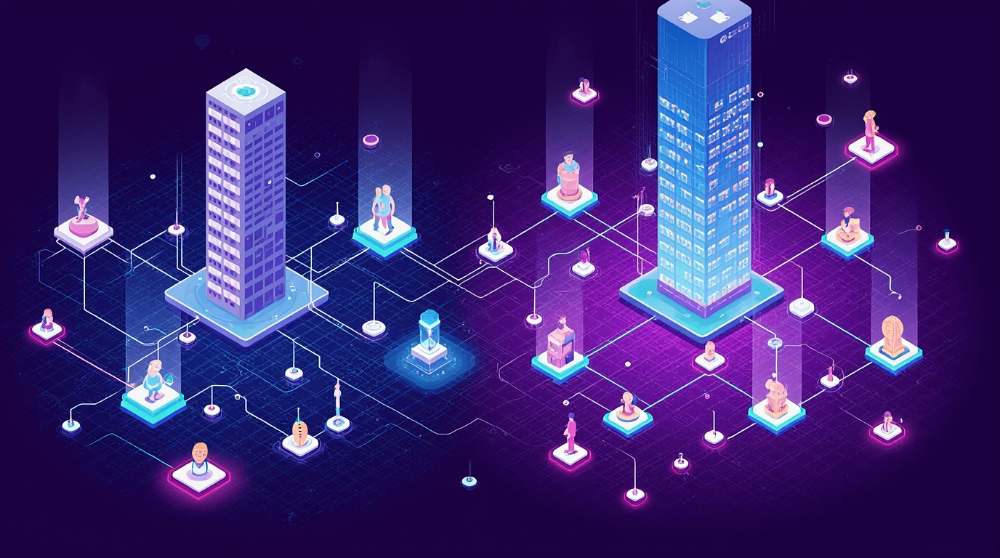
To understand the challenge, we must first recognize how powerful Big Tech companies are.
Over the past two decades, these companies have built massive digital infrastructures that support billions of users worldwide.
They provide:
- global cloud computing systems
- social media platforms
- digital advertising networks
- payment services
- app ecosystems
Their platforms benefit from network effects, meaning the more people use them, the more valuable they become.
This makes it extremely difficult for new competitors to replace them.
Even when users criticize these companies, they often continue using their services because everyone else does.
🔗 The Web3 Vision
Web3 introduces a different model for the internet.
Instead of centralized platforms owned by corporations, Web3 relies on decentralized networks built on blockchain technology.
In theory, this allows users to:
- control their digital identities
- own their online assets
- participate in governance decisions
- interact without centralized intermediaries
Developers can build decentralized applications (dApps) that operate on open protocols rather than corporate servers.
The goal is to create an internet where power is distributed across communities rather than concentrated in a few companies.
💡 Advantages of Web3 Platforms
Web3 offers several advantages that could challenge the traditional Big Tech model.
One of the most important is user ownership.
On many Web2 platforms, users create valuable content but do not own the platforms where that content lives.
In Web3, creators can monetize directly through:
- tokens
- NFTs
- decentralized marketplaces
Another advantage is transparency.
Blockchain networks allow transactions and governance decisions to be visible on public ledgers.
This can increase trust and reduce the opacity often associated with centralized corporations.
Finally, Web3 enables permissionless innovation.
Developers can launch applications without asking permission from large technology companies.
⚠️ Challenges Facing Web3
Despite its potential, Web3 still faces major obstacles before it could replace Big Tech.
First, many Web3 platforms struggle with scalability.
Blockchain networks must handle millions of users efficiently, which is still a technical challenge.
Second, user experience remains complicated compared to traditional apps.
Managing wallets, private keys, and blockchain transactions can be confusing for new users.
Third, Web3 infrastructure still relies on certain centralized services such as cloud hosting and development tools.
Ironically, some Web3 applications still depend on services provided by large tech companies.
This shows that the transition from Web2 to Web3 is not yet complete.
🧠 Big Tech Is Already Adapting
Another important factor is that Big Tech companies are not ignoring Web3.
Many of them are actively exploring blockchain technologies, digital assets, and decentralized systems.
Instead of being replaced, some Big Tech companies may simply adapt and integrate Web3 technologies into their existing platforms.
If that happens, the future of the internet may involve a combination of Web2 and Web3 rather than a complete replacement.
Technology ecosystems often evolve rather than disappear.
🚀 A More Realistic Future
Rather than completely replacing Big Tech, Web3 may gradually reshape the internet.
Certain sectors may become more decentralized, such as:
- digital finance
- creator economies
- digital identity systems
- online governance
Meanwhile, large technology companies may continue to dominate other areas where scale and infrastructure are critical.
The result could be a hybrid internet where decentralized networks coexist with large platforms.
This evolution might still shift power toward users without eliminating corporations entirely.
✨ Final Thoughts
So, can Web3 really replace Big Tech?
In the short term, that seems unlikely.
Big Tech companies have enormous resources, infrastructure, and global networks that are difficult to replicate.
However, Web3 introduces powerful ideas that challenge the traditional model of the internet.
By promoting decentralization, ownership, and open participation, Web3 may push the digital ecosystem toward a more balanced structure.
Instead of completely replacing Big Tech, Web3 might transform how power is distributed online.
And that transformation could be just as important as a full replacement.
💬 What Do You Think?
Do you believe Web3 will eventually replace Big Tech…
or will the two systems evolve together?
Share your thoughts 👇