Proof of Work vs Proof of Stake — Without the Jargon
I've written before about what happens when you send crypto, and touched briefly on how the network agrees on a single ledger. This post goes much deeper into that one specific question, because it's genuinely the most interesting engineering problem in all of blockchain, and the shallow version ("PoW uses computers, PoS uses money") barely scratches the surface of what's actually going on, or why it matters.
The problem underneath it all
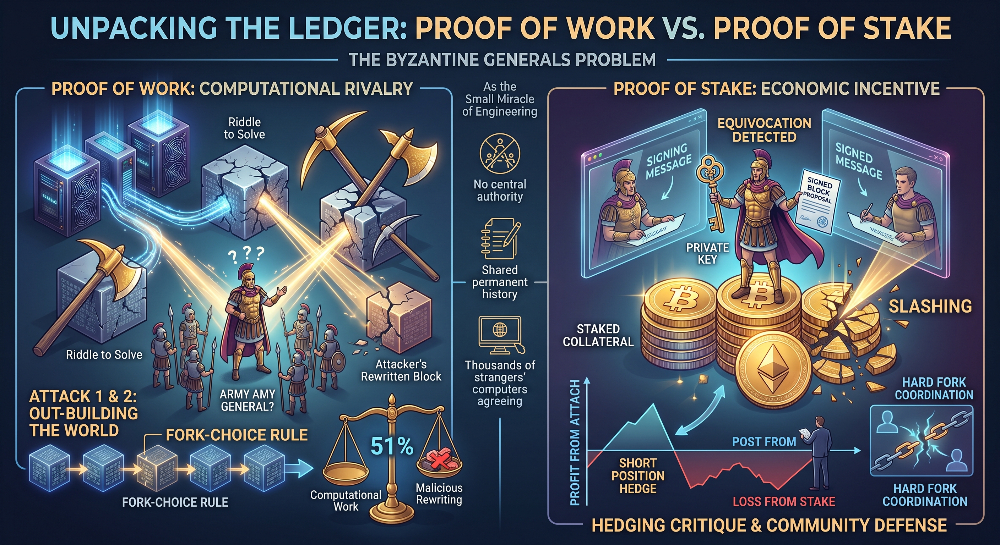
Before comparing the two, it's worth being precise about the actual problem they're both solving. It's not "how do we stop hackers." It's something subtler, known as the Byzantine Generals Problem.
Picture an army surrounding a castle, split into units. All units must attack at the exact same moment, or the whole plan fails. Orders get relayed unit to unit, but one unit might be a spy, secretly telling different units to do different things.
Here's the part that's easy to miss: the real challenge isn't just "can we catch the spy?" It's: can all the honest units still end up doing the exact same thing, even when the spy is actively trying to make them disagree?
Blockchains face this exact problem: thousands of computers, run by total strangers, need to agree on one shared ledger, with no central authority to arbitrate. Proof of Work and Proof of Stake are two different answers to that same question — not just two ways to "pick a winner," but two different mechanisms for keeping strangers in sync even when someone is actively trying to split them apart.
Proof of Work: Earning the right to speak, the hard way
The mechanism
Before any new block of transactions can be added to the chain, someone has to solve a riddle. In concrete terms: take the block's data, attach a random number (called a nonce), and hash the combination. The goal is to find a nonce that makes the resulting hash meet a specific target, commonly, starting with a certain number of zeros.
There's no clever shortcut here. Hash functions are designed so you can't work backwards from a desired output to figure out what input produces it. The only real strategy is brute force: try a nonce, hash it, check it, and if it doesn't work, try the next one — potentially billions or trillions of times — until you get lucky.
Once someone finds a valid nonce, though, verifying it is trivial. Anyone else can hash that exact same combination once and instantly confirm it meets the target. This asymmetry — hard to find, easy to verify — is the entire trick behind Proof of Work.
What happens when someone tries to cheat
There are actually two distinct attacks worth separating, because they fail for different reasons.
Attack 1: inserting a false transaction right now. A dishonest miner still has to solve the riddle, no shortcut, same rules as everyone else. Even if they succeed, they're racing the rest of the network, which collectively has vastly more computing power than any single attacker. This is where the fork-choice rule comes in: every node is programmed to always follow whichever version of the chain has the most accumulated computational work behind it. If two competing versions briefly exist, the shorter one gets abandoned as soon as the longer one pulls ahead, usually within a block or two.
Attack 2: rewriting an already-confirmed transaction. This is the harder problem. Changing an old block invalidates its nonce, forcing it to be re-solved, and because every block references the hash of the one before it, every single block after the altered one breaks too, and must also be re-mined. Meanwhile, the honest network isn't standing still; it keeps adding new blocks the entire time. The attacker isn't just solving one riddle, they're racing an ever-growing target, alone, against everyone else combined.
The only way to actually pull this off is to control more than half the network's total computing power — the famous 51% attack. For a network the size of Bitcoin, this is effectively impossible: you'd need to out-build and out-power hundreds of thousands of specialized machines running globally, all day, every day. But it's not just theoretical, as smaller networks with far less total computing power, like Bitcoin Gold and Ethereum Classic, have actually suffered real 51% attacks. Security here scales directly with the size of the honest network, not with the cleverness of the riddle itself.
Proof of Stake: Earning the right to speak, by risking your own money
The mechanism
Instead of burning electricity solving a riddle, each participant puts up their own coins as collateral (their stake). The more you stake, the higher your chance of being picked to propose the next block, roughly proportional to how much you've put up. It's more like a raffle than a race: more stake means more tickets, not a guaranteed win. Once chosen, the validator pushes their block onto the chain and earns a reward, later getting their stake back too.
The cheating mechanism that's actually detectable
Here's a subtlety that's easy to gloss over: PoS doesn't judge whether a decision was good or bad. It only catches one very specific, provable form of misbehavior — equivocation, meaning signing two conflicting things at once.
Concretely: imagine a chosen validator signs one block saying "add transaction A" and, at the exact same moment, signs a second, conflicting block saying "add transaction B" instead, sending each to a different part of the network. Both signatures are genuinely, verifiably theirs. There's no ambiguity, no need for a judge, the two contradicting, signed messages are undeniable proof of double-dealing. When this is detected, the network automatically slashes (confiscates) the validator's staked collateral.
The honest gap in this defense
Here's something worth being upfront about: if a chosen validator simply proposes one dishonest thing (once, with no contradiction), slashing catches nothing. There's no equivocation to detect, so there's nothing for the protocol to flag. This is a real, acknowledged limitation: PoS can catch you lying to two people at once, but it can't tell whether your one decision was made in bad faith.
Why validators mostly don't bother anyway
Beyond the mechanical slashing, there's a second, softer layer of defense: self-interest. A validator with a large stake has effectively bet a large portion of their own wealth on the network staying trustworthy. If they cheat and it becomes known, confidence in the network drops — and so does the price of the coin, including everything that validator still holds. The people with enough stake to cause real damage are usually the same people with the most to lose if they do.
Where that argument actually breaks down
This is worth taking seriously rather than glossing over, because it's a real, well-known critique: what if the attacker hedges first?
If someone shorts the asset (bets on the price falling) before launching an attack, they can profit from the very crash their attack causes, even while their staked collateral gets destroyed in the process. This genuinely undermines the "no rational actor would hurt their own investment" argument.
What actually limits this in practice:
- Slashing happens regardless of price — it's a mechanical, guaranteed loss, independent of whatever the attacker makes on their short.
- Acquiring enough stake to attack is itself hugely expensive, and tends to push the price up while accumulating, working against a short position, not for it.
- A short large enough to be worthwhile is hard to hide — unusual borrowing activity or open interest spikes tend to draw attention before an attack even executes.
- Communities can fight back after the fact. If an attack is detected, the network can coordinate a fix, this is essentially what happened after Ethereum's 2016 DAO hack, where the community executed a hard fork to reverse the malicious transactions entirely, undoing the attacker's gains regardless of any hedge.
So it's not a fully solved problem. It's a genuine, ongoing tension in how these systems are secured, not just a theoretical worry, and it's one of the more interesting open questions in the space.
The takeaway
Both systems are answers to the same underlying question: how do you keep a room full of strangers honest, with no one in charge? Proof of Work does it by making dishonesty computationally expensive: You'd need to out-build the world. Proof of Stake does it by making dishonesty financially expensive, and by catching a specific, provable kind of betrayal outright, but it leaves a narrower, more interesting set of edge cases still being actively debated.
Neither is flawless. Both are, in their own way, genuinely clever solutions to a problem that used to require a bank to solve.