Crypto Marketing Framework: Creating a Strategy Around Trust and Attention

The bigger challenge is converting attention into confidence.
This matters because cryptocurrency operates in an environment where users must evaluate unfamiliar technologies, financial risks, anonymous teams, smart contracts, token economics, and rapidly changing market conditions. Pew Research Center found in 2024 that 63% of U.S. adults had little or no confidence in the safety and reliability of cryptocurrencies, while only 5% expressed very high confidence.
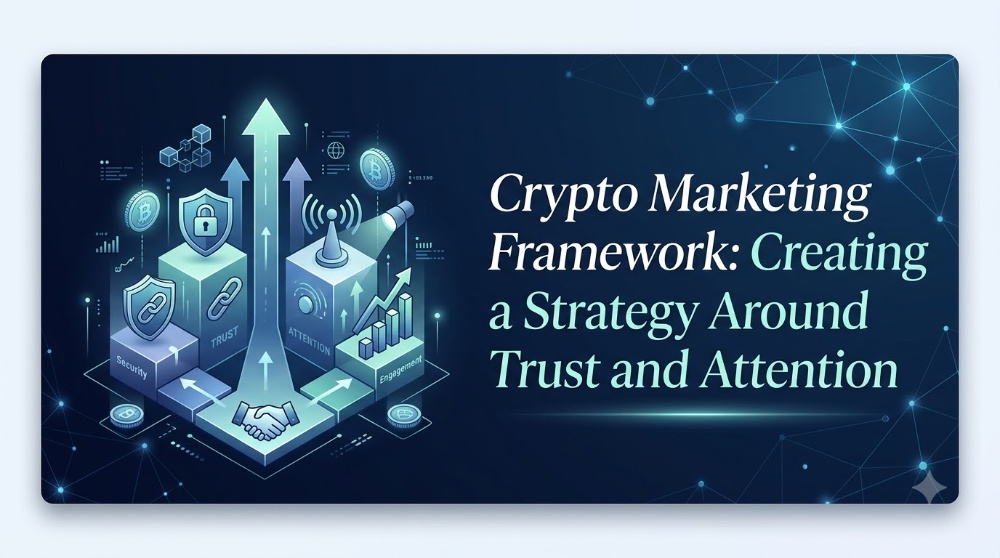
For crypto projects, marketing architecture therefore needs to connect two essential forces: attention and trust. Attention brings people into the conversation. Trust determines whether they stay, learn, participate, invest, use a product, or recommend it to others.
Why Trust Has Become the Foundation of Crypto Marketing
Trust is particularly important in cryptocurrency because users cannot evaluate many projects through traditional business signals. A physical company may have offices, established products, years of operating history, and recognizable executives. A crypto project may instead present a token, website, whitepaper, anonymous wallets, smart contracts, and a community spread across multiple platforms.
That creates an information gap.
Users naturally look for signals that help them determine whether a project is credible. These signals can include identifiable team members, technical documentation, independent audits, transparent token allocations, verifiable partnerships, clear roadmaps, public development activity, and consistent communication.
Security has made this issue even more important. Chainalysis estimated that cryptocurrency scams and fraud resulted in approximately $17 billion in stolen funds during 2025, while the average scam payment increased 253% year over year to $2,764. Impersonation scams also grew dramatically during the year.
This environment changes how legitimate projects should approach marketing. Claims should be backed by evidence, partnerships verified, and product capabilities clearly demonstrated. Crypto marketing agencies like Blockchain App Factory help projects promote their offerings through crypto SEO, content marketing, PR, influencer outreach, and community management while maintaining clear and credible messaging.
Trust, in this context, is not a branding slogan. It is an accumulation of evidence.
The Architecture Begins With a Clear Value Proposition
Before a crypto project starts publishing content or buying media placements, it needs to establish what it actually offers.
A weak value proposition usually sounds similar to hundreds of other blockchain projects. It may mention decentralization, scalability, innovation, community, or Web3 without explaining the practical problem being addressed.
A stronger architecture starts with four questions:
- What problem does the project solve?
- Who experiences this problem?
- How does the blockchain component contribute to the solution?
- What evidence demonstrates that the product works?
These answers should remain consistent across the website, whitepaper, social media accounts, community channels, interviews, and third-party publications.
Consistency is important because users often encounter a crypto project in fragments. Someone may first see an X post, then visit a website, read a CoinMarketCap profile, watch a YouTube explanation, and eventually enter a Telegram community. If every channel communicates a different value proposition, confidence declines.
A coherent message creates continuity between discovery and deeper research.
Attention Should Create Curiosity, Not Pressure
Attention remains essential. A technically strong blockchain product cannot build a user base if nobody knows it exists. However, the role of attention should be understood differently.
The objective is not simply to maximize impressions. It is to attract the right audience and give that audience a reason to investigate further.
For example, a DeFi protocol could publish educational content explaining liquidity risks, yield mechanisms, and smart-contract considerations. A tokenization platform could publish research about how businesses can represent real-world assets on-chain. A blockchain infrastructure company could release technical comparisons showing how its architecture handles transactions.
These subjects can attract relevant audiences without relying on exaggerated claims.
The strongest attention strategies create a progression:
Discovery → Curiosity → Education → Verification → Community → Action
Each stage requires different content. Short social posts may generate discovery. Long-form articles can answer questions. Technical documentation supports verification. Community discussions build familiarity. Product demonstrations help users make decisions.
This is more durable than treating every channel as a place to publish promotional messages.
Content Is the Bridge Between Attention and Trust
Content plays a central role because crypto audiences often conduct extensive research before taking action.
A project may therefore need several layers of content rather than a collection of generic blog posts.
Educational content explains the market and technology. Technical content demonstrates competence. Research content provides original analysis. Product content explains functionality. Documentation answers practical questions. Case studies provide evidence of execution.
This approach also aligns with Google's current guidance around helpful, reliable, people-first content. Google states that its systems seek content demonstrating experience, expertise, authoritativeness, and trustworthiness, with trust described as the most important element within E-E-A-T. Google also recommends making authorship and the purpose behind content clear.
For cryptocurrency websites, this has particular relevance because financial and investment-related information can affect users' financial decisions.
A crypto marketing architecture should therefore make the source of information visible. Articles can include qualified authors, references, methodology, publication dates, supporting research, and clear distinctions between facts, forecasts, and opinions.
Community Marketing Should Focus on Participation
Community is often treated as a follower-count exercise. That can produce impressive numbers without creating meaningful engagement.
A healthier community strategy focuses on participation.
Telegram and Discord can support direct conversations between users and project representatives. X can distribute updates and facilitate public discussions. Reddit can provide opportunities for longer community conversations. LinkedIn can help reach business audiences and institutional stakeholders.
The important question is not simply how many people joined a community. It is whether members understand the product, receive useful information, ask questions, receive answers, and feel that communication is transparent.
Projects should also establish clear rules for moderation and official communication. In a market where impersonation scams are increasing, users need to know which accounts, links, contracts, and announcements are authentic.
That makes community management part of the trust architecture rather than simply a social media function.
Influencer Marketing Needs Verification
Crypto influencers and KOLs can generate substantial attention, but their effectiveness depends heavily on audience quality and credibility.
A large follower count does not necessarily indicate influence. Projects should examine engagement patterns, audience relevance, previous collaborations, content quality, and whether the creator's audience actually matches the project's target market.
Disclosure is equally important. Audiences are increasingly capable of identifying paid promotion, repetitive sponsorships, and unrealistic claims. A creator who explains the product, discusses limitations, and clearly identifies promotional relationships may contribute more credibility than someone who simply publishes a token price prediction.
The goal should be to use creators as information distributors and interpreters, not as substitutes for evidence.
PR and Third-Party Validation Strengthen the Structure
Owned media gives a project control over its messaging, but independent sources can provide additional credibility.
Press coverage, technical interviews, industry publications, conference appearances, research citations, developer discussions, and independent reviews can all contribute to reputation. Their value comes from the quality and relevance of the source rather than the number of publications secured.
A project should also avoid treating every mention as positive proof. Credible marketing acknowledges uncertainty and limitations.
For example, if a protocol has undergone a security audit, marketing material should explain who conducted it, what was assessed, when the audit occurred, and whether identified issues were resolved. Similarly, a partnership announcement should clearly distinguish between a confirmed integration, a pilot program, and a simple business discussion.
Precision makes claims easier to verify and therefore easier to trust.
Measuring the Architecture: From Reach to Reputation
A crypto marketing strategy needs measurement at every stage of the user journey.
Traditional metrics such as impressions, followers, website visits, and video views can show whether a campaign is attracting attention. They do not necessarily show whether the audience trusts the project.
More meaningful measurements can include:
- Branded search growth and direct website traffic
- Engagement from relevant users rather than total impressions
- Community retention and meaningful discussions
- Documentation and product-page visits
- Conversion from educational content to product activity
- Quality and sentiment of third-party coverage
- Organic mentions and backlinks
- Repeated visitors and returning community members
This creates a more complete picture. A campaign producing 10 million impressions but little product interest may be less valuable than a campaign generating 500,000 highly relevant impressions and strong engagement from potential users.
A Real-World Lesson From Crypto Security
The industry's security challenges provide a useful lesson for marketers.
Chainalysis reported that more than $2.17 billion was stolen from cryptocurrency services during the first half of 2025, with personal wallet compromises representing 23.35% of stolen-fund activity during that period.
For marketing teams, security cannot remain a technical topic hidden from communications. Users want to understand how their assets are protected, how contracts were tested, how incidents are handled, and what safeguards exist.
A project that openly explains these subjects can turn a potential concern into an opportunity for informed evaluation.
This does not mean presenting security as a guarantee. No responsible project should promise that users face zero risk. Instead, the objective is to provide enough evidence for users to understand the safeguards and limitations.
Building a Sustainable Crypto Marketing Architecture
A strong crypto marketing architecture can be viewed as a connected system rather than a collection of promotional activities.
At the foundation sits trust, supported by transparency, security information, credible authorship, technical evidence, and consistent communication. Above that sits education, which helps audiences understand the product and market. Around it sits attention, generated through SEO, social media, PR, communities, influencers, events, and useful content.
The final layer is measurement. Marketing teams need to determine which activities create qualified attention, which content strengthens confidence, and which channels contribute to meaningful user action.
The most effective crypto brands therefore do not treat attention and trust as competing priorities. Attention brings people closer to the project, while trust gives them a reason to remain there.
Conclusion
Crypto marketing is becoming less dependent on simply creating noise and more dependent on creating credible reasons for people to pay attention. In a sector where scams, hacks, impersonation, and speculative claims continue to affect public confidence, trust must be built into the marketing structure from the beginning.
The strongest strategy connects clear positioning with useful content, transparent communication, credible third-party validation, responsible community management, and measurable audience engagement. When these elements work together, marketing becomes more than a traffic-generation exercise. It becomes a system for helping potential users discover a project, understand its value, verify its claims, and make informed decisions.