Is AI Slop Rewiring our Kids Brains?

Hey everyone! This is another video turned into an article. You can watch the video version below. AI slop is getting worse, and as AI becomes more advanced, more and more people are flooding YouTube and TikTok with brainrot. This article will explore what this kind of content does to our children’s minds, and what we can do to help mitigate the problem.
You know that feeling when you’re on YouTube Shorts or TikTok and something about the video just feels…off? The faces look a little weird, the voice sounds a little too smooth, the story is kind of nonsense, but you still watch the whole thing anyway. That, my friend, is AI slop. And it is flooding the internet.
AI slop is basically low-effort, AI-generated content pumped out in ridiculous volume just to grab attention and make ad money. It’s not made to inform you, entertain you in a meaningful way, or teach you anything. It’s made to hijack your eyeballs for 20 seconds and move on to the next one. Think of it like digital junk food. Empty calories for your brain.
Here’s the wild part though. This isn’t a niche thing anymore. Recent reports show that a big chunk of what brand new YouTube accounts get recommended is low-quality, AI-generated video content, and some of the fastest-growing channels on the platform are basically AI content factories. Over on TikTok, they’ve already labeled over a billion videos as AI-generated, and that’s just what they’ve caught. So when your kid opens these apps, there is a very good chance they’re not just watching creators, they’re watching machines.
Now, on its own, weird AI content is annoying, maybe creepy, but not necessarily catastrophic. The real danger is what happens when you combine AI slop with how these platforms are built and how your kid’s brain actually works.
What Is AI Slop?
When your kid opens TikTok, Reels, or Shorts, they’re not just casually browsing. They’re stepping into a hyper-optimized reward machine designed to keep them there as long as possible.
The algorithm is not there to show them what’s “good.” It’s there to show them what keeps them watching. That’s why every short starts with some loud hook: “POV”, “Wait for it…”, “You won’t believe this…”. If the hook doesn’t land in the first one to three seconds, they swipe, and the system quietly takes notes.
If they pause, watch, like, rewatch, or share, that’s a green light. Their brain receives a little hit of dopamine from the novelty and the payoff. Then the app immediately feeds the next video, and the next, and the next. The feed never ends, and that’s the point.
That might not sound like a big deal, but every time that cycle repeats. Attention, stimulation, anticipation, reward. It’s training their brain to expect quick hits of excitement over and over again. Over time, the brain adapts. It starts demanding more intensity, more novelty, and faster pacing to feel the same level of satisfaction. This is how addiction works. It’s the same basic circuitry you see with gambling and other compulsive behaviors.
The Dopamine Trap
Now imagine that happening in a brain that isn’t even finished wiring itself yet. Kids and teenagers are working with hardware that’s still under construction.
The part of the brain that handles self-control, planning, and long-term thinking (the prefrontal cortex) doesn’t fully mature until the mid-20s. So when the algorithm is throwing rapid-fire, high-intensity short videos at them all day, it’s not just distracting them. It’s shaping the way their brain is wired.
And this isn’t just theory. The research is starting to stack up. A large review that looked at dozens of studies and around a hundred thousand people found a consistent link between heavy short-video use and problems with attention and self-control. Another big study followed thousands of kids for several years and found that the more time they spent on social media, the more their ability to concentrate gradually declined over time.
This is not “they got a little distracted sometimes,” but measurable, long-term changes in attention.
On top of that, kids today already have insane amounts of screen time. Teens are averaging around eight hours a day on screens, and as kids go from age nine to thirteen, their social media use can jump from about half an hour to a couple of hours a day or more. When you combine that volume with the way the content is structured. Fast, loud, emotional, and endless. It’s not surprising that attention spans are shrinking.
Some reports even show that kids’ average attention span on certain tasks can be under half a minute before their mind starts wandering, and that focus drops further the longer they try to stick with something. Then we turn around and ask, “Why can’t my kid sit still and read a book?” It might not be that they suddenly developed a brain disorder. It might be that their brain has been trained by design to expect a new stimulus every few seconds.
When AI Slop Meets Young Brains
Now layer AI slop on top of all that. AI slop is content that is cheap to make, easy to optimize, and perfectly tuned to get attention without saying anything meaningful.
Because it’s automated, creators can flood the system with thousands of videos and let the algorithm figure out which ones perform well. If even a small percentage goes viral, it pays off.
For your kid, that looks like an endless stream of videos with hyper-exaggerated expressions, weird AI voices, nonsensical storylines, fake “relatable” skits, or bizarre mashups of gaming footage and AI commentary. Their brain doesn’t care that it’s nonsense. It just reacts to the novelty, the movement, the color, the sudden cuts, the emotional triggers. They keep watching, and the algorithm keeps feeding more of it.
Meanwhile, the research on what this does to actual mental health is getting darker. Short, emotionally intense content has been linked to more anxiety, more depression, more stress, more loneliness, and worse sleep in young people. Girls in particular are reporting record levels of sadness and hopelessness in recent surveys. They’re also constantly being exposed to ideals of beauty and success that are filtered, edited, or straight-up AI-generated. Comparing yourself to that, especially as a teenager, is like stepping into a rigged game you can never win.
At the same time, ADHD diagnoses have gone up, and some experts are asking whether at least part of what we’re seeing is kids whose attention systems are overloaded by constant, high-intensity media rather than classic, lifelong ADHD in every case. The symptoms look similar. Restlessness, difficulty focusing, and chasing stimulation, but the cause might be external for some of them.
So when we talk about “brain rot” from AI slop and short-form content, we’re not just being dramatic. We’re describing a feedback loop: more shallow content, less deep focus. Less deep focus, more reliance on shallow content. More shallow content, worse mental health. Worse mental health, more escape into shallow content.
Inside the Attention Economy
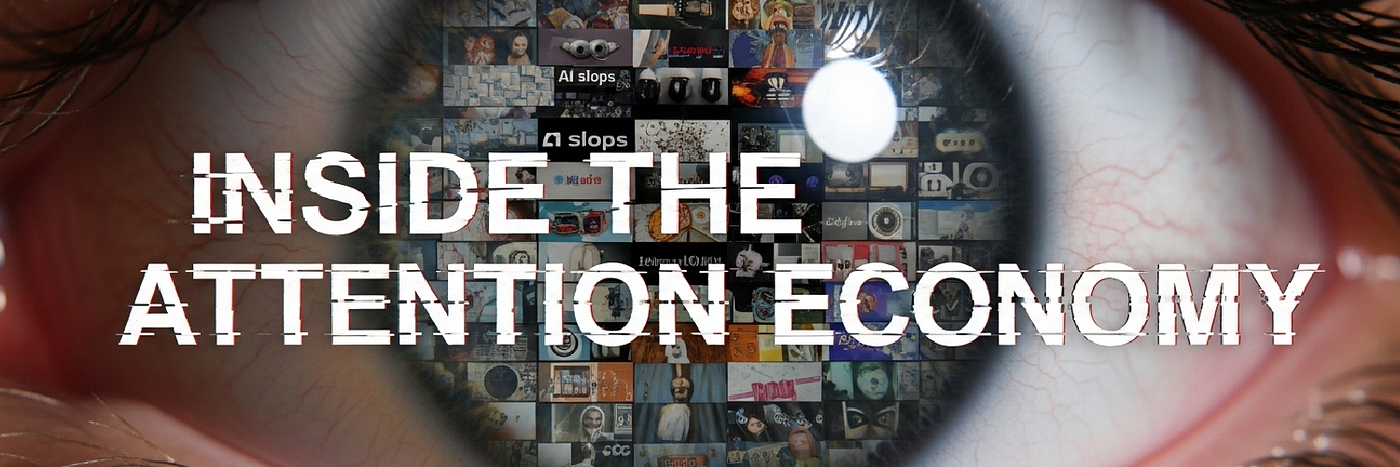
Now let’s zoom out and talk about why this is happening at the platform level. These platforms live and die by engagement. They don’t care if a video is from a human, an AI, a brand, or a bored teenager. They care how long you stay on the app and how many times you interact, because that’s what sells ads.
Short videos that hook you quickly, get a strong reaction, and move you on to the next one are a goldmine. That’s why metrics like watch time, completion rate, and engagement velocity (how fast likes and comments appear) matter so much. A video that gets a hundred likes in 30 seconds can be more valuable to the system than one that gets a thousand likes over a day, because it proves it can instantly grab people and keep the feed hot.
So the algorithm preferentially pushes content that spikes emotions fast. Creators quickly learn to play this game. Bigger hooks, faster cuts, more outrageous claims, more emotional bait. Once AI enters the picture, it just pours gasoline on it. Now you can generate endless variations, test them at scale, and let the algorithm surface the most addictive ones.
On top of that, social comparison is baked in. Every scroll is a reminder of someone who looks better, has more money, is funnier, or seems more successful than you. Studies have shown that constant exposure to this kind of content is strongly associated with body image issues, low self-esteem, and mood problems, especially in teens. The algorithm figures out what keeps you engaged, and if insecurity and envy do the job, it’s not going to politely avoid that.
If we don’t change direction, it’s not hard to imagine where this leads. Picture a future where finishing a book is rare. Long-form anything like books, lectures, deep conversations ends up feeling exhausting. Kids grow into adults who struggle to sit through a meeting, follow a complex argument, or stick with tasks that don’t give an immediate reward. Critical thinking takes a hit because everything is consumed in 10- to 30-second chunks, ripped out of context, framed for maximum emotional punch, and forgotten two videos later.
Schools will keep trying to teach using tools from the analog world such as reading, writing, slow discussion. While kids’ brains have been tuned for fast, interactive, always-changing digital stimulation. That gap gets wider every year. Mental health services get overwhelmed. Employers complain that new workers are smart but can’t sustain focus. At the same time, the internet gets even more saturated with AI-generated content, making it harder and harder to tell what’s real and what’s synthetic.
What the Future Looks Like If We Do Nothing

As bleak as that sounds, we’re not locked into that timeline. There are ways to push back and help kids build healthier relationships with technology.
At home, one of the most powerful things parents can do is to make a real plan instead of just nagging. That means sitting down with your kid and actually figuring out how much screen time they’re getting, what apps they’re using, and how it makes them feel. A lot of parents who track this for the first time are shocked by the numbers. Once you both see what’s happening, you can start setting boundaries that make sense: limits on daily use, certain apps only at certain times, and clear rules around phones at night.
Tech-free zones and times are another game changer. Bedrooms, dinner tables, and the hour before bed are great candidates. When screens are out of those spaces, kids sleep better, conversations improve, and their brains get at least a little time to reset from constant stimulation.
The next big piece is modeling. If the adults in the house are scrolling constantly, kids learn that’s normal. If they see you put your phone away, read, focus on a project, or just sit in silence for a bit without freaking out, that becomes normal instead. Kids may not listen to everything you say, but they definitely notice what you do.
Then there’s the question of what fills the gap. If you just yank the phone away and say “go read,” most kids are going to bounce off that. But when you intentionally build in alternatives like sports, music, making art, learning to code, building something with their hands, even playing longer-form games that require planning and patience. It gives their brain a chance to enjoy slower, deeper experiences again. At first it might feel “boring,” because their reward system is used to constant hits. But after a little detox period, a lot of kids rediscover that they actually like being creative and doing things that exist outside a screen.
And then there’s media literacy. This one is huge. Kids need to understand what these apps are designed to do. When they learn that the algorithm is literally observing every pause, every swipe, every like, and feeding them more of whatever kept them hooked, it starts to feel less like “my favorite app” and more like “a system trying to program my brain.” When they understand that AI slop exists because it’s cheap to make and profitable to push. Not because it’s good. They’re more likely to question it instead of just consuming it.
On the bigger picture level, schools and policymakers have a role to play too. Schools can integrate digital literacy and healthy tech use into the curriculum, so kids aren’t just handed devices and told “good luck.” They can help students recognize manipulation tactics, understand how recommendation systems work, and practice focusing on longer, more complex material.
Governments are already debating laws around kids and social media, from age-verification systems to stronger parental controls and platform accountability for harm to minors. Some proposals push for raising the minimum age for social media or limiting the most addictive design choices for apps used by kids. Whether you love or hate regulation, the fact that this is even on the table tells you how serious the impact is becoming.
What We Can Actually Do
So where does that leave us? It leaves us at a point where we have to decide whether we let the default path such as AI slop, endless scroll, and shrinking attention spans raise our kids, or whether we step in and say, “No, we’re doing this differently.”
Being anti–brain rot is not the same as being anti-tech. Tech is incredible. AI can do amazing things. Long-form YouTube videos, educational content, online communities. There’s a lot of good here. But right now, the most profitable version of the internet is the one that keeps your kid scrolling endlessly through content that gets clicks first and cares about their brain last.
So maybe the first step is just awareness. Look at what your kids are actually watching. Look at what you’re watching. Ask yourself, “Is this helping me grow or just keeping me numb?” Have that conversation with them. Not as “the angry parent” or “the weirdo teacher,” but as someone who gets it and doesn’t want to see their mind turned into a highlight reel of 15‑second clips.
We can’t completely delete AI slop from the internet. That genie is out of the bottle. But we can teach our kids and ourselves, how not to live on a steady diet of it. We can make space in their lives for boredom, for depth, for focus, for real human connection. And if enough of us do that, the future doesn’t have to be a generation who can’t look away from their screens. It can be a generation who understands exactly what these systems are trying to do to their brains, and chooses something better instead.
As always, thanks for reading! AI is changing how we create and consume content, for better or worse. I created this article and video to spread awareness about what this type of content is quietly doing to our kids’ minds, and ours too.
Remember everyone, stay curious and keep learning 🤔📚
Original article on Medium
Sources
How Parents Manage Screen Time for Kids (Pew Research Center)
https://www.pewresearch.org/internet/2025/10/08/how-parents-manage-screen-time-for-kids/
Mobile phone short video use negatively impacts attention functions (Frontiers in Human Neuroscience)
https://www.frontiersin.org/journals/human-neuroscience/articles/10.3389/fnhum.2024.1383913/full
Scrolling minds: how short-form videos shape teenagers’ attention span
https://www.academia.edu/144726483/SCROLLING_MINDS_HOW_SHORT_FORM_VIDEOS_SHAPE_TEENAGERS_ATTENTION_SPAN
Quantifying attention span across the lifespan (Frontiers in Cognition)
https://www.frontiersin.org/journals/cognition/articles/10.3389/fcogn.2023.1207428/full
TikTok will let users tone down the amount of AI content in their feed
https://www.engadget.com/social-media/tiktok-will-let-users-tone-down-the-amount-of-ai-content-in-their-feed-050100596.html