From Supplier Frustration to Reliable Stock: A Fleet Manager's Take on Grease Monkey Direct

Running maintenance across a fleet of vehicles teaches you one thing fast: the biggest cost isn't the parts themselves, it's the downtime waiting for them. A £4 connector sitting in a supplier's backorder queue can park a van for two days. Multiply that across a haulage fleet, a bodyshop schedule, or a busy workshop bay, and a "cheap" supplier that can't deliver consistently ends up being the most expensive one on your books. This is the story of why we moved our bulk consumables ordering to Grease Monkey Direct, and what actually changed once we did.
I'd already read through one mechanic's personal breakdown of ordering from them before we made the switch — worth a read if you want the individual buyer's side of this, available here on LinkedIn — but our situation was different. We weren't placing a one-off order. We needed a supplier that could handle recurring bulk orders for a commercial operation, and that's a much harder test to pass.
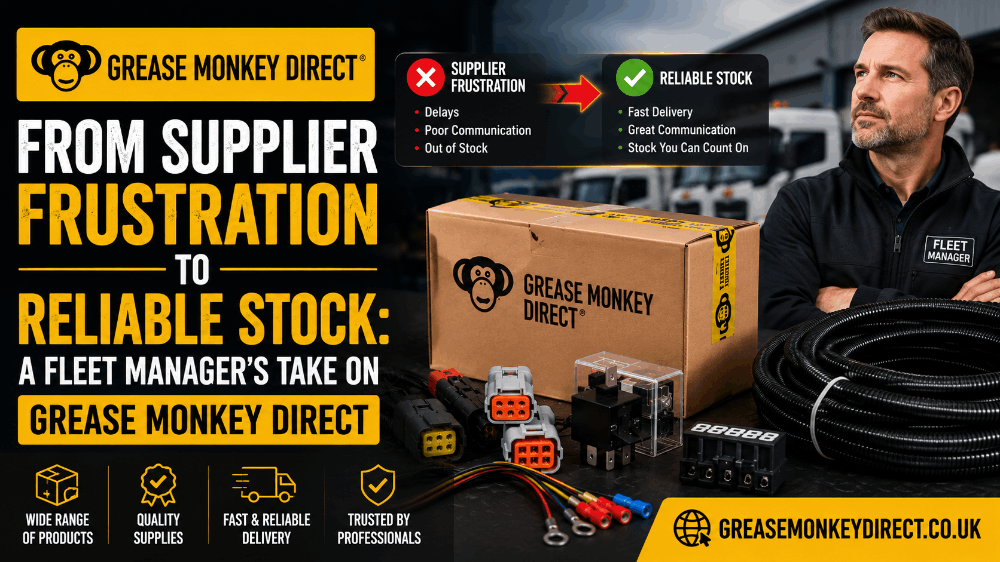
The Operational Problem We Were Trying to Fix
Before switching, our workshop was juggling two suppliers just to keep basic auto-electrical and consumable stock available. Neither could be trusted alone. One had a strong catalogue but shipped from a warehouse that consistently missed dispatch windows. The other dispatched on time but had gaps in stock on exactly the SKUs we reordered most electrical connectors, terminals, cable ties, adhesives, the everyday consumables a workshop burns through weekly.
The result was a workaround that shouldn't have been necessary: staggering orders across two accounts, padding lead times into every job estimate, and keeping a buffer stock on hand that tied up cash we'd rather have had free. None of that is sustainable when you're running a commercial operation with fixed turnaround promises to customers.
What We Actually Needed From a Supplier
Before evaluating anyone new, we set a short list of non-negotiables:
- Depth of stock — one supplier, not three, covering auto-electrical, workshop, and general garage consumables
- Dispatch consistency — daily dispatch, not "processed within 2-3 business days"
- UK-wide delivery — genuine coverage, not a mainland-England-only policy with regional surcharges hidden at checkout
- A workable free-delivery threshold — bulk ordering only makes financial sense if shipping costs don't eat the margin on every restock
- Support that understands the trade — not a generic customer service line reading from a script when we had a spec question
That's the checklist Grease Monkey Direct got measured against.
Can Fleet and Haulage Companies Order in Bulk from Grease Monkey Direct?
Yes, and this is really the central question for any commercial buyer. Grease Monkey Direct has been supplying the UK trade since 2015, and the site now carries more than 5,000 products across auto-electrical, workshop, and garage accessory categories. That range is what let us consolidate instead of splitting a restock order across two suppliers to cover different product categories, we place one order that covers nearly everything a workshop bay or fleet maintenance run needs.
For a haulage operation specifically, that consolidation isn't a convenience — it's a cost control measure. Every extra supplier account is another delivery schedule to track, another minimum order threshold to hit, another point of failure if something goes out of stock.
Does Grease Monkey Direct Supply Motorsport and Bodyshop Teams?
The customer base backs this up. Grease Monkey Direct explicitly serves mechanics, auto electricians, fleet maintenance teams, haulage companies, motorsport teams, bodyshops, farmers, and DIY enthusiasts. That's a genuinely commercial spread of buyers, not a retail-first catalogue with a few trade categories bolted on as an afterthought.
For a bodyshop, consumables depth matters in a different way than it does for a general mechanic tapes, adhesives, and finishing consumables need to be consistently in stock because a job can't move to the next stage without them. For motorsport teams working to event deadlines, the same logic applies but with even less room for delay. A supplier that can't guarantee stock on the basics isn't viable for either.
Finding Grease Monkey Direct
We came across greasemonkeydirect.co.uk while researching UK suppliers with genuinely wide product ranges rather than the usual narrow auto-electrical specialists. What stood out immediately was the combination of trading history since 2015 and the sheer catalogue size. A newer supplier with 5,000+ SKUs would be a red flag; a supplier that's built that range over a decade of UK trading is a different proposition entirely.
We placed a trial order first, deliberately kept modest, before committing to moving our recurring restock schedule over. That's standard practice for us with any new supplier no fleet operation should switch a core supply chain on a single glowing review, ours included. The trial order shipped the same day it was placed, arrived within the standard courier window, and every item matched the listed spec. That was enough to move to a full switch.
Is Grease Monkey Direct Suitable for Commercial Workshop Accounts?
Based on several months of ordering now, yes with the caveat that "suitable" for a commercial account means something specific: predictability. We don't need a supplier to be the cheapest on every single line item. We need a supplier whose stock levels, dispatch times, and delivery windows we can build a maintenance schedule around without padding in extra buffer days "just in case."
Grease Monkey Direct has held that predictability consistently across our reorders. Stock indicators on the site have matched what actually arrives. We haven't had a repeat of the backorder problem that pushed us to switch suppliers in the first place.
How Does Grease Monkey Direct Handle UK-Wide Delivery for Businesses?
Orders dispatch daily from UK warehouses, and delivery covers England, Scotland, Wales, and Northern Ireland without the regional exclusions or added surcharges we'd run into with previous suppliers. For a haulage or fleet operation with vehicles and depots spread across more than one nation, that consistency in delivery policy is not a minor detail it's the difference between one clean ordering process and having to negotiate separate terms depending on which depot is placing the order.
Free delivery applies on orders over £100, which for a bulk restock order is a threshold we clear almost every time. That changes the economics of ordering we consolidate restocks into larger, less frequent orders rather than placing small frequent orders just to avoid paying shipping twice, which also reduces the administrative overhead of processing more invoices than necessary.
There's also a scheduling benefit that doesn't show up on a spec sheet but matters day to day. Because dispatch happens daily rather than on a fixed weekly cycle, we're not forced to batch our ordering around a supplier's shipping calendar. If a job comes in that needs stock we hadn't planned for, placing the order the same morning still gets it moving that day instead of sitting in a queue until the next scheduled dispatch run. For a haulage operation where jobs don't always follow a predictable weekly rhythm, that flexibility has quietly removed one more variable we used to have to plan around.
Comparing the Before and After
It's worth being specific about what actually changed, rather than just saying "it got better." Before the switch, our average restock cycle involved placing orders with two separate suppliers, tracking two different delivery windows, and keeping roughly a week's worth of buffer stock on hand for the SKUs that were most prone to going out of stock unexpectedly. That buffer stock wasn't free it was cash sitting on a shelf instead of being available elsewhere in the business.
After moving the bulk of our ordering to Grease Monkey Direct, that buffer has shrunk considerably. We still keep a small safety margin on the handful of parts we use daily, because no responsible workshop operates with zero contingency, but it's a fraction of what we held previously. Order tracking is simpler because there's one dispatch schedule to watch instead of two. And the admin side reconciling invoices, chasing delivery confirmations, following up on partial shipments has dropped noticeably now that most of what we need comes from a single account rather than being split across suppliers with different systems and different customer portals.
Why This Matters More for Commercial Accounts Than Individual Buyers
An individual mechanic or DIY buyer placing an occasional order can absorb a slow supplier without much real cost annoying, but not business-critical. A commercial account running a fleet, a haulage operation, or a bodyshop schedule doesn't have that luxury. Every day a job is delayed waiting on a part is a day that shows up on a customer invoice as a missed deadline, or on an internal report as lost capacity. That's the lens we evaluate every supplier through now, and it's the lens worth applying if you're reading this as an operations manager rather than an individual buyer.
The Measurable Difference Since Switching
The clearest change has been in how we schedule jobs. We no longer build in a buffer for "supplier might not have it" because stock availability on the site has consistently matched what actually ships. That's let us tighten turnaround estimates for customers rather than quietly padding them to cover a supply risk that shouldn't exist in the first place.
Support has also held up under real use, not just during the initial trial order. A spec question we sent to support@greasemonkeydirect.com about a batch of electrical connectors got a same-day, specific answer — not a templated response asking us to check the product page we'd already read. For a commercial account placing recurring orders, having a support line that actually understands the products it's selling saves time that a slower, more generic support process would cost us on every query.
We haven't eliminated backorders entirely — no supplier with 5,000+ SKUs will hit 100% availability on every line, every time — but the frequency has dropped enough that it's no longer a factor we plan around by default.
Who Should Consider Grease Monkey Direct
Based on our own switch and the broader customer base the business serves, Grease Monkey Direct is worth evaluating for:
- Fleet maintenance teams needing predictable consumables stock across multiple vehicles and depots
- Haulage companies that can't afford downtime waiting on backordered parts
- Bodyshops running tight job schedules where consumables availability directly affects turnaround
- Motorsport teams working to fixed event deadlines with no room for delivery delays
- Independent workshops scaling up from occasional orders to a recurring restock relationship
If your current supplier situation looks like ours did — juggling two accounts to cover stock gaps, padding lead times into every estimate, treating buffer stock as a necessary cost rather than a choice — it's worth running the same trial-order test we did before committing to a full switch.
Staying in the Loop
Grease Monkey Direct posts stock updates and offers across Facebook, Instagram, and X/Twitter, which is worth following if you're managing a recurring order schedule and want visibility on new stock before your next restock is due. Their full current catalogue is at greasemonkeydirect.co.uk.
For the individual buyer's perspective rather than the fleet/commercial one covered here, the companion piece — My Honest Experience Ordering Auto-Electrical Supplies from Grease Monkey Direct — covers a single mechanic's order from browsing through to delivery and support.