Artificial Intelligence (AI) on healthcare

The impact of AI on healthcare is not a simple "either/or" scenario; it is a high-stakes evolution that is simultaneously doing both. While AI is already proving its ability to save lives through earlier diagnoses and reduced errors, it also carries the inherent risk of magnifying historical prejudices and creating new vulnerabilities for patient data.
The outcome depends largely on whether we implement AI as an "autonomous pilot" or a "decision-support tool" governed by strict ethical and regulatory guardrails.
1. The Promise: Improving Care and Safety
AI’s greatest strength lies in its ability to process vast amounts of data—imaging, genetic markers, and real-time vitals—far faster and more accurately than humans.
- Early Detection & Precision: AI models are now outperforming specialists in identifying early-stage cancers (especially in mammography and dermatology) and predicting life-threatening events like sepsis or cardiac arrest hours before they occur.
- Reducing "Death by Decimal": Medication errors are a leading cause of hospital injury. AI systems act as a safety net, cross-referencing prescriptions with patient history to flag potentially fatal drug interactions or dosage mistakes.
- Operational Efficiency: By automating administrative tasks (billing, scheduling, and documentation), AI can reduce physician burnout, allowing clinicians to spend more "eyes-on" time with patients.
2. The Peril: Entrenching Bias and Threatening Privacy
If not carefully monitored, AI can become a "black box" that automates and accelerates discrimination.
- Algorithmic Bias: Most medical AI is trained on historical data. If that data predominantly represents certain demographics (e.g., middle-aged white men), the AI may fail for women or people of color.
- Example: A famous 2019 study found an algorithm used on millions of patients was less likely to refer Black patients for extra care because it used "healthcare spending" as a proxy for "health needs," ignoring the fact that Black patients historically had less access to expensive care.
- The Privacy Paradox: To be effective, AI needs "Big Data." However, even "anonymized" data isn't fully safe; AI has shown it can re-identify individuals using just a few demographic data points, making traditional privacy laws like HIPAA harder to enforce. HIPAA has not been rewritten for the AI era; a proposed overhaul of its Security Rule (published January 2025) would bring AI systems that touch patient data into mandatory risk analyses and asset inventories, but it had still not been finalized at the time of this update.
- Automation Bias: There is a risk that doctors may stop questioning a machine's recommendation, leading to errors if the AI "hallucinates" or fails to account for a patient's unique social determinants of health (like lack of transportation or stable housing). This risk is now acknowledged in policy: FDA’s revised January 2026 guidance on clinical decision support software explicitly discusses automation bias and expects tools to be designed to support, rather than replace, clinician judgment.
3. The Path Forward: Balancing Innovation with Ethics
To ensure AI improves safety without sacrificing equity, the industry is moving toward several "safeguards":
Regulatory Update: Where the Rules Stand Now (October 2026)
Since this article was first written, several of the policies it points to have been delayed, loosened or replaced. The picture is less a single tough global standard and more a patchwork that differs by region and is still shifting:
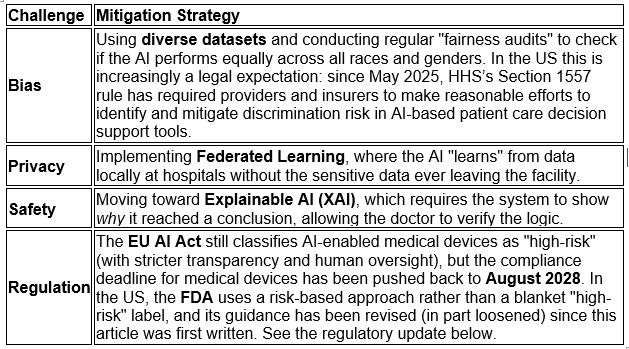
- EU AI Act – still high-risk, but later. AI-enabled medical devices remain classed as high-risk, but the Digital Omnibus on AI (Regulation (EU) 2026/1744, in force since 27 July 2026) moved the deadline for AI embedded in regulated products, including medical devices, from 2 August 2027 to 2 August 2028. Stand-alone high-risk systems moved from August 2026 to 2 December 2027. Transparency duties for AI that interacts with people (Article 50) were not delayed, and existing medical device rules (MDR/IVDR) continue to apply in the meantime.
- FDA – lighter touch on decision support, clearer lifecycle rules. FDA finalized guidance in December 2024 on predetermined change control plans, which lets manufacturers pre-authorize planned updates to AI-enabled device software, and a January 2025 draft guidance sets out lifecycle expectations. In January 2026 FDA revised its clinical decision support guidance: software that offers a single clinically appropriate recommendation can now fall outside FDA regulation if a clinician can independently review the basis for it, while tools that analyze medical images remain regulated. Critics note the guidance says little about large language models and consumer-facing health chatbots.
- Anti-discrimination rules for AI tools are in force. Since 1 May 2025, HHS’s Section 1557 rule has required covered providers and insurers to make reasonable efforts to identify patient care decision support tools that use race, color, national origin, sex, age or disability as inputs, and to mitigate the risk of discrimination. This moves "fairness audits" from good practice toward legal expectation, although enforcement priorities under the current administration remain uncertain.
- US transparency requirements may be rolled back. Under the HTI-1 rule, developers of certified EHR software have had to disclose "model card"-style source attributes for predictive decision support tools since 2025. A proposed rule (HTI-5, December 2025) would remove those requirements, citing a lack of evidence that they improved care. Industry groups and at least one state attorney general have pushed back, and the rule had not been finalized at the time of this update.
- HIPAA – not yet updated for AI. The proposed Security Rule overhaul has met strong resistance from hospital and provider groups over its cost, the original spring 2026 target passed without a final rule, and some industry reports now point to 2027. Until then, the existing HIPAA rules, including its de-identification standards, remain the law, which leaves the re-identification risk described above largely unaddressed.
- States are filling the gap. California (AB 489, from January 2026) bars AI from implying it holds a healthcare license, and its SB 1120 requires a physician to make the final medical-necessity decision when insurers use AI in utilization review. Texas requires providers to disclose AI use to patients and bars AI from being the sole basis for an adverse utilization review decision (SB 815). Illinois (HB 1806, August 2025) prohibits AI from providing therapy. These laws reinforce the "human-in-the-loop" principle.
- Federal preemption is the wild card. A December 2025 executive order (EO 14365) directs the Justice Department to challenge state AI laws seen as overly burdensome, and the White House has urged Congress to preempt them. As of the latest reports no federal statute does so, so state laws remain enforceable, but their long-term footing is uncertain.
The net effect: human oversight, fairness testing and transparency, the principles this article argues for, are increasingly expected in law, but the binding rules differ by jurisdiction and are still moving. Organizations should verify current requirements for their own region before relying on any single framework. This summary is not legal advice.
AI will likely improve care and safety for the majority, but without active intervention, it risks leaving marginalized groups further behind. It is a powerful tool that requires a "human-in-the-loop" to ensure that the speed of technology never outpaces the requirement for empathy and equity.
There’s an active global movement to use AI to solve the very problems it creates. While the initial wave of AI in healthcare raised alarms about bias and privacy, a second wave of "Protective AI" technologies is emerging to counteract these risks.
The transition from AI being a threat to AI being a solution is happening through three specific technological shifts:
1. Improving Care & Safety: From "Static" to "Real-Time" Protection
Instead of just diagnosing a disease, new AI systems act as real-time safety buffers.
- Predictive Safety Nets: Systems now monitor electronic health records (EHRs) to flag early signs of sepsis or internal bleeding hours before a human doctor would notice symptoms.
- Automated Compliance: AI is being used to monitor hospital workflows, ensuring that safety protocols (like hand-washing or correct medication dosages) are followed, drastically reducing "human factor" errors.
2. Overcoming Bias: From "Inherited Prejudices" to "Fairness-Aware" Models
Engineers are moving away from simply feeding AI "historical data" and instead using technical interventions to force equity:
- Synthetic Data Generation: If a dataset lacks enough data on a specific minority group, AI can create "synthetic patients" to fill the gap, ensuring the final model is trained on a balanced population.
- Fairness Regularization: Developers now add "fairness constraints" into the math of the algorithm itself. This penalizes the AI if its accuracy varies significantly between different racial or gender groups.
- Bias Auditing: Tools like "Model Cards" act like nutrition labels for AI, documenting exactly which demographics the AI was tested on so doctors know when a tool might be less reliable for a specific patient. A caution on the policy side: in the US, the HTI-1 rule has required developers of certified EHR software to supply this kind of "source attribute" information for predictive tools since 2025, but a proposed rule (HTI-5) would remove that requirement, so model cards could become a voluntary best practice rather than a mandate.
3. Protecting Privacy: From "Data Hoarding" to "Privacy-Preserving" Tech
The "Data Dilemma"—needing patient data to learn but needing to keep it secret—is being solved by technologies that allow AI to learn without ever seeing the raw files:
- Federated Learning: Instead of hospitals sending patient data to a central server (a major privacy risk), the AI model travels to the hospital, learns locally on their servers, and then only sends back "knowledge updates" (mathematical weights), never the actual patient records.
- Differential Privacy: This technique adds "mathematical noise" to a dataset. It makes it impossible for the AI (or a hacker) to re-identify an individual patient, while still allowing the system to learn broad medical trends.
4. Innovation vs. Ethics: The "Human-in-the-Loop" Framework
To balance the rush of innovation with ethical safety, the medical community is adopting the "Decision Support" model rather than "Autonomous AI":
- Explainable AI (XAI): Regulators are pushing for AI that can "explain its work." The EU AI Act’s transparency and human-oversight requirements will apply to AI-enabled medical devices from August 2028 (delayed from 2027), and in the US, FDA’s 2026 guidance makes non-device status for decision support software depend on clinicians being able to independently review the basis of a recommendation. If an AI flags a patient for high risk, it should highlight exactly which biomarkers (e.g., blood pressure, age, white blood cell count) led to that decision.
- AI Safety Committees: Many hospitals are establishing multidisciplinary boards—including ethicists, patients, and doctors—to review every AI tool before it is deployed, shifting the burden of ethics from the "algorithm" to the "institution." This is also becoming a compliance matter: Section 1557 expects covered entities to identify the decision support tools they use, and several states, including Texas and California, now require disclosure to patients when AI is involved in their care.
Can AI Fix Itself?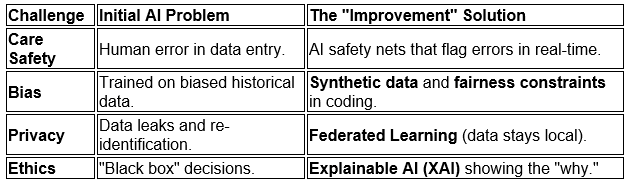
This is general information, not medical or legal advice. Regulation here is changing monthly; check current sources before relying on any date above.