Autonomous Weapons Are a Global Threat to Civilians and Require International Cooperation

That evolution should concern technology professionals, regulators, policymakers, and citizens everywhere.
Recent reporting by The New York Times documented a particularly disturbing development. In July 2026, a Russian drone struck a gas station in Zaporizhzhia, killing three Ukrainian civilians, including a 19-year-old student. According to Ukrainian investigators and experts who examined the wreckage, the drone contained an Nvidia Jetson Orin computer chip and was guided by an onboard AI system. Human operators programmed the drone to travel toward the area, but the AI reportedly selected the specific object to attack without a human making the final targeting decision. The Nvidia chip was not designed specifically as a weapon or for military use, but it excels at computer vision, machine learning, and running artificial intelligence tasks in low-power devices. Such supply-chain components can be repurposed in ways that manufacturers did not anticipate, to become an autonomous weapons system.
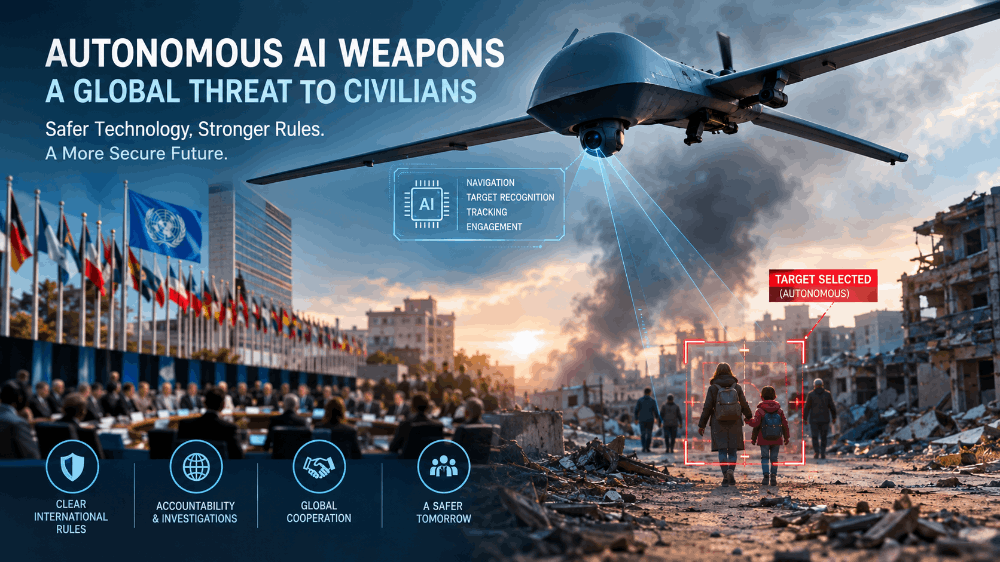
These emerging autonomous platforms are an evolution from earlier AI-assisted weapons. The system was able to operate without components for remote piloting and represents a shift toward weapons that strike independently. Software is being granted greater control over the kill-chain, including navigation, target recognition, tracking, and terminal engagement.
Autonomous weapon systems, from both Ukraine and Russia, are currently in use. Militaries across the globe are developing, testing, and beginning to deploy such AI enhanced weapons.
The danger is not simply that an autonomous weapon might make a mistake. The more profound danger is that governments could intentionally use autonomous systems to operate against non-combatant civilian populations.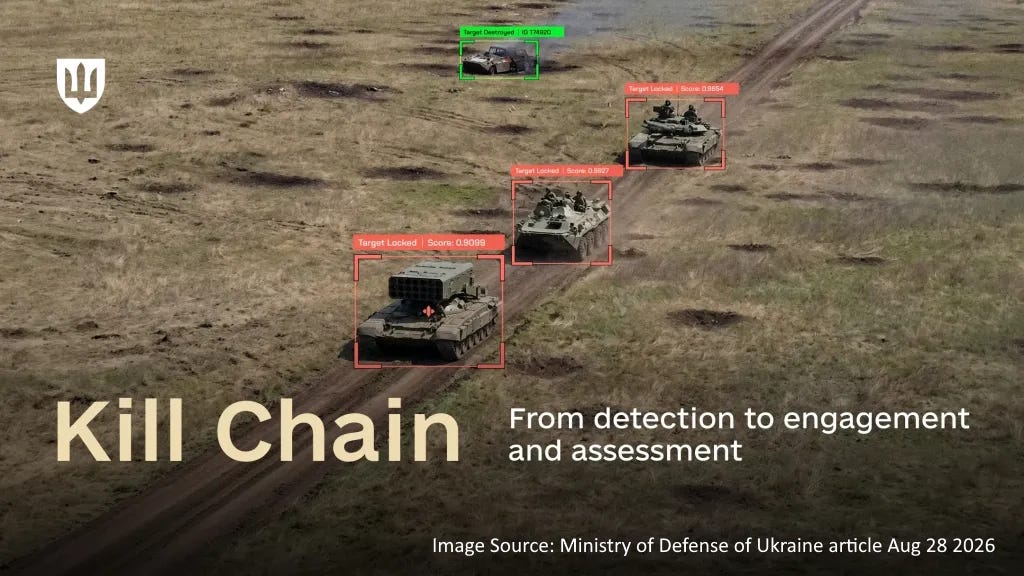 The incident demonstrates the potential global risks posed by autonomous weapons and the need for more specific international rules governing their use.
Autonomous weapons are not necessarily an unlawful or unethical use of AI. They will almost certainly be part of the future of warfare, as responsible governments will use them to reduce risks to military personnel, defend airspace and critical infrastructures, intercept threats, and engage with increased precision legitimate military targets.
That future should not be rejected. But like conventional weapons, autonomous systems must be directed only against combatants and military support infrastructures. They should be constrained to legitimate military objectives and must never be intentionally used to target civilians or other persons protected under international humanitarian law.
The international community is already debating these issues. The United Nations has been examining lethal autonomous weapons for years, and officials from the International Committee of the Red Cross have called for stronger rules. International humanitarian law already prohibits intentionally targeting civilians, but existing rules do not provide sufficiently specific, shared standards for weapons that independently select and engage targets.
There are no clear rules that govern accountability within the grey areas of intelligent weapon autonomy, nor the uncontrolled escalation of the underlying AI technologies that could be purposely employed to directly target civilians.
International policymakers must seize the opportunity to establish clear, enforceable agreements that outline acceptable standards, authority for post-incident investigations, and a clear red line for acceptable use of autonomous AI weapons, with a prohibition against targeting non-combatants, before civilian deaths become normalized.
A broadly supported unified global policy won’t in and of itself stop unethical nations from using AI weapons against civilians, but it will create the framework necessary for the international community to hold accountable those nations and to provoke a powerful coordinated response from an international coalition.
Rules could establish common definitions, well-defined expectations, incident reporting processes, forensic investigation capabilities, and mechanisms for determining whether an autonomous weapon was intentionally or negligently used against civilians. Such a framework would give governments greater confidence and speed when responding with cooperative political, diplomatic, economic, and military actions that result in compelling deterrence or remediation through coordinated sanctions, export restrictions, cessation of critical technology supply chains, and joint development of military countermeasures.
AI will transform warfare. That inevitability is already in motion. We should not wait for autonomous weapons to become commonplace in attacks against non-combatants before establishing risk managing boundaries.
International agreements are not an obstacle to technological progress. They are an essential mechanism for making technological progress safer before they spiral out of control with cataclysmic outcomes.
The International AI Safety Committee (ICAS), under the Global Council for Responsible AI (GCRAI), is working to define global safety boundaries for artificial intelligence. This group has defined red-line boundaries that the international community should establish agreements for global AI safety boundaries, including the existential risk of autonomous AI weapons that target non-combatants.
The global community needs clear international agreements that define acceptable and prohibited autonomous AI use cases to protect non-combatants, establish meaningful accountability, enable independent investigation of incidents, and oversight that paves the way for international responses when those boundaries are deliberately crossed.
The world must intentionally choose governed autonomy over uncontrolled escalation. International policymakers must act now.