Builder.ai -a billion $ counterfeited AI

How Builder.ai Built a Unicorn out of Paper and Fooled Silicon Valley
It was supposed to be a breakthrough on par with the democratization of software development - a technology that would allow small business owners to build apps "as easily as ordering a pizza." Instead, the world witnessed one of the most brazen mystifications in the history of the modern tech sector. The story of Builder.ai's collapse is a tale of how marketing, fake invoices, and an army of 700 hidden programmers in India conjured a valuation reaching $1.5 billion. Discover the inner workings of Operation "Wizard of Oz," which deceived Microsoft and Qatar’s sovereign wealth fund.
The Gospel According to Sachin Duggal: "An App Like a Pizza"
The core Unique Selling Proposition (USP) became Natasha - a supposedly revolutionary, autonomous assistant powered by artificial intelligence. In marketing materials, Natasha was presented as a digital genius: she could recognize a client's business intent, map out the system architecture, create user stories, and ultimately generate clean, error-free code ready for server deployment.
For Venture Capital funds caught up in the frenzy of finding the next big breakthrough in automation, this vision sounded like a license to print money. As a result, capital began flowing rapidly:
- 2018 (Series A): $29.5 million from Lakestar, Jungle Ventures, and Deepcore.
- May 2023 (Series D): The absolute crowning achievement of the project - a round totaling $250 million. Investors joining the table included the sovereign wealth fund Qatar Investment Authority (QIA) and tech giant Microsoft.
The partnership with Microsoft was not just an injection of cash; it was a stamp of credibility. Natasha was to be integrated into the Microsoft Teams suite, and the entire infrastructure was to be migrated to the Azure cloud. Builder.ai's valuation soared to $1.5 billion. Duggal became a star at tech conferences worldwide.
Project "AGI," or the Inside Joke Behind Closed Doors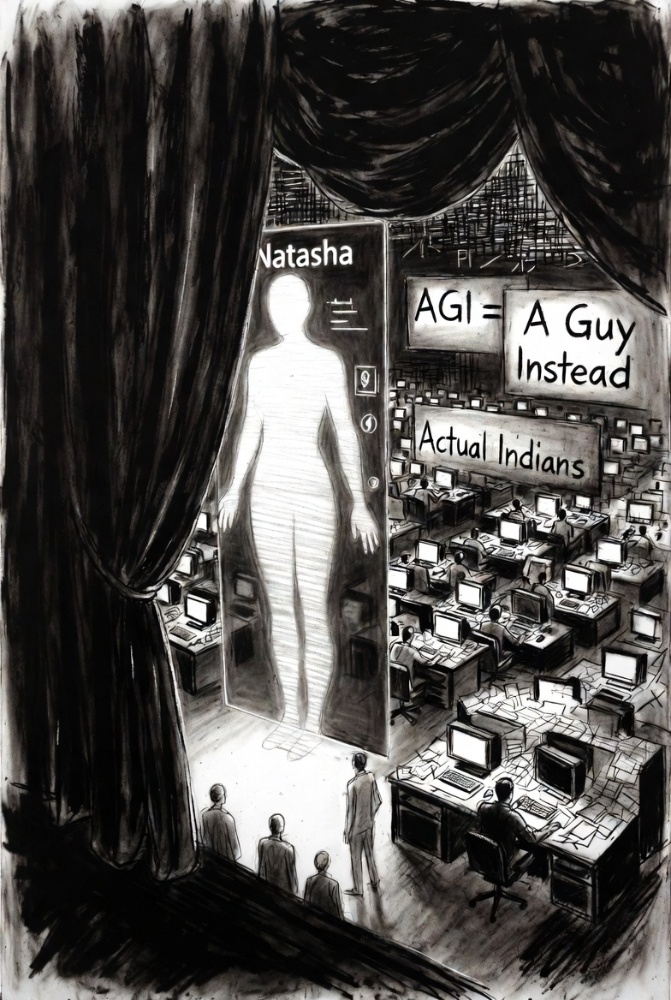
The reason for this dark humor? The powerful assistant Natasha was, in reality, nothing more than a facade. Behind this curtain lay a massive code factory in India, employing over 700 software engineers.
[Client in USA/Europe]
│
▼ (Converses with "AI Assistant" Natasha)
┌─────────────────────────────────────────┐
│ BUILDER.AI INTERFACE (Mystification)│
└─────────────────────────────────────────┘
│
▼ (Manual transcription of chats & tasks)
┌─────────────────────────────────────────┐
│ 700 PROGRAMMERS IN INDIA (Manual Labor)│
└─────────────────────────────────────────┘
When a client clicked through options on the dashboard, convinced that advanced machine learning algorithms were designing their business application, live human beings in India were simultaneously transcribing chat logs, manually routing tickets to the appropriate departments, and writing boilerplate code line by line.
The company did have a dedicated, roughly 30-person team of actual AI engineers trying to connect the platform with models like GPT or Claude, but their work was constantly pushed to the sidelines. They served as a technological alibi, while the primary production engine remained cheap human labor.
To validate the myth of being a powerful technological ecosystem to auditors, the company squandered millions of dollars developing its own internal tools - such as the video conferencing platform Builder Meet and the task management system Builder Tracker. Hundreds of better, free, or commercial alternatives existed on the market (such as Slack, Zoom, or Jira), but building them in-house was designed to distract from the fact that the company's core engine was a sham.
The Invoice Carousel: How to Conjure a 300% Growth Rate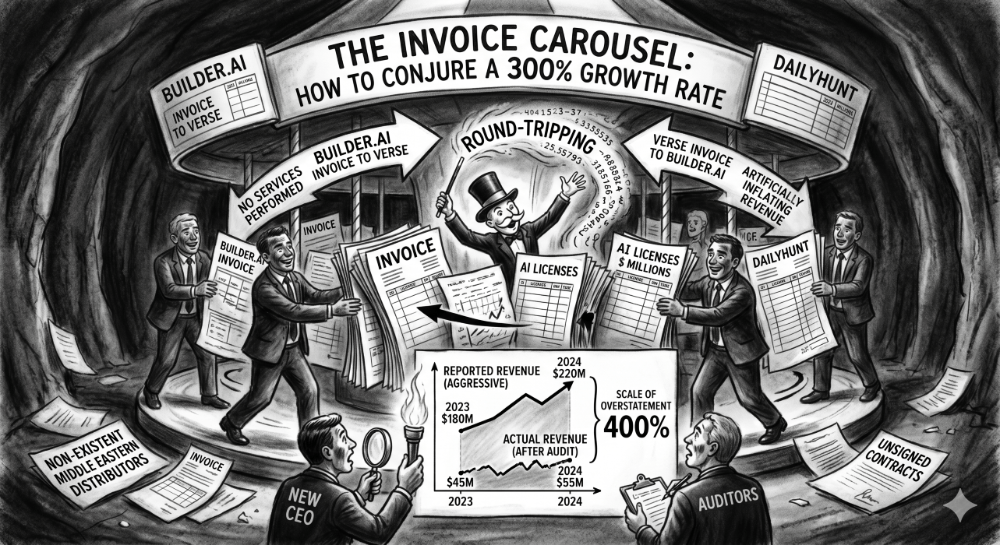
Between 2021 and 2024, Builder.ai established a peculiar relationship with an Indian entity called Verse Innovation (the parent company behind the popular Dailyhunt news app and the Josh video platform). Both companies engaged in a practice known in forensic finance as round-tripping. The mechanism was strikingly simple:
- Builder.ai would issue an invoice to Verse for millions of dollars for "AI licenses" or "software development services."
- Simultaneously, Verse would issue an invoice to Builder.ai for an almost identical amount for other, equally enigmatic digital services.
In this manner, approximately $60 million was "churned" between the two entities. In reality, no services were ever performed, and no technology ever changed hands. These transactions served a single purpose—artificially inflating revenue figures in Excel spreadsheets to show investors a supposedly dynamic growth in sales.
The bubble burst in early 2025 when, following Duggal's resignation, a new CEO, Manpreet Ratia, took the helm. As an experienced manager, he immediately ordered an independent, internal audit of the accounting books. The results of the audit shocked even the board of directors: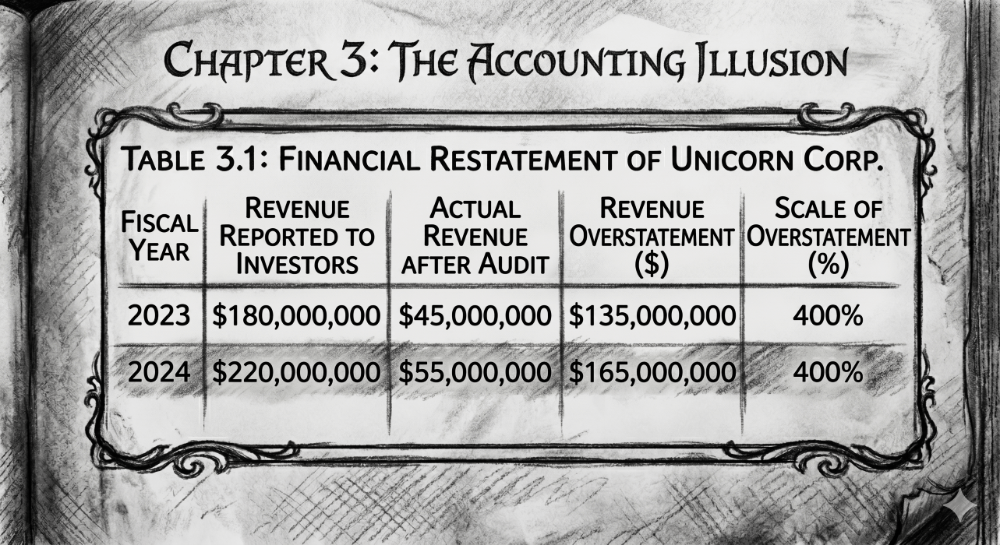
A Shadow Over the Past and the Blindness of Due Diligence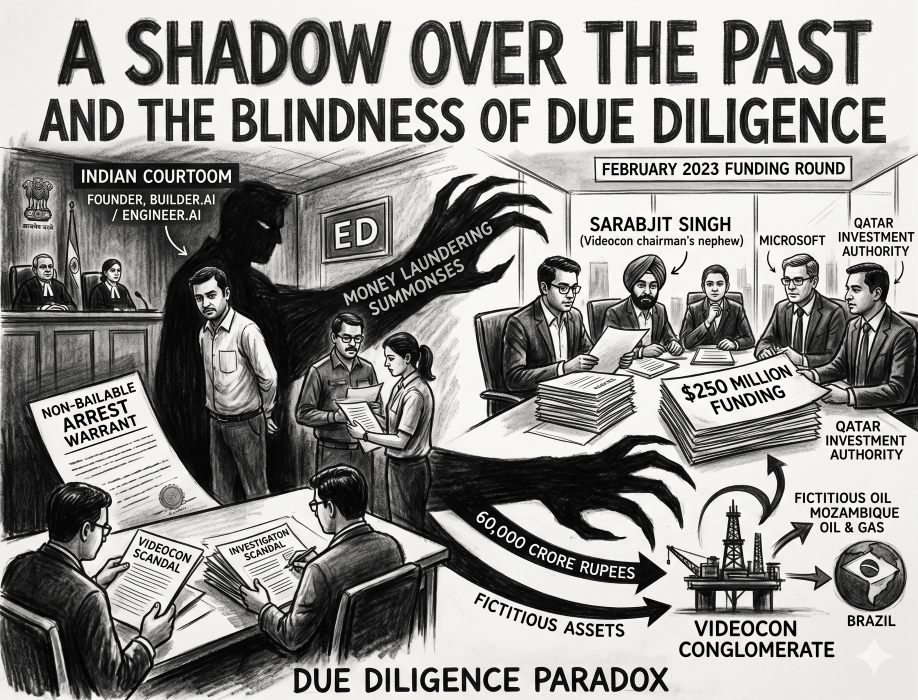
India’s Enforcement Directorate (ED), the agency responsible for investigating financial crimes, was conducting a massive probe against the Videocon conglomerate regarding the laundering of a staggering 60,000 crore rupees (billions of dollars) through fictitious oil and gas assets in countries like Mozambique and Brazil. Investigators demonstrated that Videocon had engaged in suspicious financial transfers with entities controlled by Duggal - including Engineer.ai (the direct predecessor to Builder.ai).
Duggal repeatedly ignored summonses for questioning, which ultimately led an Indian court to issue an official, non-bailable arrest warrant against him in February 2023.
The Due Diligence Paradox: In the exact same month that the Indian justice system was pursuing Duggal with an arrest warrant for money laundering, the legal departments of Microsoft and the Qatar Investment Authority were finalizing a $250 million funding round, noticing absolutely nothing suspicious in the startup's ownership structure. Furthermore, from 2018 to 2022, Sarabjit Singh - the nephew of the chairman of the collapsed and corruption-accused Videocon conglomerate - sat on Builder.ai's board of directors.
The Day the Lights Went Out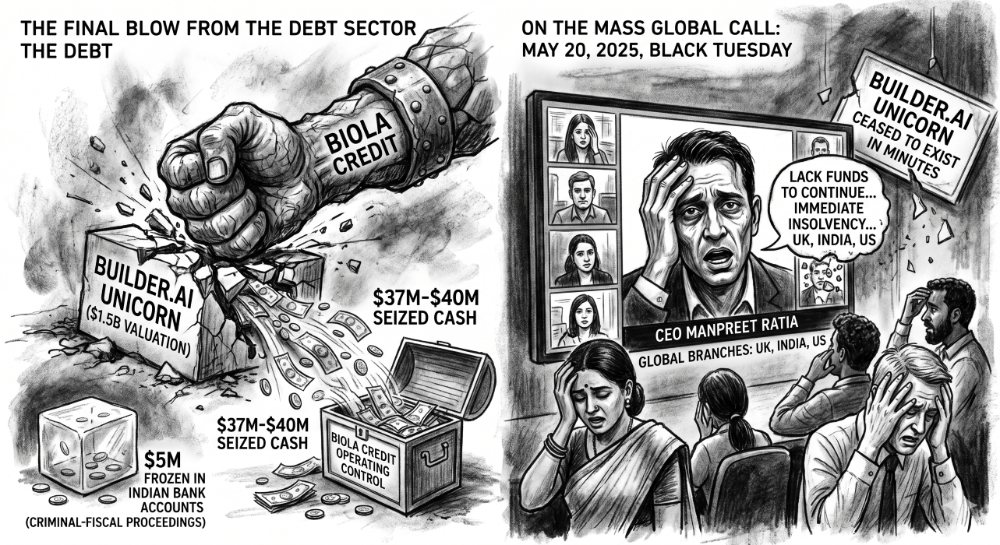
In May 2025, the fund declared a technical default and exercised its control over the company's operating accounts. In a single day, Biola Credit seized between $37 million and $40 million in cash from Builder.ai's accounts. The company was left with a meager $5 million, which was additionally frozen in Indian bank accounts due to ongoing criminal-fiscal proceedings there.
May 20, 2025, will go down in history as a black Tuesday for the company's workforce. CEO Manpreet Ratia logged onto a mass global call with all branches worldwide and announced with a trembling voice that the company lacked the funds to continue operations, and that the board had decided to immediately launch insolvency proceedings in the UK, India, and the US. The unicorn valued at $1.5 billion ceased to exist in a matter of minutes.
The Aftermath and the SDNY Hunt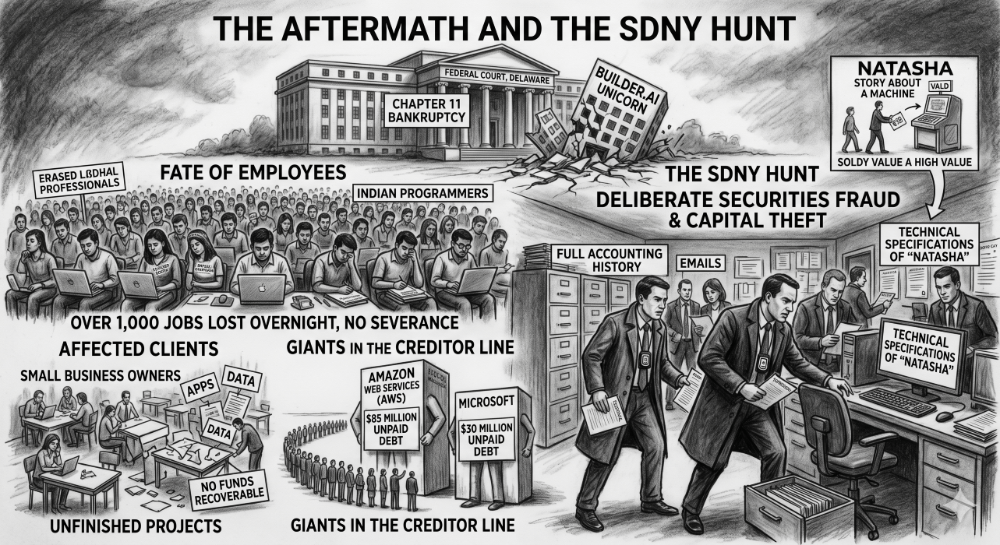
- The Fate of Employees: Over 1,000 people lost their jobs overnight without severance pay. The most tragic aspect was the fate of the 700 Indian programmers—people who performed hard, honest engineering work, but whose professional identity and contributions were erased by management because a "story about a machine" fetched a higher valuation from Western capital.
- The Affected Clients: Thousands of small businesses and entrepreneurs who paid advances for the construction of their apps were left with unfinished projects, severed access to data, and no chance of recovering their funds through bankruptcy proceedings.
- Giants in the Creditor Line: The largest unsecured creditors of the fallen unicorn turned out to be the very companies that had promoted it. Builder.ai left behind an $85 million debt to Amazon Web Services (AWS) for unpaid server fees and a $30 million debt to Microsoft.
However, the troubles for the company's leadership do not end there. Weeks before the bankruptcy announcement, the U.S. Attorney's Office for the Southern District of New York (SDNY) - one of the most relentless investigative institutions in the United States - intervened. Prosecutors issued official subpoenas, demanding the surrender of the full accounting history, emails, and full technical specifications of "Natasha." The investigation aims to prove whether there was deliberate and organized securities fraud and capital theft from American institutional entities.
A Memento for the AI Era: The End of Impunity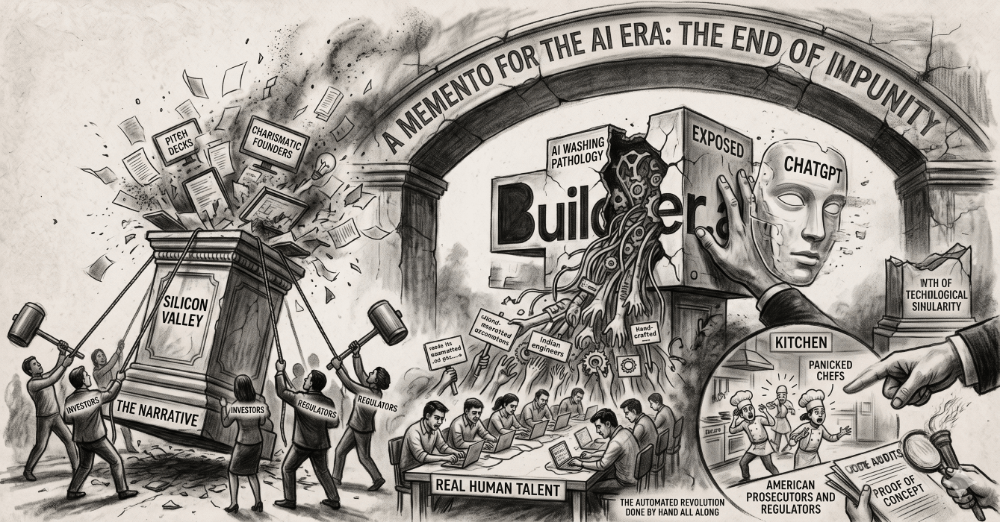
For years, Silicon Valley rewarded the narrative rather than actual technological achievements. This led to a pathology known as AI washing - the practice of drastically exaggerating or outright fabricating the presence of artificial intelligence algorithms in offered products. The case of Builder.ai brutally exposed this mechanism.
Today, under the influence of actions by American prosecutors and regulators, the era of uncritically accepting pitch decks is coming to an end. Investors are beginning to demand hard technological proof (proof of concept) and code audits rather than taking charismatic founders at their word. The tragedy of this story, however, lies in the fact that the real, human talent of hundreds of engineers from India was sacrificed on the altar of chasing the myth of technological singularity. It turned out that the automated revolution was done by hand all along - the chefs were just panicked that you would find out who was actually cooking in the kitchen.
Resources:
https://www.youtube.com/watch?v=yMu1uS2dMAw
https://medium.com/@thomas_78526/builder-ai-was-a-scam-d1f8fdd16c3f
https://www.seglerconsulting.com/builderai-anatomy-of-a-half-a-billion-dollar-deception
https://restofworld.org/2025/builderai-ai-apps-downfall/
https://www.youtube.com/watch?v=a-FocuBxln0