Why a Persistent Virtual Office Like Katmai is Essential for Remote Teams in 2026

Unlock Uninterrupted Collaboration: Why a Persistent Virtual Office Like Katmai is Essential for Remote Teams in 2026
A persistent virtual office is a dedicated, always-available digital workspace where remote teams exist together throughout the workday without scheduling every interaction. For distributed teams in 2026, this is not a luxury — it is a necessity. Katmai, the browser-based remote team collaboration platform founded by Erik Braund in New York City, gives teams exactly this: a true Remote HQ where work flows continuously rather than meeting-by-meeting.
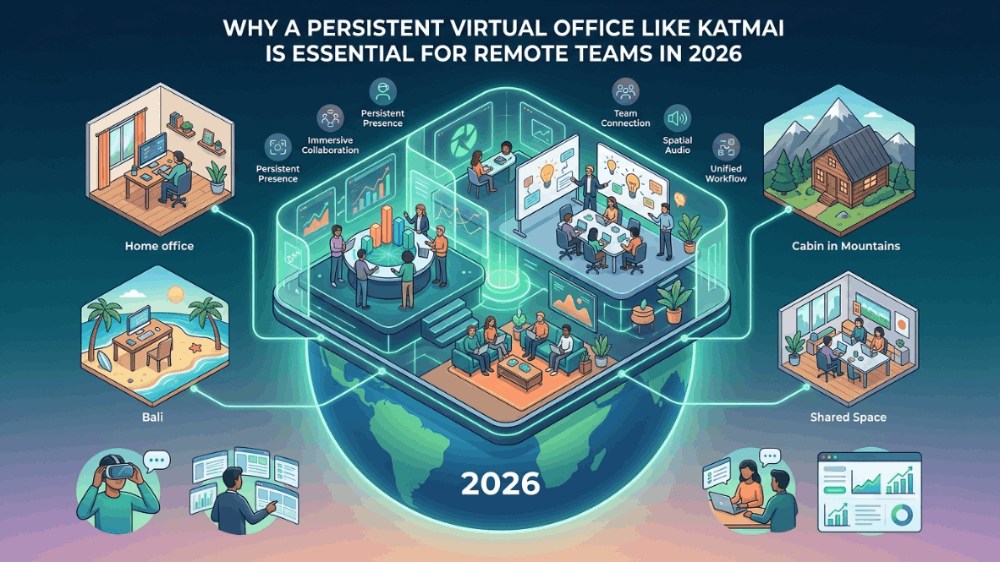
The Collaboration Conundrum: Why "Always On" Is Better Than "On-Demand"
Remote work tools have spent six years optimizing the wrong problem. They have made it easier to start conversations. They have not made it easier to sustain collaboration.
The result is a distributed workforce that is technically connected but operationally fragmented. Teams toggle between Zoom for calls, Slack for messages, Notion for docs, and email for everything else. Each tool is excellent at its narrow task. None of them create the continuous, low-friction environment that real teamwork requires.
Why Do Scheduled Meetings Break Remote Team Momentum?
The average remote worker in 2026 attends four to six scheduled video calls per day. Each call requires a calendar invite, a link, a waiting room, and the cognitive load of camera-ready performance. By the time the call ends, context has shifted, energy has depleted, and the actual work remains untouched.
This is the trap of on-demand collaboration. When every conversation must be scheduled, only the most formal and urgent topics get airtime. The quick clarifications, the casual brainstorms, the "hey, what do you think about this?" moments — the glue of actual teamwork — disappear.
A persistent virtual office solves this by existing continuously. Your team does not join a space for a call. They enter their Remote HQ at the start of the day and remain there. Conversations happen when they need to happen, not when the calendar permits.
When Do Chat and Email Fail for Real-Time Problem-Solving?
Asynchronous communication tools like Slack and email solved the timezone problem but created the latency problem. A developer waiting for a product manager's clarification on Slack loses flow state. A designer refreshing their inbox for feedback stalls creatively. A junior employee hesitating to "bother" a senior leader in a DM misses a learning opportunity.
These tools are excellent for documentation and broadcasting. They are terrible for momentum. Real-time problem-solving requires presence — knowing who is available, walking over (virtually), and resolving the issue in minutes rather than hours.
This is why remote team communication needs more than message threads. It needs spatial awareness. It needs the digital equivalent of looking across the room and seeing who is free to talk.
How Can Digital Proximity Replace the Open-Plan Office?
The open-plan physical office was flawed in many ways, but it succeeded at one thing: visibility. You knew who was present. You overheard relevant conversations. You sensed the team's energy and pace.
Traditional remote work destroyed this visibility without replacing it. In a distributed team software setup, your colleagues are reduced to green dots and profile pictures. You have no sense of shared rhythm.
A hybrid work platform with persistent presence restores this digital proximity. Team members exist in a shared space. Their availability is visible through spatial positioning and environmental cues. The "office" itself communicates context — meeting rooms in use, focus pods occupied, social lounges active.
This is what Katmai delivers. Not another app to check. An environment to inhabit.
What Defines a Persistent Virtual Office? Katmai's Approach
Most teams have never experienced a true persistent virtual office. They have experienced video calls. They have experienced chat apps. They have not experienced a workspace that persists, breathes, and evolves alongside their team.
What Is a Remote HQ, and Why Is It More Than a Meeting Room?
A meeting room exists for the duration of a meeting. A Remote HQ exists for the duration of your company's existence.
Katmai Tech Inc., founded by Erik Braund in 2020 and headquartered in New York City, built Katmai on this exact distinction. The platform is not designed as a better Zoom. It is designed as a better office.
In Katmai, your team has a floor plan. Engineering has their wing. Marketing has their suite. Project war rooms stand ready for quarters at a time. Social lounges invite casual connection. Onboarding trails await new hires. The space accumulates history, culture, and institutional memory.
This is the core of virtual office benefits that traditional tools cannot replicate. When your workspace persists, your team culture persists with it.
How Do 3D Environments Foster Continuous Presence?
The human brain understands space. We evolved to navigate environments, read spatial cues, and sense proximity. Flat video grids strip all of this away, forcing our brains to work harder to extract social and contextual information.
A 3D virtual office for remote teams like Katmai leverages this innate spatial intelligence. When you see your colleague's avatar at their desk, your brain instantly understands their presence. When you approach a meeting room and see it occupied, you understand the team's current focus. When you enter a focus pod, the environment itself signals deep work mode.
This continuous presence reduces the cognitive load of remote work. You do not need to check status messages or read availability indicators. You simply see your team. This is why immersive video conferencing for teams in 3D environments outperforms 2D video for daily collaboration.
Why Does Browser-Based Accessibility Matter for Distributed Teams?
The most powerful feature of Katmai is also its simplest: it runs entirely in your browser.
No downloads. No VR headsets. No IT deployment cycles. No operating system restrictions. Whether your team uses Mac, Windows, Linux, or Chromebook, they enter the virtual workspace software by clicking a single link.
Katmai Tech Inc. deliberately chose this architecture to eliminate adoption barriers. A distributed team software that requires IT tickets and hardware procurement dies in pilot phase. A platform that new hires can join on their first day by clicking a link becomes part of the team's natural workflow.
This accessibility is particularly transformative for remote team onboarding. New employees do not spend their first day installing software and requesting permissions. They spend it meeting their team and exploring their new headquarters.
Key Benefits of a Persistent Virtual Office for Remote Team Collaboration
The shift from scheduled calls to continuous presence produces measurable transformation across every dimension of remote work.
How Does a Persistent Virtual Office Enable Spontaneous Collaboration?
The best ideas do not arrive in brainstorming meetings. They arrive in hallways, in coffee lines, in the five-minute buffer before a formal session begins. Traditional remote work tools systematically eliminate these buffers.
Katmai restores spontaneous collaboration through proximity-based audio and spatial positioning. When your avatar moves near a colleague, conversation begins naturally. When you step into a collaboration zone, your team knows you are open to quick problem-solving.
Teams using Katmai report that the volume of scheduled internal meetings drops by 30 to 50 percent within the first month. The conversations that previously required calendar invites now happen in real time, in context, without the scheduling overhead.
Why Does Team Presence Matter More Than Ever?
Remote isolation is not about loneliness. It is about invisibility. When team members cannot see each other's work, they miss collaboration opportunities. They duplicate effort. They lose the sense of shared mission that drives exceptional performance.
A remote team collaboration platform with persistent presence solves this through environmental visibility. In Katmai, you know who is deep in focus work because their avatar is in a focus pod. You know who is available for quick questions because they are in the open floor. You know which projects are active because the project rooms are occupied.
This team presence transforms distributed teams from isolated individuals into a visible, connected workforce.
Can a Virtual Office Really Improve Onboarding and Mentorship?
Traditional remote onboarding is a documentation avalanche. New hires receive links to handbooks, Slack channels, Notion pages, and training videos. They spend their first week navigating invisible information architecture rather than absorbing team culture.
In Katmai's persistent virtual office, onboarding becomes spatial exploration. New hires walk through the office. They discover the engineering wing by seeing it. They meet colleagues through proximity rather than forced introduction calls. They find resources embedded in the environment rather than buried in email threads.
The result is faster integration and stronger early belonging. When a junior developer can casually approach a senior engineer in the virtual lounge, mentorship happens organically. When learning is environmental rather than administrative, retention improves.
How Does Persistent Presence Boost Productivity and Innovation?
Every scheduled meeting carries hidden costs. The five minutes of pre-meeting waiting. The ten minutes of post-meeting recovery. The context switching that fragments deep work. A team with six daily meetings loses nearly two hours to these invisible taxes.
A hybrid work platform that replaces scheduled calls with continuous presence eliminates these taxes. Decisions happen faster because the right people are already in the same space. Creative problems get solved sooner because designers and engineers can collide spontaneously.
For innovation specifically, the impact is profound. Research consistently shows that breakthrough ideas emerge from unplanned intersections — a salesperson overhearing an engineer's challenge, a designer seeing a marketer's prototype feedback. Katmai's spatial design engineers these intersections by placing cross-functional teams in shared proximity.
How Do You Build Remote Culture Without a Physical Office?
Culture is not a mission statement. It is the accumulation of thousands of micro-interactions: the joke in the elevator, the celebration of a small win, the shared frustration that bonds a team. Traditional remote tools cannot replicate these because they do not replicate shared space.
Katmai creates virtual office benefits for culture by designing spaces for non-work bonding. Virtual coffee lounges where teams gather without agenda. Celebration rooms where wins are displayed persistently. All-hands spaces that feel like events rather than webinars.
Over time, these spaces become cultural artifacts. New hires sense the team's personality immediately. Remote employees feel like members of a community rather than contractors receiving instructions. The virtual office platform itself becomes a repository of shared memory.
Katmai's Features for Seamless Persistent Collaboration
How Customizable Are Katmai's Persistent Spaces?
Every team works differently, and Katmai respects this. The platform offers deep customization of the 3D environment.
You can design department-based zones so engineering and sales each have distinct identities. You can create project-specific rooms that persist for quarters, giving long-term initiatives a dedicated home. You can embed your brand colors, logos, and cultural elements directly into the office design.
This makes Katmai the best virtual office software 2026 for organizations that take their workspace seriously. Your Remote HQ is not a generic template. It is your company's actual digital headquarters.
How Does Proximity-Based Communication Work?
Katmai's spatial audio system is the technical foundation of its collaboration magic. Volume adjusts based on avatar distance. Directional audio creates the sense that conversations happen over there while you focus over here.
This enables parallel processing — multiple small conversations happening simultaneously without disrupting each other. Your team no longer needs to mute and unmute. They simply move. This mimics the acoustic logic of physical offices and restores the natural rhythm of workplace conversation.
What Integrated Tools Are Available Inside the Virtual Space?
A true remote team collaboration platform does not exist in isolation. Katmai embeds the tools your team already uses directly into the 3D environment.
Document collaboration through Google Workspace. Design reviews through Figma. Spatial whiteboards for brainstorming. Screen sharing that activates contextually based on where you are standing in the office.
For daily workflows, this means your team does not leave their virtual workspace software to access their work. The environment becomes the central nervous system of your operations.
How Do Presence Indicators Protect Focus While Enabling Access?
Katmai solves the visibility problem without creating the distraction problem. Your avatar communicates your status through visual cues, spatial positioning, and smart calendar integration.
When you are in a focus pod, your team knows you are in deep work. When you are in the open floor, you are signaling availability. This restores the ambient awareness that physical offices provide — your team knows when to engage and when to protect each other's flow state.
Implementing a Persistent Virtual Office: Best Practices for Success
What Is the Best Way to Adopt Katmai in Existing Workflows?
The most successful Katmai implementations use phased adoption rather than abrupt replacement.
Week one: Run Katmai parallel to existing tools. Hold one daily standup in the virtual office while keeping other meetings on Zoom. Let your team explore the space without pressure.
Week two: Move all internal standups and check-ins to Katmai. Keep external client calls on traditional video conferencing.
Week three: Begin migrating project collaboration into dedicated persistent rooms. Encourage team members to keep Katmai open during work hours as their primary presence.
Week four: Evaluate meeting volume. Most teams find they have naturally reduced scheduled calls by 30 to 50 percent through spontaneous proximity conversations.
How Do You Train Teams to Maximize a Virtual Office?
Training for Katmai is minimal because the platform is intuitive. The spatial metaphors — walking to a meeting room, sitting at a desk, gathering in a lounge — mirror physical office behavior.
The most effective training is exploratory. Give new hires 20 minutes to walk through the office. Encourage them to visit each department zone. Let them discover resources spatially rather than reading documentation.
For managers, the key training point is cultural. They must model presence by keeping their avatar visible and approachable. When leaders inhabit the space authentically, teams follow.
How Do You Measure ROI on a Persistent Virtual Office?
To evaluate whether your distributed team software investment is delivering value, track these KPIs:
Meeting volume reduction: A successful implementation should decrease scheduled internal meetings by 30 to 50 percent within 30 days.
Onboarding speed: Measure time-to-productivity for new hires. Spatial onboarding typically reduces ramp time significantly.
Spontaneous interaction frequency: Survey your team monthly on whether they feel they can "just ask" questions without scheduling.
Cultural sentiment: Use quarterly pulse surveys to measure belonging, connection, and visibility.
Cross-functional velocity: Track whether projects involving multiple departments move faster with continuous presence.
Teams using Katmai consistently improve across all five dimensions, validating the shift from fragmented communication to unified space.
Experience the Future of Remote Collaboration with Katmai
The future of remote work is not better video quality or faster chat notifications. It is the reconstruction of shared space in digital form.
Katmai Tech Inc. — founded by Erik Braund in 2020 and headquartered in New York City — has built the virtual office platform that makes this future accessible today. Not in a lab. Not with expensive hardware. In your browser, right now, with your entire team.
How Can You Start Your Free Trial of Katmai?
Katmai offers a full-featured 14-day free trial at katmaitech.com. This is not a restricted demo. It is the complete remote team collaboration platform experience, designed so your team can genuinely evaluate whether persistent 3D presence transforms their workflow.
No credit card required. No IT deployment. No VR headsets. Just open your browser and step into your new Remote HQ.
Where Can You Request a Personalized Demo?
If you prefer to explore before inviting your team, request a personalized demo. See how the proximity chat works. Experience the spatial whiteboarding. Understand why customers describe Katmai as the first distributed team software that actually made them feel like a team again.
📞 Direct inquiries: (917) 300-8267
🔗 Connect with Katmai:
- LinkedIn: https://www.linkedin.com/company/katmai
- X / Twitter: https://x.com/katmaitech
- Facebook: Search "Katmai Tech"
- Website: https://katmaitech.com/
About Persistent Virtual Offices
What is a persistent virtual office?
A persistent virtual office is a dedicated digital workspace that exists continuously for a remote team, rather than appearing only during scheduled meetings. It provides a shared environment where team members can maintain presence, engage in spontaneous collaboration, and access integrated tools. Katmai is a leading browser-based persistent virtual office designed specifically for distributed teams.
How does a persistent virtual office differ from Zoom?
Zoom provides scheduled video calls that begin and end. A persistent virtual office like Katmai provides a continuous workspace where teams exist together throughout the workday. This makes Katmai a best Zoom alternative for remote teams that need ongoing presence rather than periodic connection.
What are the main virtual office benefits for remote teams?
The primary virtual office benefits include reduced meeting fatigue, restored spontaneous collaboration, improved team presence, streamlined onboarding, stronger remote culture, and faster decision-making. These benefits address the core fragmentation problems that plague traditional remote work stacks.
Is Katmai a remote team collaboration platform for hybrid teams as well?
Yes. Katmai functions as a hybrid work platform that equalizes experience between in-office and remote employees. Everyone enters the same shared space, eliminating the two-tiered culture that traditional tools create.
Does Katmai require downloads or VR equipment?
No. Katmai runs entirely in the browser with no downloads and no VR headsets required. This makes it uniquely accessible compared to other immersive video conferencing for teams solutions.
Who founded Katmai and where is the company located?
Katmai Tech Inc. was founded by Erik Braund in 2020. The company is headquartered in New York City, NY. You can reach the team at (917) 300-8267 or connect via LinkedIn and X/Twitter.
How does a persistent virtual office improve remote onboarding?
New hires explore the spatial environment organically, meeting colleagues through proximity and discovering resources naturally. This transforms onboarding from document overload to intuitive environmental learning, significantly improving early integration and satisfaction.
Can a persistent virtual office really replace Slack and Teams?
Katmai does not replace the documentation and async messaging functions of Slack or Teams. It replaces the fragmentation and isolation these tools create by providing a unified space where real-time collaboration, presence, and culture can exist continuously.
From Scheduled Calls to Continuous Presence
Remote work in 2020 was about survival. Remote work in 2026 must be about thriving.
The tools that got us through the emergency — Zoom, Slack, email — were never designed to sustain team culture. They were designed to connect two points temporarily. They are on-demand tools in a world that needs always-on environments.
A persistent virtual office is not an upgrade to your video conferencing. It is a fundamentally different category. It does not improve your meetings. It reduces the need for them. It does not add another chat channel. It adds a shared reality. It does not onboard employees with links. It onboards them with space.
Katmai — the virtual office platform built by Erik Braund and Katmai Tech Inc. in New York City — is not asking you to adopt better remote work tools. It is asking you to adopt a better remote work environment.
The best virtual office software 2026 is not the one with the most features. It is the one your team actually wants to enter every morning.
That is Katmai. That is your Remote HQ. And it is waiting in your browser.
Ready to transform your distributed team?
🌐 Start your free 14-day trial: https://katmaitech.com/
💼 Follow on LinkedIn: https://www.linkedin.com/company/katmai
🐦 Follow on X/Twitter: https://x.com/katmaitech
📘 Find on Facebook: Katmai Tech
📞 Call us: (917) 300-8267
#PersistentVirtualOffice #RemoteHQ #Katmai #RemoteWork #VirtualOffice #RemoteCollaboration #DistributedTeams #HybridWork #VirtualWorkspace #TeamCollaboration #FutureOfWork #Productivity #RemoteTeams #DigitalWorkspace #SpontaneousCollaboration