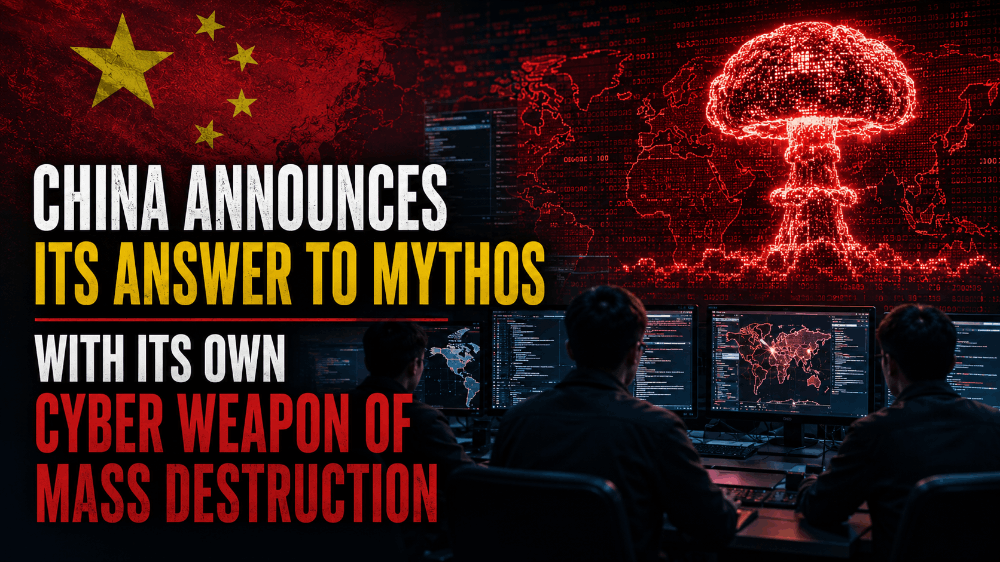
China Announces Its Answer to Mythos With Its Own Cyber Weapon of Mass Destruction

The resulting impacts, coined the Mythos Effect, are a ripple across the technology, process, and business expectations that previously existed for cybersecurity vulnerability management of IT and OT systems.
The CEO of Qihoo, Zhou Hongyi, announced their new Tulongfeng system as nearly capable of Mythos. Qihoo has been sanctioned by the US government since 2020 for ties to the Chinese military, a claim that Qihoo denies.
Mr Zhou compared the AI vulnerability detection race to that of the nuclear arms race, where countries that lack such capabilities are at a distinct disadvantage. “Previously, nuclear weapons constituted strategic deterrence. In the future, vulnerability discovery capabilities may become the new strategic deterrent,” said Zhou. He referenced the concept of mutual assured destruction, a common philosophy in nuclear armament discussions, where peace is only possible when both sides have the ability to destroy the other.
Detecting and exploiting digital vulnerabilities in critical infrastructures of adversaries, such as electrical power, communications, food distribution, and transportation, is an incredible power that is sought by many governments. Mr Zhou made the disturbing analogy that Mythos was a weapon of mass destruction and Tulongfeng was China’s equivalent.
The capabilities of Tulongfeng have not been independently verified, but Mr Zhou claimed it had discovered over 3000 vulnerabilities, with many classified as high risk.
This was an eventuality.
Cybersecurity and AI experts have been advising that this is an arms race, and other models would catch up to Mythos. At the same time, Anthropic would continue to advance its technology to stay one step ahead. Predictions proved true as it was expected that other US-based models would come close to the performance of Anthropic’s initial model, Mythos Preview, within weeks, and the Chinese models would lag several months behind. Anthropic has already surpassed the performance of Mythos Preview, with the release of Mythos 5. Shortly thereafter, due to concerns of such a powerful model falling into the hands of other nations, the US government implemented restrictions that forced Anthropic to pull the model from release.
The race will continue. Those nations that possess top models will be able to find and exploit vulnerabilities in adversaries’ digital ecosystems while using the same technology to find and patch potential weaknesses in their own. At the same time, cybercriminals are hoping to gain access to capable models to improve their activities for theft, extortion, and fraud.
The cybersecurity burden is rapidly escalating, creating serious resource, prioritization, and business problems that must be figured out.