5 Things That Would Have Saved Me Money If I Knew Them Before Entering Web3

Nobody enters Web3 knowing what they are doing. That is not an insult — it is just the reality of an ecosystem that was designed by engineers for engineers, then opened to the general public with almost no onboarding infrastructure and no customer support line when things go wrong.
The blockchain does not care that you are confused. A signed transaction is a signed transaction. There is no fraud department to call, no chargeback to file, no "are you sure?" pop-up when the consequence is irreversible. Web3 charges expensive tuition for lessons you did not know you were enrolled in.
These five things would have saved me money — and more importantly, would have saved me the particular sting of losing value not to a sophisticated attacker but to my own preventable mistakes. Every single one of these is something that cost real people real money in 2025 and is still happening today.
If you are new to Web3, or if you know someone who is, this is the article to read first.
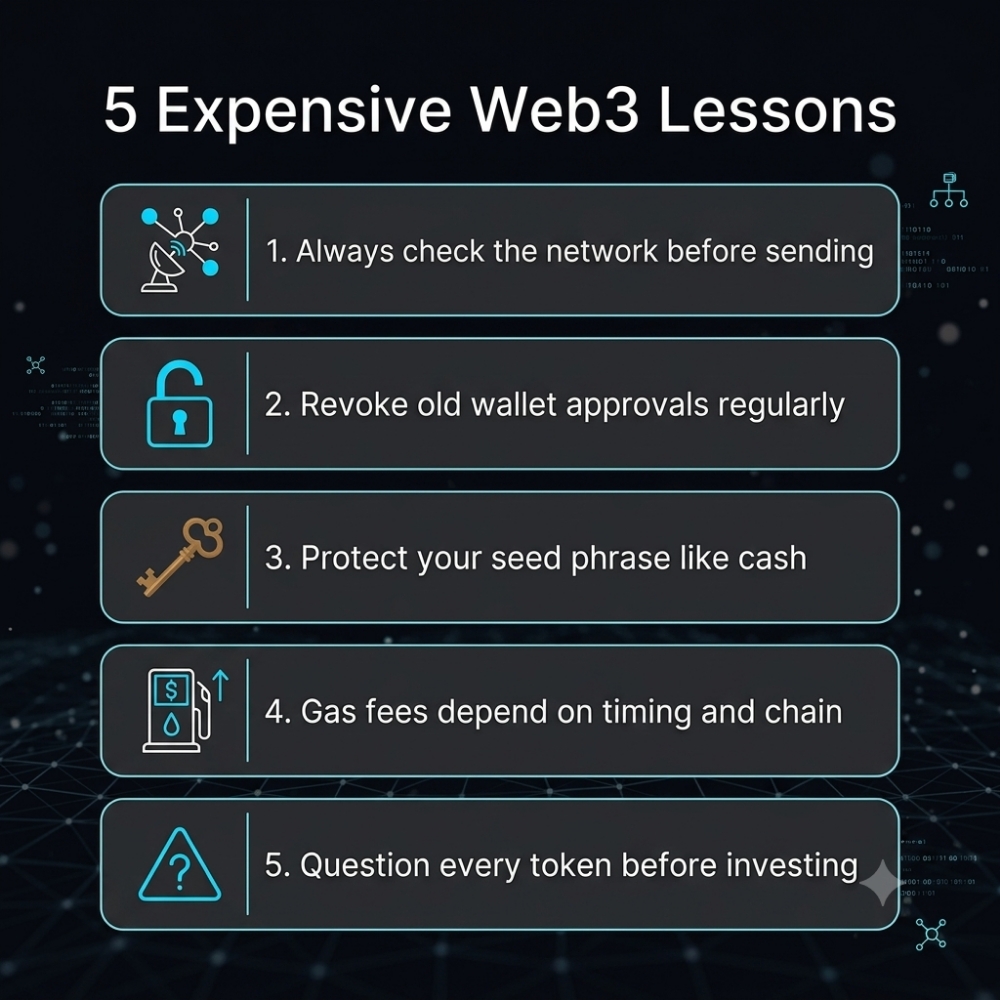
1. The Network You Send On Matters as Much as the Address You Send To
This one has probably cost more collective money than any other beginner mistake, and it is almost never explained clearly in introductory Web3 content.
Every token you hold lives on a specific network — Solana, Ethereum, Base, Arbitrum, Polygon, BNB Chain, and dozens of others. Many tokens exist on multiple networks simultaneously: the same USDC that lives in your Solana wallet is a completely different version from the USDC in your Ethereum wallet. Same name, same dollar value intended, entirely different technical existence.
The mistake goes like this: you want to send USDC to someone. You copy their address and paste it in. You send. But you were on Ethereum and they expected Solana USDC — or vice versa. The transaction confirms. The funds leave your wallet. And depending on the situation, they may be recoverable through a complex bridging process, or they may simply be stuck in an address on the wrong chain with no practical way to access them.
One person writing about their early Web3 experience described it simply: "Sent cryptocurrency to the wrong network once... poof, gone." That is the experience. Not dramatic. Not the result of a scam. Just a single selection from a dropdown that cost them real money.
The fix is simple and non-negotiable: before sending any token to any address, confirm the network explicitly. Ask yourself — and ask the recipient — are we both on the same chain? If there is any doubt, send a tiny test amount first. A $0.01 test transaction that you can confirm arrived correctly is the cheapest insurance in Web3.
2. Old Permissions Never Expire — and They Are Waiting
Every time you connect your wallet to a dApp and interact with it, you grant that application a permission to interact with your tokens. These permissions do not automatically expire. They sit open, indefinitely, until you manually revoke them.
Think about every dApp you have connected to in the past year. NFT mints you tried. DEXes you used once. Airdrop claim sites. A DeFi protocol you tested and never returned to. Every single one of those interactions may have left an open permission in your wallet — a standing approval that allows that contract to move your tokens.
The numbers behind this risk are not abstract: phishing attacks exploiting forgotten token approvals cost users over $1 billion in 2024 alone. And in 2025, the picture got worse — 69% of crypto losses tracked by CertiK were due to wallet or infrastructure compromises rather than smart contract bugs. In many of those cases, the attacker did not need to hack you. They just needed to exploit a permission you gave out months ago and forgot about.
The tools to fix this exist and are free. On Ethereum and EVM chains, revoke.cash shows every active approval on your wallet and lets you revoke them with one click per approval, paying a small gas fee. On Solana, Famous Fox Federation's revoker at famousfoxes.com/revoke does the equivalent. Phantom also lets you disconnect connected apps directly in Settings.
This should be a monthly habit. Set a calendar reminder. Spend ten minutes once a month revoking any approval from a dApp you no longer actively use. It is the most straightforward security action in Web3 that most people never do until after they lose something.
3. Your Seed Phrase Is Not a Password — It Is the Entire Wallet
Most people who have used computers for twenty years have internalized a set of rules about passwords: make them complex, do not reuse them, use a password manager, enable two-factor authentication. Those instincts are correct for traditional accounts. They transfer almost nowhere in Web3, because the thing that protects your wallet is not a password at all.
Your seed phrase — those twelve or twenty-four words you were shown when you created your wallet — is a mathematical master key that can regenerate your entire wallet on any device, anywhere in the world. Whoever has those words has everything in that wallet, permanently and irrecoverably. There is no recovery process if your seed phrase is compromised. There is no support ticket. The funds are gone.
The expensive version of learning this lesson: someone stores their seed phrase in a notes app, or takes a screenshot and backs it up to cloud storage. The cloud account gets compromised. Everything in the wallet goes with it. In 2025, phishing attacks specifically targeting seed phrase retrieval from cloud accounts, browser extensions, and email were the most financially devastating attack vector of the year, contributing to billions in losses.
The correct storage is paper. Physical paper, in a location you control. Not a photo. Not a document. Not a password manager. Two copies, in two different locations — a house fire or flood should not be enough to lose your wallet permanently.
The rule is absolute: no legitimate platform, no support staff, no customer service agent, no "wallet recovery tool" will ever ask for your seed phrase. If anything in Web3 asks for those words, it is a scam. Leave immediately.
4. Gas Fees Are Not Fixed — and Timing Changes Everything
Early in Web3, before you understand how gas works, you will encounter situations where you are asked to pay a fee that is larger than the transaction you are trying to execute. You will pay $15 in Ethereum gas to move $8 worth of tokens. You will attempt a transaction during a period of network congestion and watch it fail — and still pay the gas for the failed attempt.
The Ethereum base layer is the most extreme case: gas fees fluctuate wildly based on network activity, and during periods of high demand — a popular NFT mint, a market panic, a major protocol launch — fees can spike to levels that make small transactions economically irrational. Gas fees of $80 to $200 for a routine swap were not unusual during Ethereum's peak congestion periods.
Several things this unlocks, once you know them:
Timing matters. Ethereum gas fees are dramatically lower on weekends and late at night in US time zones. If your transaction is not time-sensitive, waiting twelve hours can cut your costs by 70%.
Chain selection matters. Solana's base fee per transaction is a fraction of a cent — around $0.001 — and does not spike under normal usage. Ethereum L2s like Base and Arbitrum offer similar cost profiles. If the dApp you want to use exists on multiple chains, the cheapest chain is often the correct choice for routine transactions.
Failed transactions still cost gas on EVM chains. If a transaction fails due to slippage, an expired deadline, or insufficient gas provided, you still pay the miners for the computation they attempted. Understanding this before it happens avoids the baffling experience of watching your balance decrease for a transaction that appeared to accomplish nothing.
Bridges have costs and risks. Moving tokens between chains requires bridging, which adds both fees and bridge risk — bridge exploits have cost users hundreds of millions of dollars. Every bridge is a potential point of failure. If you do not need to bridge, do not bridge.
5. Not Everything That Goes Up Is Going Somewhere — The Rug and the Pump-and-Dump
This one is the hardest to explain to someone who has not seen it happen, and the easiest to understand once it has happened to you.
Web3's permissionless nature — the fact that anyone can launch a token, create a liquidity pool, and list it on a DEX without any gatekeeping — is one of its most powerful features and its most weaponized one. Creating a token costs almost nothing. Creating one that looks like it might go to the moon costs slightly more — a professional-looking website, a Telegram group, some paid social media posts, a credible whitepaper, and a launch narrative that sounds plausible.
The rug pull is the extreme version: founders launch a token, attract buyers, build the price, then drain the liquidity pool and disappear. You are holding a token that is now worthless, from a project that no longer exists, with no legal recourse available.
The pump and dump is the subtler version: a group — sometimes organized, sometimes spontaneous — buys into an asset, promotes it aggressively to create FOMO, watches others pile in, then sells into the buying pressure. The promotion was real. The project might even be real. But the price movement was manufactured, and the latecomers absorb the loss.
In 2025, rug pulls and exit scams collectively cost crypto users billions. CoinGecko data shows that over 50% of all cryptocurrencies ever listed have effectively failed — 3.7 million out of nearly 7 million projects tracked. Most of those did not fail because of bad code. They failed because they were never designed to succeed as projects — only to generate a short-term price event.
The signals that matter before putting money into any small-cap project: Is the team doxxed or does it have a verifiable track record? Has the code been audited by a credible firm? Is the liquidity locked, or can it be removed at any time? Does the project have real activity — users, transactions, genuine community — or just follower counts and telegram member numbers that could have been purchased? Has the token supply distribution been disclosed? Is a large percentage of supply in wallets with no lock-up, ready to sell the moment the price rises?
None of these questions guarantee safety. But asking all of them before putting money in, and walking away if several cannot be answered, eliminates most of the obvious losses.
The One Framework That Connects All Five
What ties these five lessons together is a single shift in how you approach every interaction in Web3: slow down at the confirm screen.
The entire ecosystem is designed for speed — fast transactions, fast prices, fast opportunities, fast losses. Most of the money that has been lost in Web3 was lost at the moment of a decision that felt routine: a familiar-looking URL, a token approval, a network selection, a new project that looked credible. Each one took seconds. Each one was irreversible.
Every mistake in Web3 costs money, and there is no customer service to call. The blockchain doesn't care that you're confused.
The defense is not technical sophistication. It is the thirty-second pause before confirming anything you cannot undo. Verify the URL. Check the network. Read what the approval is actually asking for. Confirm the address character by character. Ask whether you actually know enough about this project to put money in it.
That pause — applied consistently — is the difference between staying in this ecosystem long enough to benefit from it, and paying the tuition that Web3 charges to the people who skip it.
Written for the @XlusiveWeb3 content portfolio · June 2026