Spot Trading vs Futures Trading: Which Is Better?

Crypto traders often come across the same question when choosing how to trade: spot or futures?
Both markets give traders ways to participate in cryptocurrency price movements, but they work very differently. Spot trading is generally more straightforward because you buy or sell the actual asset. Futures trading, on the other hand, involves contracts that track an asset's price and can introduce leverage, funding costs, and liquidation risk.
So, which one is better?
There is no universal answer. The better option depends on your trading style, risk tolerance, experience, and understanding of the market.
For beginners especially, knowing the difference between the two can prevent expensive mistakes.
What Is Spot Trading?
Spot trading is the simplest form of crypto trading.
When you buy Bitcoin in the spot market, you are purchasing Bitcoin at the current market price or at a price you specify through a limit order. Once the transaction is completed, the asset belongs to you and can generally be held, transferred, or sold later.
For example, if Bitcoin is trading at $100,000 and you purchase 0.01 BTC, you own that amount of Bitcoin.
Your profit or loss depends on how the asset's price changes after your purchase.
Spot trading does not normally involve liquidation simply because the price moves against you. If you own the asset outright, you can continue holding it unless you decide to sell.
That makes spot trading easier to understand for people who are new to crypto.
What Is Futures Trading?
Futures trading works differently.
Instead of buying the underlying cryptocurrency directly, you trade a contract whose value is connected to the price of that asset.
Crypto futures can allow traders to take long or short positions.
A long position generally benefits if the price rises.
A short position generally benefits if the price falls.
This gives futures traders more flexibility during both bullish and bearish market conditions.
However, futures also introduce additional risks that do not exist in the same way with ordinary spot trading.
The Biggest Difference Is Leverage
Leverage is one of the main reasons traders move from spot markets to futures.
With leverage, traders can control a position larger than the amount of capital they have committed as margin.
For example, with 5x leverage, $1,000 of margin could provide exposure to a $5,000 position.
That sounds attractive, but leverage works in both directions.
If the market moves in your favor, gains can increase.
If the market moves against you, losses can increase just as quickly.
A relatively small adverse price movement can become significant when leverage is involved.
What Is Liquidation?
Liquidation is one of the most important concepts futures traders need to understand.
When a leveraged position loses enough value and the available margin is no longer sufficient, the exchange can automatically close the position.
This means a trader can lose their margin even if the underlying asset later recovers.
Spot traders generally do not face this type of forced closure when simply holding an asset without borrowing.
For beginners, this difference is significant.
Spot Trading Is Usually Easier to Understand
Spot trading has a straightforward structure.
You buy an asset, own it, and sell it later if you choose.
There are still risks, of course. Cryptocurrency prices can fall significantly, and holding an asset does not protect you from market losses.
But the mechanics are easier to understand.
Futures trading requires traders to understand additional concepts such as margin, leverage, liquidation price, funding rates, open interest, and contract specifications.
That extra complexity can create more ways to make mistakes.
Futures Can Be Useful in Falling Markets
One advantage of futures trading is the ability to short an asset.
Suppose you believe Bitcoin is likely to decline.
In the spot market, you could sell Bitcoin you already own, but you cannot normally profit directly from a falling price unless you have an appropriate short mechanism.
With futures, a trader can open a short position and potentially benefit if the price declines.
This makes futures attractive to traders who want strategies that work in both directions.
But shorting carries substantial risk, particularly when leverage is involved.
Funding Rates Matter in Futures
Perpetual futures are particularly popular in crypto markets because they do not have a traditional expiration date.
Instead, they use funding mechanisms to help keep the contract price close to the underlying asset's price.
Depending on market conditions, traders may pay or receive funding.
This means a futures position has an additional cost or potential source of return that spot traders typically do not deal with in the same way.
When holding futures positions for longer periods, funding rates can become an important part of the overall trading calculation.
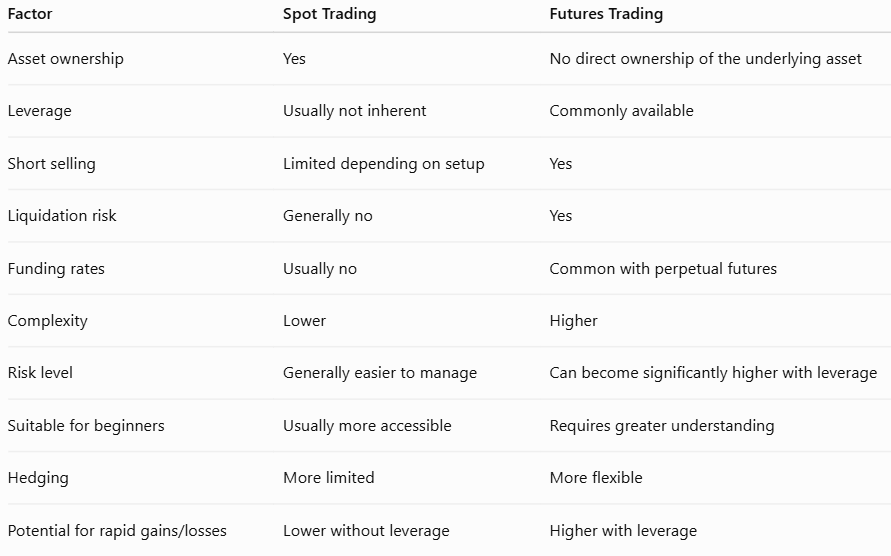
Spot vs Futures: A Simple Comparison
The table highlights an important point: more flexibility does not necessarily mean better trading.
Which Is Better for Beginners?
For most people who are completely new to crypto trading, spot trading is the easier place to start.
It allows beginners to learn how markets work without immediately introducing leverage and liquidation.
You can learn how to read charts, understand market orders, evaluate liquidity, monitor trading volume, and study market trends before moving into more complicated products.
That does not mean spot trading is risk-free.
Crypto prices can be extremely volatile, and a poorly chosen asset can lose substantial value.
The difference is that the mechanics are generally easier to understand.
When Does Futures Trading Make More Sense?
Futures may make sense for experienced traders who understand leverage and have a clearly defined risk-management strategy.
For example, futures can be useful when a trader wants to:
- Take long or short positions
- Hedge an existing spot portfolio
- Trade short-term price movements
- Use specific futures-based strategies
- Gain controlled exposure to an asset
But these benefits come with additional responsibilities.
A trader should understand liquidation risk, funding costs, margin requirements, position sizing, and market volatility before using leverage.
Market Conditions Can Change the Decision
The choice between spot and futures should not happen in isolation from the market.
Consider a highly volatile market where Bitcoin suddenly moves 8% within a few hours.
A spot trader may simply decide to wait.
A leveraged futures trader could experience a much larger impact from the same movement.
This is why crypto market analysis matters.
Before choosing a trade, it can be useful to examine price action, trading volume, liquidity, market sentiment, derivatives positioning, and relevant news.
Final Thoughts
Choosing between spot and futures trading comes down to understanding what you are trying to achieve and how much risk you can realistically manage.
Spot trading offers simplicity and direct asset ownership. Futures offer flexibility, leverage, and the ability to trade both market directions.
Neither guarantees profits.
The most important skill is not choosing the market with the biggest potential return. It is learning how to evaluate market conditions, manage risk, and make decisions based on reliable information.
As crypto markets become more data-driven, traders can also use real-time crypto market data, derivatives analytics, liquidity analysis, trading signals, and AI-powered market intelligence to build better context around their decisions.
Whether you choose spot or futures, the same principle applies
Understand the market first. Trade second.