Why You’re Still Early to Web3 (And How to Actually Capitalize On It)

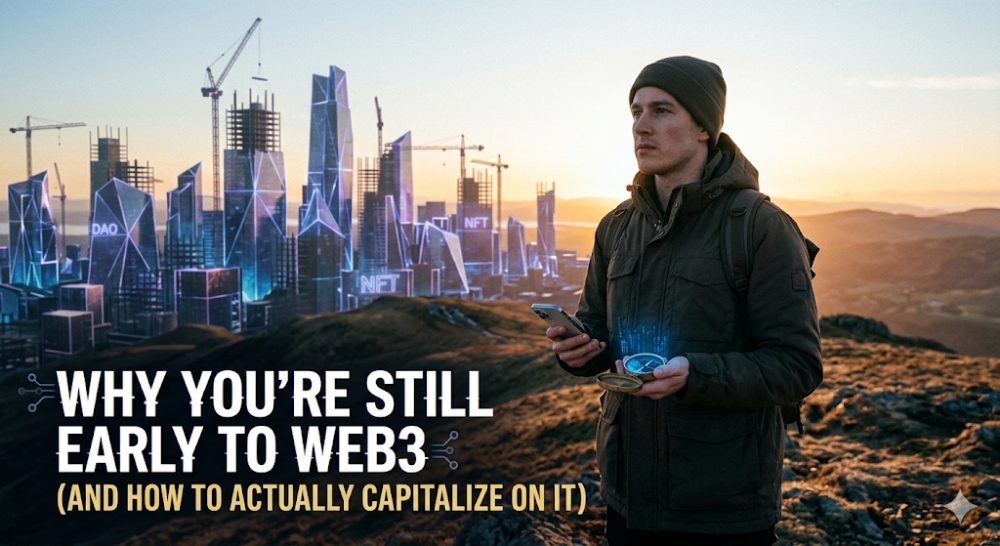
Navigating the shift from speculative noise to real-world decentralization
If you want to build a sustainable digital asset footprint or scale an independent writing business today, you need to understand that all highly profitable web3 topics hinge on a singular foundational pillar: filtering out short-term speculative hype to capture long-term structural wealth.
Let’s be completely honest for a second: the internet is lying to you about what it looks like to participate in the decentralized economy. Every single day, your feed is probably flooded with self-proclaimed crypto gurus shouting about how "easy" it is to catch the next viral memecoin or double your capital on a speculative digital art flip. I used to fall for those exact, glossy narratives until I personally launched my first web3 content strategy and realized that chasing loud, artificial market hype is a fast track to financial exhaustion and portfolio ruin.
This article is an honest, step-by-step breakdown of how the decentralized landscape is quietly transitioning into an institutional utility layer, designed to give you a clear, unvarnished road map on how to anchor your creative skills, protect your on-chain assets, and capitalize on the infrastructure phase before the masses arrive.
## Part 1: Moving Beyond the Initial Hype Cycle
When I first connected a non-custodial wallet to a decentralized publishing application, I thought the sheer novelty of blockchain technology would guarantee instant market visibility. I assumed that because the infrastructure was revolutionary, audiences would naturally flock to decentralized networks without any structural resistance.
Instead, my early deployments ran face-first into the brutal reality of a premature ecosystem.
Because I focused too heavily on the technical novelty rather than building a practical bridge for real human readers, I watched early engagement stall. I quickly learned that audiences don’t read content or use protocols simply because they are built on a blockchain; they use them when the underlying utility solves a real-world friction point. The true paradigm shift of Web3 isn't the speculative token attached to a project—it is the underlying data architecture that ensures sovereign ownership of your digital output.
* **1. The Speculation Mirage:** High early valuations often mask a complete lack of daily active user utility.
* **2. The Infrastructure Bottleneck:** Early iterations of decentralized applications suffered from poor user experiences and high execution fees.
* **3. The Shift to Real Utility:** Long-term market value is shifting entirely away from hype protocols and moving toward scalable, practical data networks.
```
[Pure Hype Phase] --> Market Capitulation --> Infrastructure Overhaul --> Institutional Adoption
```
Without looking past the surface noise, your web3 strategy will systematically stall. What many view as the "death" of crypto is actually the mandatory clearing out of unsustainable, zero-sum applications. The market didn't collapse because the technology failed; it collapsed because it cleared the board for high-speed Layer-2 networks, modular scalability, and decentralized content delivery systems that can actually handle millions of daily mainstream transactions without friction.
## Part 2: Sharing My Core Values: Why I Stand on Absolute Transparency
If you look around platforms like Bulb, Publish0x, and Hive today, you will notice a frustrating trend where creators only share their massive trading wins and inflated web3 portfolio screenshots while completely hiding the technical complexities and steep learning curves.
I refuse to run my platform that way because my digital writing career is built on a non-negotiable core value: **Absolute transparent accountability.**
I believe that true authority doesn't come from pretending you have a perfect investment record; it comes from having the courage to show your operational scars so other people don't have to experience the same financial pitfalls. I value deep technical respect—both for the integrity of smart contract verification and the security of digital asset management. When we allow bad actors to dominate the narrative with hollow promises of overnight wealth, we lower the institutional credibility of the entire web3 space.
* **1. Utility Over Speculation:** Prioritizing projects that generate real, measurable cash flow or sovereign data retention over volatile trading assets.
* **2. Educational Integrity:** Breaking down complex decentralized finance (DeFi) mechanisms into clear, actionable frameworks rather than confusing jargon.
* **3. Creative Empowerment:** Using Web3 as a direct protocol to decouple creators from centralized ad networks and algorithms.
I am sharing my real-world on-chain experiences with you because I want you to know that it is completely normal to feel overwhelmed by the velocity of Web3 updates. But it is not acceptable to remain uneducated. When you understand the underlying mechanics of sovereign data storage, you realize that learning how to manage your public and private keys isn't just a technical hobby—it is a mandatory act of capital preservation in the digital age.
## Part 3: The Strategic Blueprint: What You Will Gain From This Framework
I will never forget the exact moment I realized that the broader market was completely misinterpreting the timeline of Web3. I was auditing a series of automated platform smart contracts, looking at the rapid rise of decentralized data registries like Arweave and IPFS, and realizing that while the casual public was panicking over token prices, developers were quietly building the un-censorable back-end infrastructure of the next internet.
That was the exact moment the lightbulb finally went off, and it forced me to build a rigid, repeatable system to protect and deploy my digital capital.
By looking at how the underlying infrastructure is evolving, you can take away four definitive operational laws to capitalize on this early window today:
* **1. Target Decentralized Storage Networks:** True digital sovereignty requires moving past token speculation and anchoring your media files on permanent data layers.
* **2. Leverage Layer-2 Scaling Solutions:** Never execute core transactions on congested mainnets; utilize Arbitrum, Base, or Optimism to drop your overhead fees to fractions of a cent.
* **3. Build Multi-Platform Redundancy:** Treat decentralized platforms as your immutable source of truth, while using web2 front-ends strictly as distribution funnels.
* **4. Implement Cold Storage Hygiene:** Never keep your core operational capital or valuable creative intellectual property on hot browser wallets or centralized exchanges.
To help you immediately apply these lessons to your digital asset journey, take this exact operational layout and use it as your strategic benchmark before interacting with any new decentralized application:
| Operational Pillar | Legacy Web2 Vulnerability | High-Authority Web3 System |
|---|---|---|
| **Data Ownership** | Centralized platforms can ban your profile and seize your content overnight. | Immutable content signatures tied directly to your cryptographic wallet address. |
| **Monetization Route** | Heavily fragmented ad-revenue splits dictated by unpredictable algorithms. | Direct, peer-to-peer write-to-earn micro-incentives settled instantly on-chain. |
| **Network Overhead** | Massive payment processing friction and localized banking restrictions. | Borderless smart contracts clearing global transactions inside a multi-second execution block. |
| **Security Protocol** | Single-point-of-failure passwords vulnerable to corporate database breaches. | Multi-signature authentication and offline ledger hardware configurations. |
## Part 4: Deconstructing the Micro-Incentive Capital Loop
When you analyze how independent writers and digital content creators are successfully extracting long-term revenue from Web3, you find that the strategy doesn't rely on massive viral windfalls. It happens through consistent, micro-incentive capital loops built natively into decentralized social layers.
During my transition to decentralized publishing, I tracked exactly where traditional monetization models break down versus where web3 data streams clear cleanly.
If you aren't integrating your content assets straight into decentralized web architectures, you are giving away your intellectual property value for free to legacy social media conglomerates. We often forget that your audience data is a highly valuable commodity. When you publish through an application built on an open protocol, your engagement metrics are no longer locked inside a closed company database—they are visible on a public ledger, allowing multiple independent applications to compete for your attention.
* **1. Direct Tokenized Attributions:** Collecting micro-tips, curation rewards, and writing incentives without third-party escrow interference.
* **2. Open Protocol Portability:** Moving your entire subscriber base and publication history instantly from one app to another without losing a single contact.
* **3. Cross-Chain Identity Pooling:** Building a single, verified reputation score that unlocks premium access and exclusive ecosystem permissions across different chains.
The ultimate takeaway here is simple: Never treat your web3 output as a casual side experiment. If you publish an article, distribute an asset, or deploy a contract, ensure you are utilizing verified, open-source protocols. This instantly forces the market to interact with you as an independent financial entity rather than a dependent tenant on a centralized platform's server.
## Part 5: The Sovereign Content Framework
To transition from a standard content provider into a highly resilient digital enterprise, you must master the operational art of decentralized asset deployment. This is the exact toolset that rescued my business model after years of shifting web2 monetization policies.
When you implement a formal mechanism for cryptographic validation, you remove platform risk entirely from your professional career.
You no longer have to feel anxious or defensive when a centralized platform updates its algorithmic parameters or drops its revenue-sharing percentages. Instead, you simply lean on your established open protocol footprint. The moment an article or media file is timestamped and signed by your wallet key, your ownership is fixed permanently into the global ledger state—giving you an unalterable proof of work that no corporate entity can erase.
* **1. Cryptographic Wallet Authentication:** Logging into publishing front-ends using verified digital signatures rather than tracking insecure email strings.
* **2. Content Content-Addressing:** Utilizing IPFS hashes to guarantee that your articles remain accessible globally, regardless of domain level bans.
* **3. On-Chain Revenue Splitting:** Hardcoding secondary royalty structures or collaborative co-author payouts straight into your deployment parameters.
By enforcing this system, you change the psychology of your creative production. You stop viewing your digital footprint as temporary rental property and begin managing it as a long-term, self-sovereign financial estate.
## Final Thoughts: Capitalizing on the Infrastructure Phase
The modern independent economy doesn't need another casual spectator sitting on the sidelines waiting for Web3 to become completely mainstream before taking action. The internet is already drowning in that passive noise. What serious digital business owners, independent writers, and forward-thinking asset managers look for on platforms like Bulb and Publish0x is a structurally sound blueprint showing exactly how cryptographic tools and decentralized networks interact to protect real cash flow.
Stop letting short-term market corrections dictate your long-term focus. Stop trying to navigate the new web using old, centralized management habits. Focus entirely on deterministic contract definitions, rigid self-custody practices, clear-eyed protocol analysis, and robust multi-platform distribution. That is how you survive the ongoing transformations of the internet, and that is how you permanently protect and scale your capital.
## Step Into the Strategy Room
**If this granular, operational breakdown opened your eyes to the real structural mechanics of decentralized applications and saved your capital from speculative hype loops, make sure to give this piece a high rating on Publish0x, share it across your web3 professional networks, and subscribe to my channel for continuous, unfiltered finance blueprints.**
Let’s turn the comments section below into a technical boardroom discussion. I want to ask you an important strategic question that every serious on-chain user answers before hitting the ledger:
> **Given the choice between the high transaction costs but absolute liquidity of Ethereum Layer 1, versus the sub-penny execution fees but ongoing bridging security risks of Layer 2, do you prefer to anchor your primary web3 content assets on a native scaling chain, or do you actively manage multi-chain deployments?**
>
If you have ever encountered a strange contract prompt while connecting your wallet, or if you have a favorite decentralized protocol that keeps your intellectual property secure, drop your insights, platform choices, or wallet setups in the comments below. Share your experiences, ask your questions, and let's optimize our operational parameters together!