Symmetric vs Asymmetric Cryptography, and What Blockchain Actually Uses

"Blockchain encryption" is one of those phrases that gets used constantly and is, strictly speaking, almost never accurate. Transactions on a public blockchain aren't encrypted at all, as anyone can read them in plain sight. What blockchain actually relies on is a specific type of cryptography doing a very different job: proving authenticity, not hiding information.
To understand why, it helps to properly separate the two families of cryptography this all comes from, and then look at where each one actually shows up in a blockchain system, because the honest answer is "in more places than you'd expect, and not the place most people assume."
Symmetric Cryptography: One key, shared by both sides
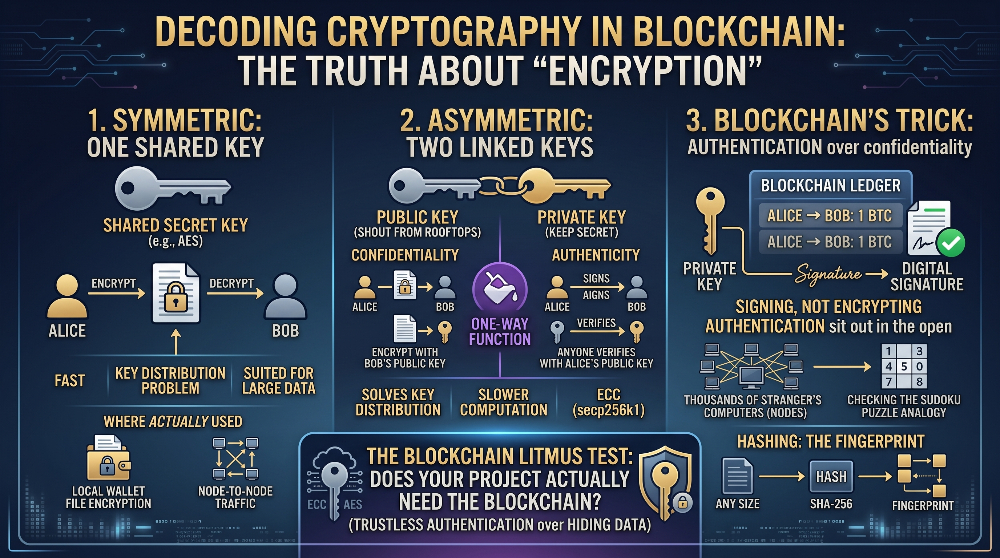
Symmetric cryptography is the older, more intuitive idea: one single secret key both locks and unlocks the data. If Alice wants to send Bob an encrypted file, they both need a copy of the exact same key beforehand. Alice encrypts with it, Bob decrypts with the same key.
Think of it like a physical padlock where only one key exists, and you've made a duplicate for a friend. Simple, fast, and it works as long as you can safely get that duplicate key to your friend in the first place.
Strengths:
- Computationally fast and lightweight: Well suited to encrypting large amounts of data
- Simple to reason about
- Common modern example: AES (Advanced Encryption Standard), used everywhere from Wi-Fi encryption to file storage
The core weakness - The Key Distribution Problem: How do you get the shared key to the other person in the first place, without an eavesdropper intercepting it along the way? If you already had a perfectly secure channel to send the key, you probably wouldn't need encryption to begin with. This chicken-and-egg problem is exactly what asymmetric cryptography was invented to solve.
Asymmetric Cryptography: Two keys, mathematically linked, doing different jobs
Asymmetric cryptography uses a pair of keys instead of one: a private key kept secret, and a public key shared freely. Critically, they're not interchangeable duplicates; they do different jobs depending on what you're trying to achieve:
- Confidentiality: anyone can encrypt a message using your public key, but only your private key can decrypt it. Even the sender can't undo their own encryption afterward.
- Authenticity: you sign a message with your private key, and anyone can verify that signature using your public key, without ever needing your private key themselves.
The relationship between the two keys relies on a mathematical one-way function, easy to compute forward, effectively impossible to reverse. A useful mental picture: mixing blue and red paint into purple. Given the purple result, you can't work out the exact original proportions used, even though making the mixture in the first place was trivial. Deriving a public key from a private key works the same way: fast forward, computationally infeasible in reverse.
Strengths:
- Solves the key distribution problem entirely - Public keys can be shouted from the rooftops
- Enables both encryption and, separately, digital signatures
- Common modern examples: RSA, and elliptic curve cryptography (ECC): The specific curve secp256k1 is what Bitcoin and Ethereum both use
The core weakness: It's computationally far heavier than symmetric cryptography, noticeably slower, especially for large amounts of data.
So which one does the real world actually use? Both, usually together
This is the part that surprises people: most real-world secure systems use both, in a hybrid. HTTPS, the padlock icon in your browser, is a perfect example: your browser and the website use asymmetric cryptography briefly, just to securely agree on a temporary shared secret, and then switch to fast symmetric encryption for the actual bulk of the traffic. You get asymmetric cryptography's easy key exchange, without paying its speed penalty for every byte of your Netflix stream.
Where does blockchain actually fit into this?
Here's the misconception baked into the phrase "blockchain encryption": a public blockchain doesn't encrypt transactions at all. Every transaction (sender, recipient, amount) sits in plain, unencrypted, permanently public view. Anyone can read it without any key whatsoever. Encrypting transaction data would defeat the entire point of a transparent, publicly auditable ledger.
What blockchain actually uses asymmetric cryptography for is signing, not encrypting, and this distinction genuinely matters, not just semantically:
- Your wallet is an asymmetric keypair. Your private key signs transactions; your public key (or an address derived from it) lets anyone verify that signature.
- Signing proves authorship and integrity: "this transaction really came from whoever holds this private key, and hasn't been altered", without hiding the transaction's contents from anyone.
- Decrypting and verifying are different operations entirely. Verifying a signature doesn't reveal anything that wasn't already visible; it just mathematically confirms consistency between the message, the signature, and the public key, closer to checking a finished Sudoku puzzle than unlocking a safe.
So if someone tells you blockchain "encrypts" your transactions to keep them secure, that's not quite right. It signs them to keep them authentic, while deliberately leaving them fully visible to everyone.
Where symmetric cryptography quietly still shows up
Even though the ledger itself isn't encrypted, symmetric cryptography isn't absent from the blockchain world, it just operates one layer away from the chain itself:
- Wallet files at rest. When your wallet software stores your private key on your laptop or phone, it typically encrypts that file using a symmetric algorithm like AES, protected by a password you set. This has nothing to do with the blockchain protocol itself, it's just standard, sensible local file security.
- Node-to-node network traffic. When blockchain nodes communicate with each other across the internet, that connection is frequently secured the same hybrid way HTTPS is, asymmetric cryptography for the initial handshake, symmetric encryption for the ongoing traffic.
- Privacy-focused cryptocurrencies. Coins like Monero use various additional cryptographic techniques specifically designed to obscure transaction details that Bitcoin and Ethereum leave fully public, a deliberate design choice, not the default blockchain behavior.
The third category people constantly mix up with encryption: Hashing
It's worth clearing up one more piece of confusion while we're here, because it comes up constantly: hashing is neither symmetric nor asymmetric encryption, it's a completely different tool.
A hash function takes an input of any size and produces a fixed-length "fingerprint." Critically, hashing is one-directional by design, there's no key involved at all, and there's no way to "unhash" a result back into its original input, even in principle. This is what blockchain uses to link blocks together (each block contains a hash of the previous one) and to generate wallet addresses from public keys. It's not encrypting anything, and there's no secret being protected, it's simply a tamper-evident fingerprint.
The Takeaway
Blockchain's reputation for "encryption" is a bit of a misnomer stacked on top of a real, genuinely elegant idea. The actual innovation isn't hiding information, it's the opposite: using asymmetric cryptography's signing ability to let a transaction be fully public and fully authenticated at the same time. Symmetric cryptography and hashing are both quietly doing important work around the edges, but the real trick, the one that makes a decentralized ledger of strangers possible at all, is a signature nobody can forge, sitting right out in the open for anyone to check.