Echelon: The Network That Was Never Meant To Exist

The tale of Echelon leaves you with more questions than answers.
Right now, at multiple locations across the globe, giant satellite dishes are staring at the communications satellites that help us to maintain global connectivity. This all-seeing, electronic eye works around the clock, in all weather, with little public fanfare regarding the job they perform.
The land they operate on belongs to their respective governments. The equipment on-site is classified and not for public consumption. And all of this has been happening since the 1960s.
We were never supposed to know that this program existed. The Governments that run it would first deny its existence. When denial became impossible to maintain, they would acknowledge the equipment but refuse to discuss the capability.
When investigative journalism would uncover the capability, it would be framed as a justification and kept on, keeping on anyway.
This is the story of Echelon. It is the most ambitious signals intelligence operation in history, built in secret by five allied nations, hidden in plain sight across three continents, and exposed by a series of investigators who were told, repeatedly, that they were all looking at something that did not exist. Pine Gap in Australia is just one of many global stations that collect intelligence information. Source: Wikipedia.
The Beginnings: A Cold War Secret
While Echelon would be highly relevant during the Cold War, the reality was that the program's origins would come from the closing days of World War 2. During this time, both the United Kingdom and the United States would work on cryptographic programs that would directly influence the war effort. The cryptographic cooperation that had helped win the war gave both nations every reason to maintain the partnership after it
In 1946, the two countries formalised that relationship in a secret agreement known as the UKUSA Communications Intelligence Agreement. The document, which was classified for over sixty years and not officially acknowledged until 2010, established a framework for the sharing of signals intelligence between the two nations that has remained in continuous operation ever since.
As the 1950s approached and the Cold War continued to get spicy, the agreement would expand to include Australia, Canada and New Zealand. Each partner would contribute land and resources to the program, helping to further the program's reach. The reward for this would be access to the intelligence that was produced.
The end result of this program would give us the first foundations of the still-running, Five Eyes alliance.
Five Eyes was aimed at tempering Soviet reach and influence via the collection and processing of Signals Intelligence to maintain the edge during the Cold War. With the Soviets operating a large diplomatic network across the globe, the alliance aimed to collect as much of this traffic as possible.
The collection infrastructure that evolved over the following decades was built around three primary methods:
Satellite interception stations, positioned to capture traffic from specific orbital slots, collected communications from civilian and military satellites passing overhead.
Undersea cable tapping operations, conducted by specialist submarines and later by fixed installations, captured traffic from the physical infrastructure of the global telecommunications network.
High-frequency radio monitoring networks, distributed across remote locations chosen for their propagation characteristics, collected the shortwave traffic that militaries and diplomatic services depended on before the satellite era.
The ground stations that would help to give the network its reach were chosen specifically for their geographical locations and features.
Menwith Hill, in the Yorkshire Dales of northern England, became one of the largest and most capable signals intelligence facilities in the world, its golf ball-shaped radomes protecting the antenna equipment from weather and observation.
Meanwhile, Pine Gap in the desert outside Alice Springs in central Australia, provided coverage of communications satellites serving Asia and the Middle East. It was also located in an area that was remote enough to provide protection from snooping SIGINT assets that might try to listen in on uplink traffic.
Lastly, Waihopai, in the Marlborough wine country of New Zealand’s South Island, intercepted satellite traffic across the Pacific. Each station would provide limited information, but when acting as a node in a global network, Five Eyes would end up with a highly functional system that was capable of collecting huge amounts of data.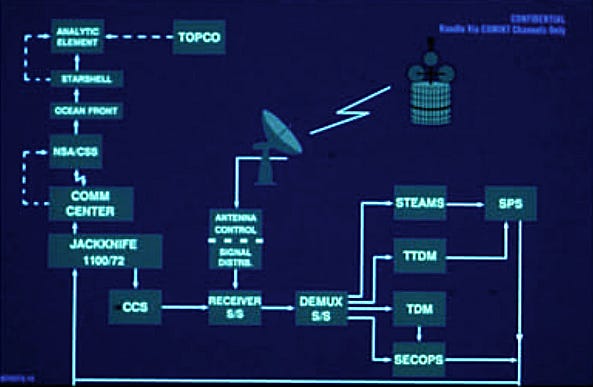 A well-refined pipeline existed for the analysis and collection of satellite intelligence. Souce: Wikipedia.Press enter or click to view image in full size
The RF Layer
The signals intelligence problem that Echelon was built to solve is, at its core, an RF engineering problem, and it is worth understanding the technical foundation before moving to the political empires that ran it.
Geostationary satellites sit at approximately 35,786 kilometres above the equator, positioned to remain stationary relative to the ground below. They receive signals transmitted from Earth, amplify them, and retransmit them back down over a coverage footprint that can span an entire hemisphere.
A single satellite can carry thousands of simultaneous telephone calls, teletype circuits and data connections, providing a target-rich environment for those who might like to snoop on some traffic.
This matters because as each satellite receives a transmission and re-broadcasts it back to Earth, it creates a giant “footprint”. Radios are apolitical. They do not care about privacy, and physics dictates that stations within the footprint remain perfectly capable of intercepting this traffic using an appropriate antenna.
Each ground station would use multiple dish antennas that were capable of staring at geostationary satellites and hoovering up large volumes of traffic that passed between them. This traffic would be stored, then separated into individual channels that were able to be analysed later on.
This analysis would be automated under a program known as DICTIONARY. This would use keywords to classify traffic against a known dictionary of keywords that had been pre-registered. If DICTIONARY registered traffic that would contain these keywords, it would flag the traffic for further analysis. If no keywords were found, the traffic would be discarded.
And in case you're wondering, yes, you’re absolutely right. That is essentially warrantless surveillance under the same “greater good” goal we’ve been fed for decades.
The interesting part of the program isn’t that this was occurring. It was that each individual partner reportedly had their own DICTIONARY keyword system that was directly relevant to their intelligence needs.
For the radio nerds in the audience, the frequency bands of primary interest were the C-band and Ku-band allocations used by commercial and military communications satellites (Roughly 3.7 to 4.2 GHz for C-band & 10.7 to 12.75 GHz for Ku-band).
The ground stations required for collection at these frequencies are large, expensive and difficult to conceal. They are, in many cases, still visible today. The Menwith Hill facility in Yorkshire currently operates more than thirty radomes. Pine Gap has expanded significantly since its establishment in the 1960s.
This is one of the most interesting parts of the program. The infrastructure is not, and was never hidden. The purpose is what was denied. The Snowden era leaks would give plenty of new information on Echelon. Source: Wikipedia.
The Secret Is Out
The concept of open-source intelligence (OSINT) can be quite controversial. Some claim this is little more than glorified Googling, however, in 2026, the effectiveness of the technique has been validated on many occasions.
Interestingly enough, OSINT would play a key role in the uncovering of the program. The first leaks would not come from the military or a government whistleblower. They would come from an investigative journalist working with public datasets.
In 1988, Duncan Campbell published an article in the New Statesman titled “Somebody’s Listening”, in which he described the existence of a global signals intelligence network operated by the United States and its English-speaking allies. Campbell, who had pieced the picture together from declassified documents, academic papers, planning records and interviews with former intelligence personnel, would then make the stunning claim that the network was targeting civilian communications traffic.
The response from the Governments of the day was surprisingly lukewarm. Their response would be almost template-like, ignore the claims, do not challenge the sources and do not confirm or deny any information regarding the program.
It would take another full decade before the noise became too loud to ignore. In 1999, the European Parliament would commission an investigation into signals intelligence activities affecting European citizens and businesses. The resulting STOA report (Scientific and Technological Options Assessment) would name Echelon explicitly, describe its architecture in explicit detail, and reach a conclusion that went significantly beyond the question of military surveillance.
The revelations were stunning. What had started as a military intelligence apparatus had eventually been turned inwards. While intercepting civilian traffic was a revelation, the report also claimed that the Echelon program had also carried out corporate espionage in the aim of furthering American economic goals.
The political fallout was significant in Europe and carefully managed in Washington. The United States neither confirmed the commercial espionage allegations nor offered a credible denial. The UK, whose territory hosted some of the most important collection infrastructure in the network, maintained its position that it did not comment on intelligence matters. The European Parliament passed a resolution recommending that European businesses encrypt their communications.
As usual, very few businesses listened.
And more importantly, Echelon had just weathered another storm and marched straight through it essentially unscathed.
The public knew. However, nobody really cared.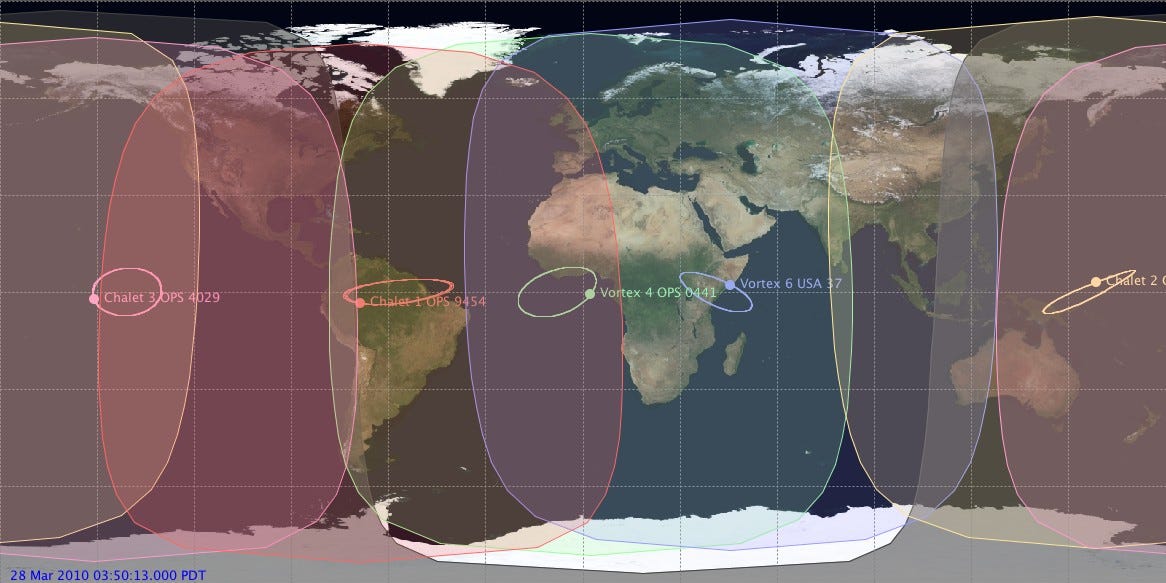 The US Vortex satellites would be identified as part of the space-based intelligence gathering apparatus. their footprint was essentially global. Source: Wikipedia.
When The Curtain Dropped
A small hint of irony would come with the fact that when Echelon would face sweeping structural changes, it would come as the result of an incident that the program was designed to prevent. The attacks on September 11 would lead to sweeping changes to the intelligence apparatus, and for the most part, they wouldn’t be for the better.
The early Echelon framework was designed to target the military infrastructure. A successful terrorist attempt on US soil would reframe this dynamic entirely, and civilian communications would play a key role in this.
The budget allocated to SIGINT collection would expand dramatically, and the legal framework that held it all together would also be expanded as well. The result of this was a better-funded project that was run with far looser legal guidelines than we’d seen previously.
Privacy was treated as a binary; you were either for it or against it, with no middle ground accepted. With minimal political resistance to developing this framework, years of this would end up with an Echelon program that looked very different to the one Duncan had described in the 80s.
It’s worth considering just how much the shift to digital communications has helped to feed this monster. When Echelon started in the post-war era, the majority of communications were not digital. In the aftermath of 9/11 and into the age of social media, the bulk of communications became digital. If this were a trap, you could almost say that we walked right into it.
However, the age of the whistleblower wasn’t quite over yet. In June 2013, a contractor working for the National Security Agency named Edward Snowden would provide journalists at the Guardian and the Washington Post with a haul of classified documents describing the current state of American and British signals intelligence collection.
The programmes revealed were PRISM, XKeyscore, Tempora & MUSCULAR. While they were visibly different to early Echelon, they were recognisably descendants of the original program.
The intent was the same. Collect as much traffic as possible, analyse for keywords and distribute to partners where necessary. The scale was different, as was the technical approach. However, the fundamentals would remain the same.
While people paid attention to the Snowden leaks, the reality was that we would see the same old strategies playing out as the fallout from the leaks was managed. We got false indignation, promises for reform and a commitment to investigate the program, while behind the scenes, the collection would continue.
As we close out the story of Echelon, it’s worth considering one final point. The network that was never supposed to exist has now been publicly acknowledged, partially documented and legally challenged in multiple jurisdictions. It has also been subjected to intense parliamentary and congressional scrutiny in multiple countries.
Yet the radomes still listen. The collection stations still operate. The hardware that powers the entire operation is better than it ever has been.
It turns out that knowing about something and being able to stop it are two entirely different problems.
Investigator515 explores the RF spectrum, cybersecurity, and the hidden tech behind modern espionage.
Follow for new content weekly
Bluesky • X • Substack
You might also like,
- OSINT Investigators Guide to Self-Care & Resilience
- Spies In The Mud: The RF-111 Aardvark
- What The Tech?! Space Shuttles