Radio & The Faraday Cage

Understanding how a shielded box would change how we think about RF security.
As you read this, what is broadcasting in the room around you? You probably have a phone, a wristwatch, maybe some wireless headphones, perhaps. In a digital world, it’s not uncommon for most people to carry multiple emitting devices over the course of a typical day.
Most of the time, that’s fine. But there are circumstances where RF emissions leaving a device or an environment are a serious problem, and understanding how to contain and control them is a useful skill that sits at the intersection of radio theory and practical security work.
The Faraday cage is the best tool for that job. It’s one of those concepts that sounds complicated until you understand it, and then it seems obvious. And, just to make it confusing, sometimes, it doesn’t require a cage at all.
Let’s break it down and see why this is an important consideration in RF testing.
 A Faraday cage takes many different forms. At the Green Bay Observatory, they are built into window panes to ensure that stray RF can’t disturb sensitive equipment. Source: Wikipedia.
Easy Physics
With the words “easy physics” rarely being used in the same sentence, you’ll be happy to know that the concept of a Faraday cage is as simple as it is effective.
Michael Faraday demonstrated in 1836 that a conductive enclosure could block electromagnetic fields. When an external electric field hits a conductive material, the free electrons in that material redistribute themselves to cancel the field out on the other side. The result is that anything inside the enclosure is shielded from electromagnetic radiation outside it and vice versa.
That last part is the important bit that most people miss. A Faraday cage works in both directions. Signals can’t get in, and signals can’t get out.
It’s important to note, though, that design plays a huge part in this, as does the wavelength of the frequency that you are trying to block. For the cage to work, the conductive material needs to be continuous. Gaps, seams, and openings that are large relative to the wavelength of the signal you’re trying to block will allow that signal to pass through.
To understand how this works in the practical sense, we can look at a gadget that nearly everybody in the modern world should have used at least once in their life. The modern microwave.
The mesh on the window has holes small enough that microwave-frequency radiation can’t pass through, but large enough that visible light can. That’s frequency-dependent shielding hard at work in everyday life.
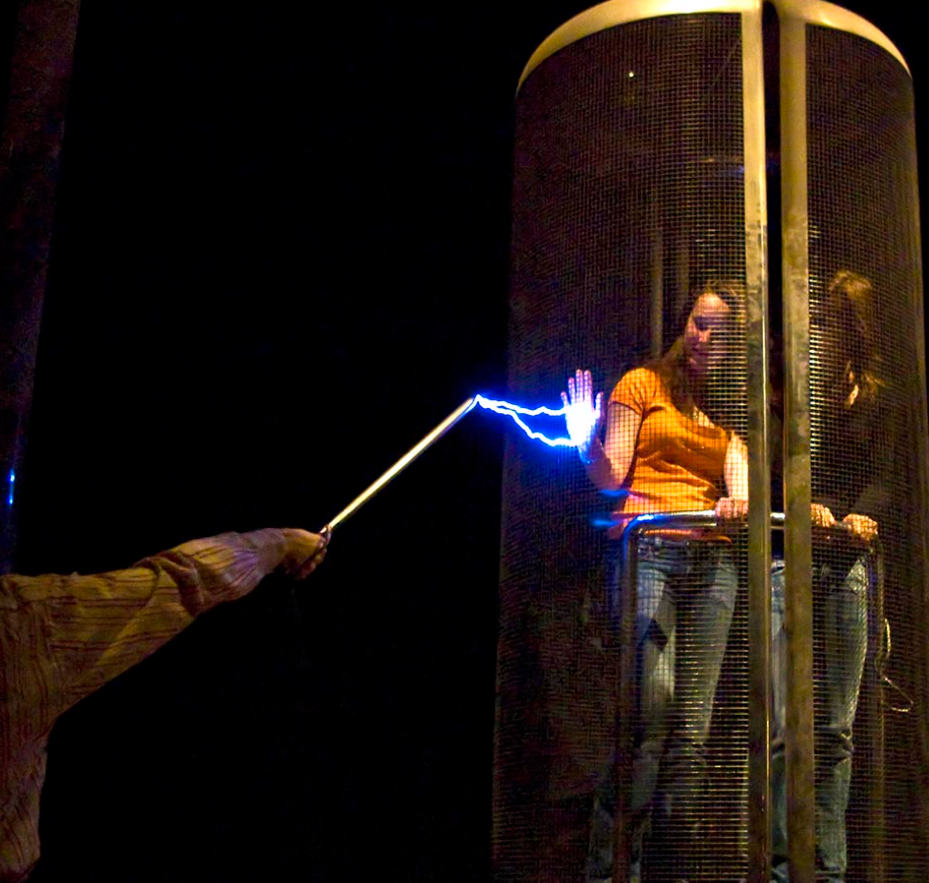 An example of shielding at it’s most extreme. Source: Wikipedia
Why It’s Relevant
For most people, Faraday cages are a curiosity. For people working in RF and security, they’re a practical tool with a few distinct use cases worth understanding.
Police agencies will often use Faraday bags when seizing devices for evidentiary purposes. This helps to keep the integrity of the evidence and prevent opportunities for remote wiping before the device can be examined.
They can also be used to prevent a device from phoning home before you have access to things at the hardware level. If you can’t be sure or are unable to lock things down, a secure test area will prevent your target machine from escaping the area.
Where they are particularly useful, though, is in a lab context. Often, we’ll look at signals or test theories that have the potential to do real-world damage and disruption, to say nothing of the legal attention that often comes with this.
A Faraday cage allows us to test theories and carry out research without the risk of it escaping into the real world or causing significant disruption. This is a net positive as it allows us to research things that we might not get to see under any other conditions.
Real World Usage: Want to be sure you’re avoiding being tracked by technical means? A phone in a Faraday Cage/Bag can provide some quick peace of mind.
 You might have heard about crisp packets being used as cages, but the reality is that different materials work for different frequencies. Source: Wikipedia.
What Actually Works
The good news is that basic Faraday shielding doesn’t require specialist equipment. The bad news is that the cheap solutions have real limitations, and understanding those limitations matters as much as understanding the concept.
Effective Faraday cages can be broken down into three different types:
- The Bag: Accessible, RF-shielded, and works well at Wi-Fi and Bluetooth frequencies. Widely available. However, you get what you pay for.
- The Enclosure: Ammo Cans, Biscuit tins, and old microwave ovens are all options that, when sealed properly, provide significant shielding capacity. The keyword is sealed. A lid that sits loosely on a tin is a gap, and gaps have a habit of leaking.
- The Anechoic Chamber: The professional solution. Often used by nation-states and intelligence agencies, commercially relevant and provides known shielding capabilities across a broad range of frequencies. The best possible option for when you simply can’t let something get out.
For most people reading this, a quality Faraday bag for device isolation and a well-sealed metal enclosure for RF testing work covers the majority of practical use cases.
As always, you should determine capabilities against your own circumstances and needs to get the best results.
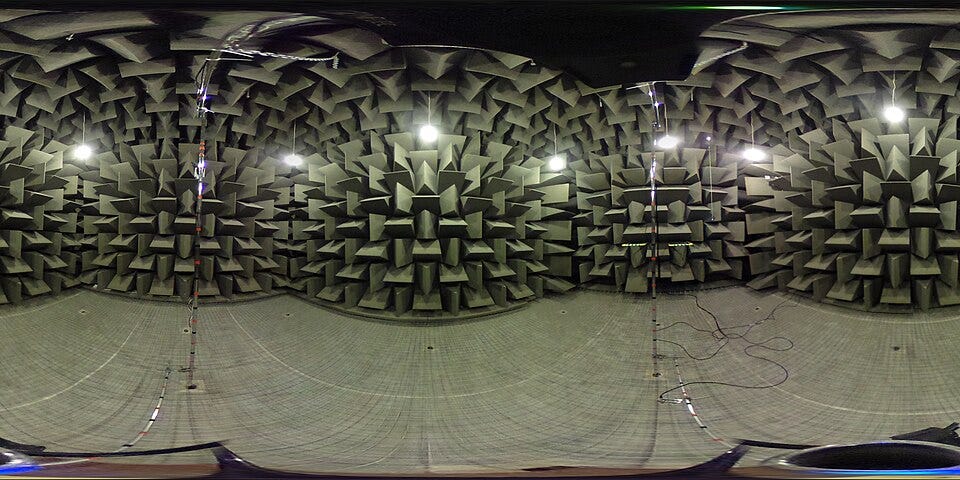 Proper Anechoic chambers cost a bomb and look kind of weird on the inside. Source: Wikipedia.
It’s All In The Numbers
Here’s the thing about Faraday cages that most writeups don’t spend a huge amount of time considering. Building one is easy. Knowing whether it actually works and what its effectiveness is is a different question entirely.
A bag that offers near-perfect attenuation at 900MHz might be nearly transparent by the time it’s working at the 2.4GHz Bluetooth range. That metal tin with a perished seal might perform amazingly from the sides because everything is being pushed out of the gaps in the lid.
These are the types of variables that we encounter in the real world, and to understand how they affect us, we will have to test them. And testing them means creating conditions that allow us to have a clear understanding of what exactly it is that is getting through.
In case you’re interested, that’s where an SDR comes in. And that’s exactly what we’re going to cover in the next part of this series.
Investigator515 explores the RF spectrum, cybersecurity, and the hidden tech behind modern espionage.
Follow for new content weekly
Bluesky • X • Substack
You might also like,
- OSINT Investigators Guide to Self Care & Resilience
- Spies In The Mud: The RF-111 Aardvark