Sovereign AI vs API AI: Why Enterprises Are Switching

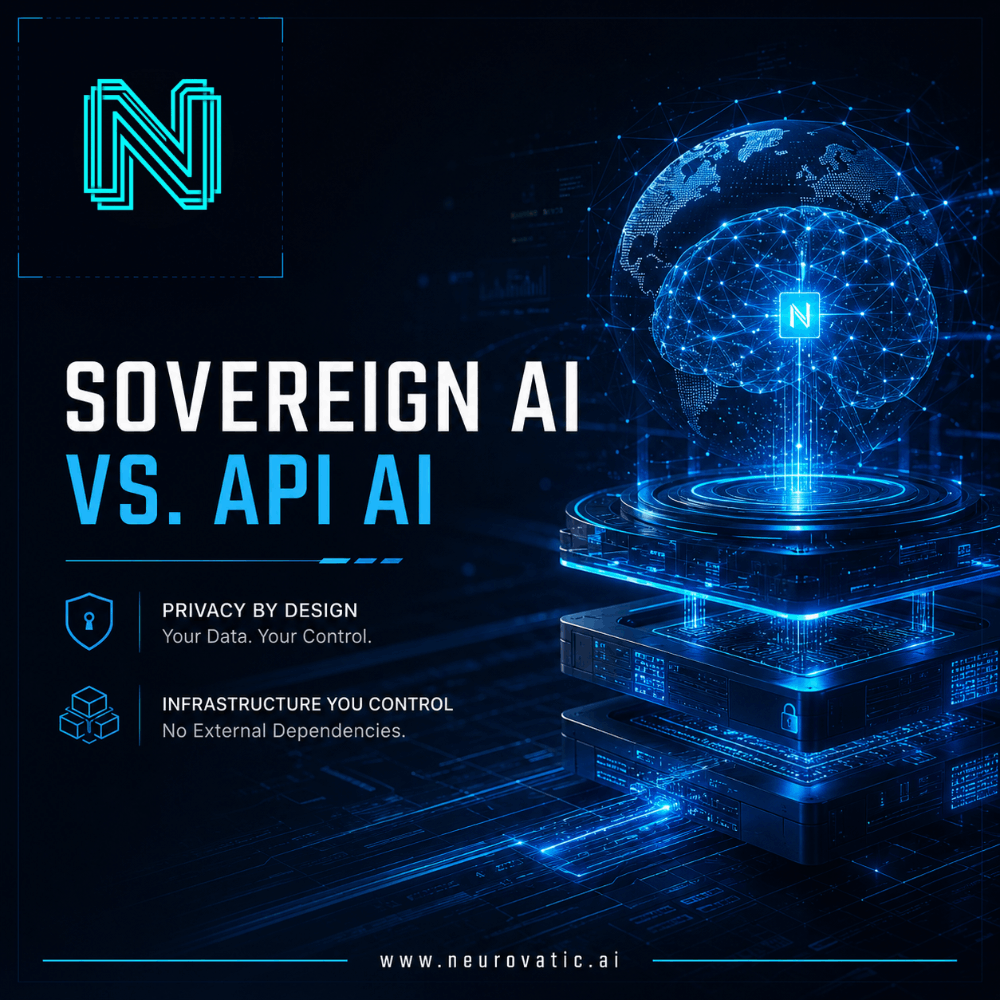
As AI becomes increasingly integrated into critical business operations, however, many enterprises are also evaluating Sovereign AI architectures that provide greater control over infrastructure, governance, data handling and long-term operational independence.
Rather than replacing API-based AI entirely, Sovereign AI represents an alternative approach for organizations with strict security, regulatory or operational requirements.
Why Organizations Explore Sovereign AI
1. Greater Control Over Sensitive Data
For organizations operating in regulated industries such as healthcare, finance, critical infrastructure or government, controlling how sensitive information is processed can be an important architectural requirement.
Self-hosted AI deployments may reduce the need to transmit sensitive data to external AI services and can simplify internal governance policies, depending on the organization’s implementation and regulatory obligations.
2. Infrastructure Independence
Cloud AI services provide tremendous flexibility, but they also introduce dependencies on external providers for pricing, service availability, model lifecycle and feature evolution.
Organizations seeking long-term operational stability sometimes evaluate infrastructure that they can manage and evolve according to their own requirements.
3. Predictable Performance
Every remote API call introduces network latency.
For applications requiring deterministic response times — such as industrial automation, cybersecurity, robotics or algorithmic decision systems — local inference can offer lower and more predictable latency by removing external network communication.
Actual performance depends on hardware, networking and model architecture.
4. Governance and Auditability
Emerging AI regulations increasingly emphasize transparency, accountability and documentation.
Organizations deploying their own AI infrastructure can design audit mechanisms, logging strategies and governance processes that align with their internal compliance requirements.
5. Model Ownership and Customization
Running AI models on self-managed infrastructure provides greater flexibility regarding model selection, fine-tuning, deployment schedules and integration with proprietary knowledge.
This level of control may be valuable for organizations building AI as core infrastructure rather than as an external productivity service.
NEUROVATIC’s Approach
At NEUROVATIC, we are developing a Sovereign AI architecture based on the principle that organizations should be able to deploy intelligent systems with maximum control over their infrastructure, governance and operational lifecycle.
Our long-term architecture includes multiple complementary components:
- SIGMA: proprietary language intelligence designed for self-hosted deployment
- UNDECA: distributed cognitive architecture coordinating specialized AI capabilities
- NPoI (Neural Proof of Intelligence): a research initiative exploring verifiable AI decision provenance and auditability
- NV-CHAIN: blockchain infrastructure supporting governance, integrity and distributed coordination
- AEGIS: security and validation framework designed to strengthen trust across the AI lifecycle
Some of these technologies are currently under active research and development as part of the broader NEUROVATIC ecosystem.
Comparing Deployment Approaches
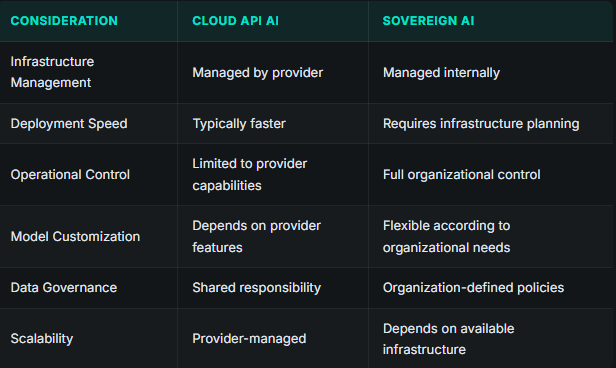
Choosing the Right Architecture
Cloud AI services remain an excellent solution for many startups, research teams and organizations that prioritize rapid deployment and managed infrastructure.
Sovereign AI becomes increasingly relevant when AI systems support mission-critical operations, process highly sensitive information or require greater control over governance, infrastructure and deployment strategy.
Ultimately, the appropriate architecture depends on an organization’s technical requirements, regulatory environment, operational objectives and long-term AI strategy.
To learn more about NEUROVATIC’s vision for Sovereign AI, distributed intelligence and verifiable AI systems, explore our whitepaper:
https://neurovatic.ai/whitepaper