ChatGPT Can't Do This — Why AI Agents Are a Completely Different Beast

Let's be honest about something most people won't say plainly: the AI revolution that the world experienced between 2022 and 2025 was mostly about one thing — better autocomplete.
ChatGPT blew everyone's mind. Rightly so. Suddenly you could have a conversation with a machine that understood context, generated coherent paragraphs, explained complex topics, wrote code, and passed bar exams. For most people, that was the revolution. The thing that changed everything.
Except it didn't change everything. Not yet. Because ChatGPT — and every tool like it — is still fundamentally reactive. You ask, it answers. You prompt, it responds. It does not decide. It does not act. It does not move on its own.
AI agents do. And that gap — between a tool that responds and a system that acts — is the difference between a calculator and an employee.
The Simplest Way to Understand the Difference
Think about what actually happens when you use ChatGPT or any standard AI chatbot.
You type something. The AI reads it, generates a response, and stops. If you want something else, you type again. The entire interaction is a back-and-forth where you are always the one initiating. The AI is always the one reacting. Nothing happens between your messages. Nothing is being done in the world. The AI is waiting.
Now think about what you actually need to get things done in real life.
You don't just need information. You need actions. You need someone — or something — to look up your calendar and schedule the meeting, not just tell you that Tuesday works. You need it to check the price, place the order, and confirm the shipping, not just explain how online shopping works. You need it to read the brief, run the research, draft the document, format it correctly, and send it to the right person — not respond to fifteen separate prompts while you do all the coordination yourself.
That is what AI agents do. They operate in the world, not just in a conversation window.
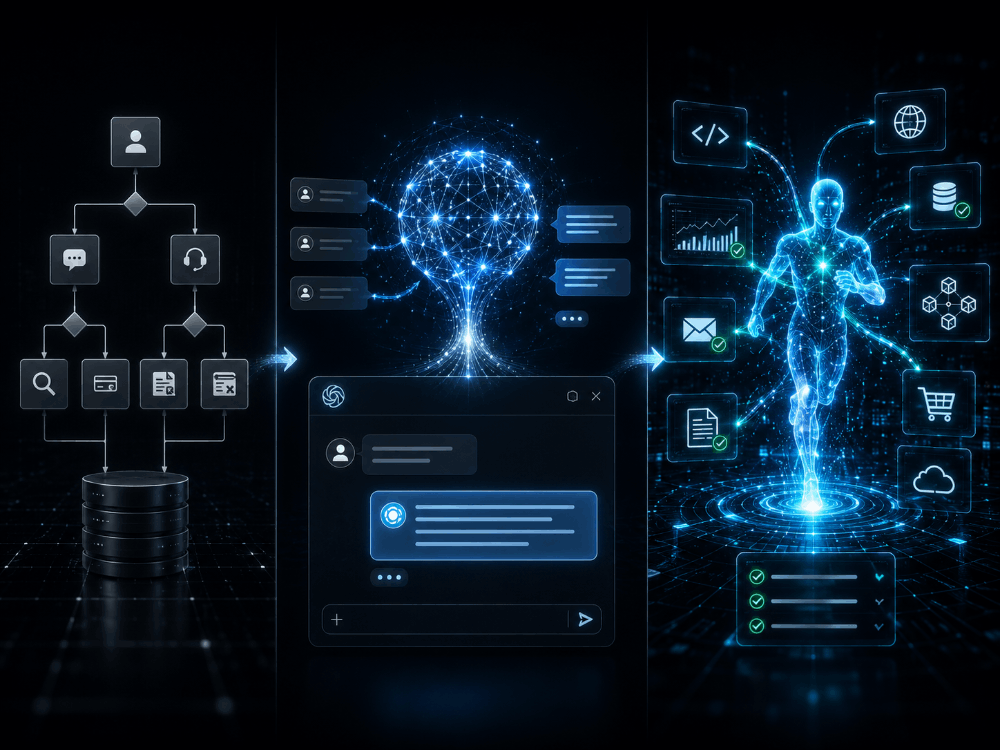
In 2026, three categories of AI exist on a spectrum, and understanding where each one sits changes how you evaluate every product claiming to be "AI-powered":
Rule-based chatbots follow a fixed decision tree. You ask a question, they match it to a pre-written answer. Banks use these. Airlines use these. They are not intelligent — they are menus disguised as conversations.
LLM chatbots — like ChatGPT, Claude in a basic chat window, Gemini — understand natural language and can reason. They are enormously more capable than rule-based chatbots. But they still operate in a request-response pattern. No autonomous tool use. No multi-step planning. No action in external systems unless you specifically set that up. They are read-only AI.
AI agents take the reasoning capability of an LLM and pair it with a reasoning loop, tool access, memory, and the ability to take action. They observe the environment, plan a sequence of steps, execute those steps using real tools, evaluate the results, and adapt. They are read-write AI. They change things in the world, not just describe them.
The line between an LLM chatbot and an AI agent is not always perfectly sharp — adding a single tool to a chatbot moves it toward the agent end of the spectrum. But the architectural difference is real. A chatbot without a reasoning loop processes one request at a time. An agent chains multiple observations and actions to solve compound problems.
What ChatGPT Can Do (And What It Cannot)
To be fair to the tool that genuinely started a revolution: ChatGPT is exceptional at what it is designed for.
Ask it to explain quantum entanglement in plain language and it will do it brilliantly. Ask it to write a cover letter and it will produce something better than most humans would in the same time. Ask it to debug a short function, summarize an article, brainstorm five angles for a blog post, translate a paragraph — it handles all of these tasks with remarkable competence.
But watch what happens when the task requires more than generating text in a single exchange.
Ask it to monitor your competitor's website and alert you when they drop a new product. It cannot. Ask it to check your project management tool, identify the tasks that are overdue, email the responsible team members with a summary, and update the status fields. It cannot do any of that by itself. Ask it to watch the price of a token on-chain and execute a swap when it crosses a threshold. Without a purpose-built agent layer on top, it cannot do it.
The underlying problem is not intelligence. ChatGPT is intelligent in the reasoning sense.
The problem is that it has no persistent existence between your prompts. It cannot watch. It cannot wait. It cannot act without you first sending a message. It has no memory that persists across sessions by default, no access to external tools unless you specifically enable them, no ability to chain multiple actions toward a goal over time.
2025 was the year chatbots went mainstream. 2026 is the year autonomous agents move from research labs into production environments. The difference is not incremental — it is architectural.
What AI Agents Can Do That Changes the Equation
The best way to understand what agents add is through concrete examples of what actually happens in production systems today.
In sales: A chatbot can respond to an incoming inquiry if the lead contacts the company first. An agent can autonomously scan a CRM for qualified leads, draft personalized outreach messages, send them, follow up automatically based on response patterns, schedule meetings when interest is detected, and log every interaction — without any human initiating each step.
In customer service: A chatbot can retrieve a FAQ answer. An agent can access the customer's account, identify their issue, take the remedial action, update the record, send a confirmation, and resolve the ticket — handling up to 80% of interactions without human escalation when properly integrated.
In software development: A chatbot can explain what a function does. An agent can review an entire codebase for architectural issues, run tests across multiple files, identify failures, propose and apply fixes, and iterate until the test suite passes — autonomously.
In finance: A chatbot can explain what DCA means. An agent can monitor market conditions, rebalance a portfolio according to defined parameters, execute transactions across multiple platforms, and report back — without waiting for manual approval on each step.
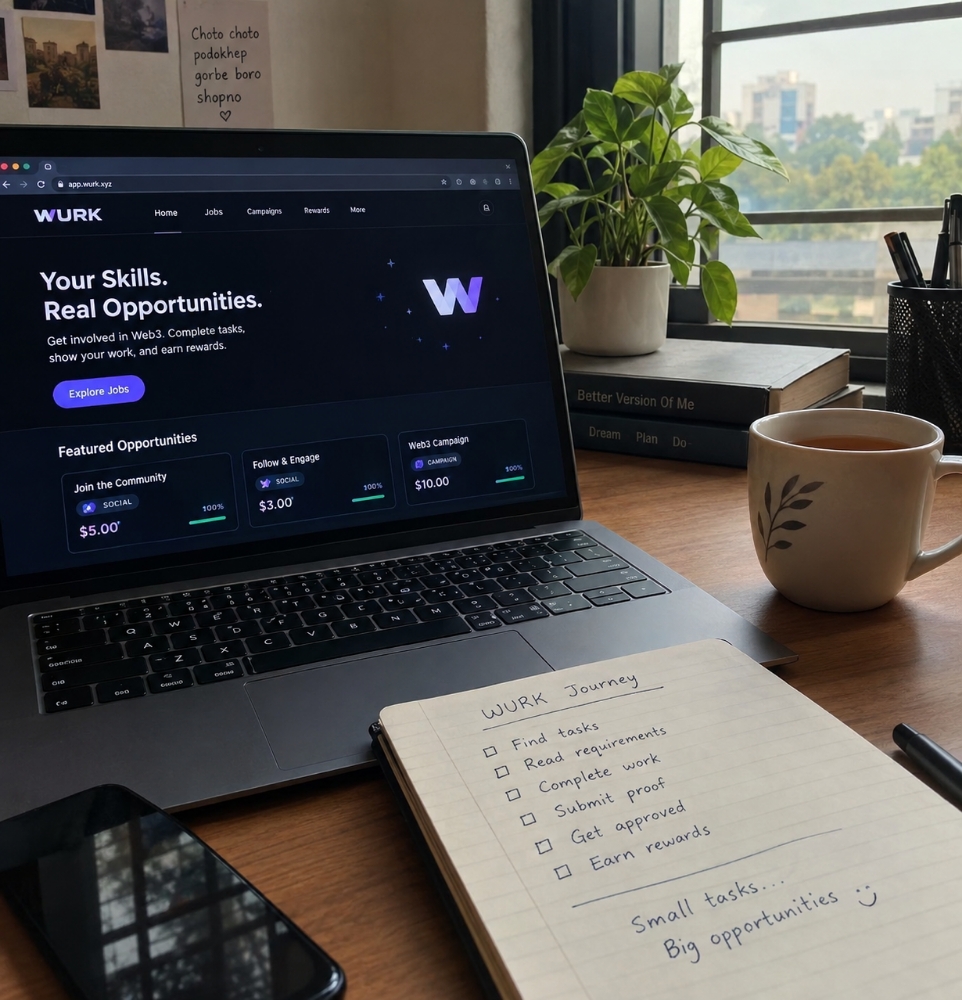
In Web3 specifically: A chatbot can describe what WURK does. An AI agent can post a microtask on WURK, select a qualified human worker, pay them automatically on Solana via x402 when the work is verified, and move on to the next task — all without a human operator touching the interface.
The pattern is consistent across every context: the chatbot describes or responds to a single thing. The agent does a sequence of things, adapts when something changes, and produces an outcome — not just a response.
The Technical Reason This Is Possible Now and Not Before
Something real changed in 2024 and 2025 that made agents viable at scale in a way they were not in 2023.
Two infrastructure protocols emerged as the connective tissue of the agentic layer. The Model Context Protocol (MCP), introduced by Anthropic in November 2024, became an open standard for connecting AI systems to external tools, databases, and applications — think of it as USB-C for AI. By March 2025, OpenAI announced full support. The protocol spread rapidly because it solved the integration problem: instead of every agent needing custom connections to every tool, MCP provides a standardized interface.
The Agent-to-Agent protocol (A2A) — backed by Google and adopted across the industry — extended this further, allowing different agents to communicate and coordinate with each other. Multiple specialized agents can work together on a complex task, each handling the piece it is best equipped for, coordinating through a shared protocol.
The combination of these two infrastructure layers is what makes complex agentic workflows possible at scale — not just in controlled demos, but in production systems handling real tasks for real businesses.
Why This Matters for Web3 Specifically
The connection between AI agents and Web3 is not incidental. It is structural.
AI agents need to transact. They need to pay for API access, license data feeds, hire human workers, purchase compute resources, and route micropayments to counterparties — all in fractions of a cent, thousands of times per hour, without human approval on each transaction.
Traditional payment rails cannot support this. Credit card processing fees exceed the value of most agent micropayments. Bank transfers are too slow. Even most crypto transactions on congested networks are too expensive for sub-cent machine-to-machine payments at scale.
Solana's architecture — sub-cent fees, sub-second finality — solves this at the infrastructure level. The x402 payment standard, now backed by Coinbase, Stripe, Visa, Mastercard, and Google, gives agents a standardized way to discover a service price, pay for it, and receive the result inside a single HTTP exchange — no accounts, no subscriptions, no human approving each step.
This is why the most sophisticated agent platforms are building on Solana. WURK's agent-to-human endpoint lets AI post microtasks and pay human workers automatically. Fetch.ai's Agentverse deploys autonomous agents for DeFi and data workflows. Virtuals Protocol lets builders create tokenized AI agents that transact across decentralized networks. These are not chatbots with a Web3 wrapper — they are autonomous systems that operate, earn, and spend within the on-chain economy.
The Honest Limit Nobody Wants to Say Out Loud
AI agents are not magic. They are not the final form of intelligence. And the gap between what they can do in a polished demo and what they reliably deliver in production is real and wide.
Agents fail in unscripted environments more often than their proponents admit. They get confused by unexpected inputs. They sometimes take actions that are technically correct by their parameters but wrong in context. Production-grade agents in regulated industries or high-stakes financial environments require careful design, monitoring, and human escalation paths for edge cases.
And most things that call themselves "AI agents" in 2026 are not agents in the full architectural sense. They are chatbots with a tool or two bolted on, or workflow automations with a language model generating the text at one step. The term has become a marketing category as much as a technical one — which means evaluating any specific claim of "agentic AI" requires looking past the label and asking: does this system actually perceive, reason, hold context, and act autonomously across multiple steps? Or does it just answer questions and occasionally look things up?
The real agents are arriving. But they are arriving alongside a lot of things that are not real agents but want to be called that. The ability to tell the difference is the most valuable thing you can take from this article.
Why You Should Care — Even If You're Not a Developer
If you are a creator or freelancer, agents are already routing work your way through platforms like WURK — microtasks posted autonomously by software, paid automatically when completed. This is new income infrastructure that did not exist in 2023.
If you are a token holder or investor, agents are not a narrative to trade around a market cycle. They are the reason companies like JPMorgan have 450+ agent use cases in production, the reason Microsoft calls 2026 the year of the agent, and the reason institutional capital is flowing into the projects building the underlying infrastructure. The question is not which AI agent token moons next — it is which platforms have real agents running real transactions.
If you are everyone else, the honest summary is this: ChatGPT showed you what AI could say. Agents will show you what AI can do. The gap between those two things — between talking and acting — is where the next decade of productivity, business, and economic change is going to happen.
The chatbot era was impressive. The agent era is going to be consequential.
Written for the @XlusiveWeb3 content portfolio · June 2026