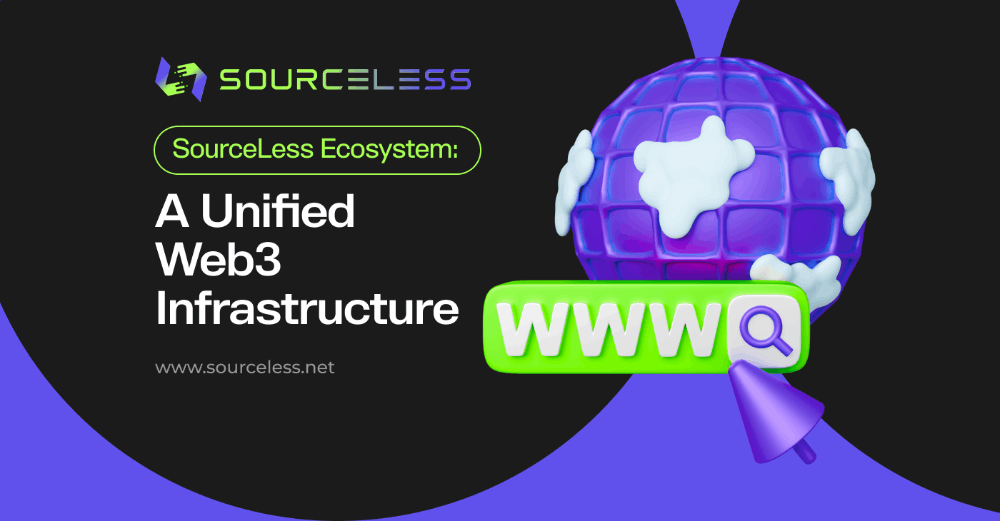
SourceLess Ecosystem: A Unified Web3 Infrastructure

Most of us have only known the web in its latest form: Web 2.0. It’s the interactive, read–write, social version of the internet. You can create something and publish it instantly for people around the world to see, react to, and discuss. Upload a video, and it can reach millions who can watch, interact, and comment.
Platforms like YouTube, Facebook, Flickr, Instagram, and Twitter became the face of Web 2.0. Think back to what these sites felt like when they launched, then compare that to how dominant they are today.
That growth made the web more participatory and massively scalable. It also concentrated power: a handful of companies ended up holding most of the user data, which made large-scale data mining possible — sometimes beneficial, sometimes exploitative.
As more users lost control to these platforms, interest grew in what became known as Web 3.0.
Under the hood, the Web 2.0 era relied on centralized control. Infrastructure could be spread across servers, but control stayed with a small group — and privacy and data-usage problems followed.
Web 3.0 developed with decentralization as a core requirement. Web3 applications are meant to be deployed in decentralized ways, and their data storage is decentralized too. But that transition toward Web3 raised a practical question: what does decentralization look like when you try to use it every day?
It’s easy to agree with the idea in principle. It’s harder to build systems where identity, access, communication, and ownership actually work together without falling back to the same old chokepoints. Because in practice, most of “decentralized” experiences and Web3 projects still begin at the same place: email, passwords, and account recovery.
Back in 2024, Microsoft’s Digital Defense Report pointed out that password-based attacks make up over 99% of the 600 million daily identity attacks they track in Microsoft Entra. Verizon’s DBIR keeps showing the same weak point from another angle: stolen credentials remain one of the most common ways systems get compromised.
That’s the problem SourceLess set out to solve.
Rather than treating Web3 as a collection of disconnected tools, SourceLess is developing an ecosystem where a decentralized identity layer (STR Domains) can be used as a consistent entry point across servicesso access and ownership aren’t spread across dozens of accounts and platforms, but always rooted in something the user holds.
If Web2 trained us to “log in” to exist online, the next step is making identity portable, verifiable, and usable across an ecosystem and without handing the control back to centralized gatekeepers.
STR Domains: the access key inside SourceLess
An STR Domain is designed to act as your identity inside the SourceLess ecosystem. It’s the identifier services recognize for login, access, signing, and trust-based interactions.
In practice, it can serve as:
· your ecosystem login
· your identifier across SourceLess services
· a way to sign or confirm actions
· a consistent handle tied to ownership
When you own an STR Domain, control stays with you. It doesn’t depend on a platform administrator the way a Web2 account does. The obvious caveat still applies: ownership is only as secure as the way you secure your keys.
That difference is exactly the point. Web2 accounts are granted and managed by platforms. STR Domains are meant to be held and used by the user.
Why ecosystem access should be domain-based
The modern internet is built around platforms. You “get access” because a centralized system allows it, under rules you don’t set. That’s why online identity can change overnight: accounts get suspended, impersonated, locked behind recovery loops, or pushed through shifting policy and moderation decisions. And even when nothing goes wrong, your digital life ends up scattered across countless logins.
SourceLess shifts the starting point from accounts to owned identity. Instead of creating a separate account for every service, ecosystem entry is meant to start from the STR Domain identity. It functions closer to a passport than a profile: a consistent identifier that can be verified and recognized across services.
The goal is a foundation where identity is owned by the user, verification is cryptographic, and ecosystem access becomes more coherent — without pretending this removes every risk or replaces good security habits.
Unified Services Under One Secure Identity
The SourceLess ecosystem includes multiple major platforms, designed to work as one system, with the STR Domain as the connective layer across them.
Key ecosystem components include:
· SourceLess Blockchain & Hybrid Network
· IgniteHeX (Hybrid Exchange & ecosystem gateway)
· Ccoin Finance & Ccoin Bank
· STR Talk (secure communication layer)
· ARES AI (intelligent support and automation)
· StrDome / Marketplace for Business
· SLNN Mesh (decentralized internet infrastructure)
· SourceLess tools and identity-based applications, and more
As integration expands, the STR Domain is intended to become the default way users access and use these services across the ecosystem.
Data Safety by Design
Most Web2 services collect and store user data on centralized servers. That concentration is convenient for platforms, but it also creates obvious pressure points: breaches, internal misuse, third-party access, and monetization through profiling.
SourceLess is built to reduce how much trust users have to place in a central operator. The idea is straightforward: when identity and access are anchored in something the user holds, you don’t need to expose the same amount of personal data just to prove you’re “allowed in.”
Using STR Domains as identity anchors, SourceLess aims to reduce the exposure that comes with centralized credential systems. The direction is toward:
- minimal personal data exposure
- identity verification without turning the user into a data source
- cryptographic proof in place of “trust the platform”
Identity That’s Harder to Imitate
On Web2, impersonation is constant. Someone can copy your name, your photo, your brand, and create a convincing fake in minutes. Platforms try to moderate it, but the default identity model makes imitation easy and cheap.
STR Domains add proof to identity.
A domain like str.maria is unique, and its ownership can be verified on-chain. So instead of guessing whether an account is real based on a badge or a profile page, you can check whether the domain is controlled by the correct owner.
That enables a different trust standard: when you receive a message, a transaction, or an interaction tied to a specific STR Domain, authenticity can be verified through cryptographic ownership rather than platform optics.
And this stays relevant wherever identity needs to be trustworthy: communication, payments, contracts, services, and community systems.
Ownership as the Core Value and a Usable Model
STR Domains are treated as assets. Why: because an asset behaves differently than an account. It is held by the user, it can be verified, and it can be used across services without recreating identity each time.
That also changes how access scales globally. The internet can be “available” while participation is still blocked by region locks, banking friction, platform bans, or policy pressure. A domain anchored identity model reduces how often identity is the first gate you have to negotiate.
SourceLess is connecting multiple services under one identity layer so users don’t have to keep rebuilding trust and access every time they move between tools.
As the ecosystem becomes fully connected, STR Domains are intended to be the required sign-in for SourceLess services. That keeps authentication, access, and ownership tied to something the user holds, instead of drifting back to email accounts, passwords, and platform-controlled profiles.
References:
Microsoft Digital Defense Report 2024 (Identity and social engineering)
Microsoft2024 Microsoft Digital Defense Report (MDDR) | Security Insider
Verizon DBIR 2025 — additional research on credential stuffing
erizonVerizon Business
FTC (Consumer Sentinel) — 2024 fraud and identity theft reporting figures (press release, March 10, 2025)