IgniteHEx Explained: Staking, Swaps, Governance

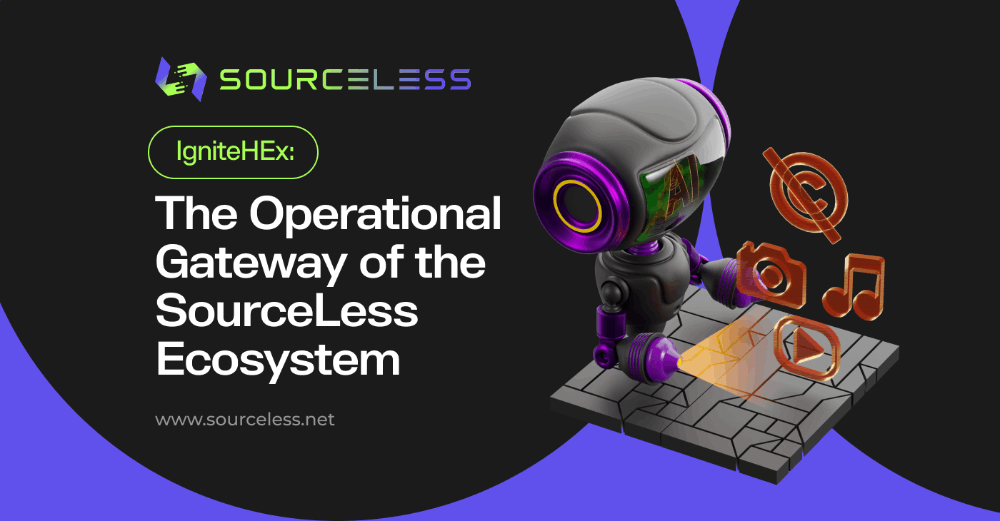
On growing Web3 ecosystems, users face a familiar problem: fragmentation. You need one place for staking, another for swaps, another for governance. IgniteHEx is where you actually use the SourceLess ecosystem. Stake, swap, govern, bridge, access your CCoin card, monitor your rewards. It is the single environment where the ecosystem’s moving parts become something a person can interact with. That is worth understanding clearly, because it shapes everything about how the platform is built.
Five Tokens, One Place
The SourceLess ecosystem runs on five native tokens, each with a distinct role.
STR is the root — governance, identity creation, DAO participation.
wSTR is its wrapped form, a stablecoin proxy backed by 1,000 STR per domain treasury vault.
CCOS (Cross-Chain Operating System) handles the financial layer — zero-fee payments across chains and within the network.
ARSS fuels the ARES AI engine, satellite operations, and edge computing. eSTR converts verified renewable energy into programmable sovereign value.
These are not interchangeable. Each one does something specific, and IgniteHEx is the place where you manage all of them without switching contexts. Live exchange rates update every 30 seconds. Swaps are zero-fee when you are validated through STR.Domains. The crypto-to-fiat path goes directly to your CCoin Visa card and settles in two to five minutes.
The platform holds $25.3M in total value locked across its governance pools, with 5,259 active stakers and 847,200 wSTR distributed in rewards. These are not projection; they are the current state of the platform.
Staking as a Position, Not a Trade
The governance staking pools on IgniteHEx cover three assets: STR, CCOS, and STR Domains. Lock periods run from 3 months to 48 months, and the multiplier structure is straightforward — the longer the commitment, the higher the return. A 3-month lock earns a 1x multiplier and a base APY of 11%. A 48-month lock earns a 4x multiplier and a base APY of 35%, with a maximum APY of 75%.
The range matters. Three months is a reasonable entry point for someone still orienting themselves. When you go up to forty-eight months — you’re saying you are here to be part of the ecosystem. You’re an active contributor. The staking structure accommodates both without treating either as the wrong answer.
Rewards are distributed daily as wSTR, delivered directly to the connected wallet with performance reports. Governance rights come with the stake and participants in these pools have a voice in protocol decisions.
What STR.Domains Actually Does Here
STR.Domains is the authentication core of IgniteHEx. When a user validates through STR.Domains, they unlock zero-fee transactions, seedless wallet management, and streamlined access across the ecosystem’s modules.
This is the identity-aware architecture in practice.
Your wallet address is a starting point; your STR Domain is what the ecosystem recognizes. It connects your staking positions, your governance participation, your swap history, and your CCoin card access under a single, persistent identity. The security model — AES-256 encryption, asymmetric keys, anti-quantum protection — runs underneath all of it.
The practical effect is that IgniteHEx does not treat each session as a fresh interaction. It knows who you are within the ecosystem, and that continuity changes what the platform can do for you.
The Modules
IgniteHEx is structured around a set of discrete modules, each handling a specific function. Swap covers token-to-token, token-to-fiat, and fiat-to-token exchanges.
MultiBridge handles cross-chain swaps and liquidity visibility.
The A.R.E.S Engine triggers programmable workflows and smart routing. STR Domains Pools manages staking, proposal voting, and domain statistics.
The CCoin Card module connects directly to your IBAN-linked account for funding and withdrawal.
Energy Indexing tracks eSTR-based energy flow from SourceLess mesh nodes.
The STR Domain Marketplace handles buying, selling, and governance strength browsing.
Each module is self-contained but operates within the same authenticated environment. You do not re-verify between them. You do not move to a different platform. The architecture is modular by design; this means new functions can be added without disrupting what already exists.
Infrastructure Behaves a Certain Way
The platform supports MetaMask, Trust Wallet, WalletConnect, and browser wallets. It runs across SourceLess, Ethereum, BSC, and Polygon. The STR staking pool currently holds 14.1 billion STR. The CCOS liquidity pool sits at $2.7 billion. These numbers reflect a system that is already operating at scale.
Infrastructure does not announce itself. It does not ask you to be excited about it. It handles what it is supposed to handle, consistently, and makes the things built on top of it possible. IgniteHEx is built to that standard — not as the most visible part of the SourceLess ecosystem, but as the part that makes the rest of it usable.
That is the role it occupies, and it is the right one.
If you’ve been watching the SourceLess ecosystem grow but haven’t stepped in yet, the best way to understand IgniteHEx is to simply use it. It can look complex from the outside, but it’s built to be a home base. Connect your wallet, explore the staking pools, and see how the modules actually fit together. It’s ready when you are.
Learn more about the SourceLess ecosystem: SourcelessSourceLess
Explore IgniteHex: IgnitehexIgniteHeX — SourceLess DEX