DexBooster One vs GMGN, DexScreener and the usual trading terminals: what each one is actually for.
Most people don't use one crypto tool. They use four tabs: a chart site, a sniper bot, a security checker, and a Telegram channel that tells them what already pumped. Each tab solves one piece, and the cost is the time you lose jumping between them.
DexBooster One is an attempt to put the pieces in one place. This is an honest look at what it does, and where the other tools you probably know are still the better choice.
What DexBooster One is
A multi-chain DEX terminal for Solana, Ethereum, BNB Chain, Base and Robinhood Chain. You open a token and get the chart, the trade feed, the risk readings and the holders on one page, with the same layout on desktop and phone.
The parts that matter in daily use:
- Trending, Hot Pairs and a Meme Mode board with New, Almost-bonded and Migrated columns, filtered by chain with one click.
- Radar: tokens that are trading hard in the last hour but are not listed on the site yet. It is built from live swap data and a security check, and each row shows the sell-test result, so you see the risk before you click.
- Token readings on every page: top-10 holders, dev wallet, snipers, insiders, bundlers, tax, LP burned, and the dev's launch record (how many tokens they launched and how many migrated).
- Honeypot simulation: a real buy-then-sell test, not just a flag from a list.
- Whale trades and followed-wallet alerts.
- Instant wallets on Solana and Robinhood Chain, so you can trade from the page.
- Paper sniper: test a sniping strategy with fake money first.
- Dex Boost: projects can pay to be pinned and boosted on the board, and that is clearly marked.
How it compares
Where the others still win, plainly:
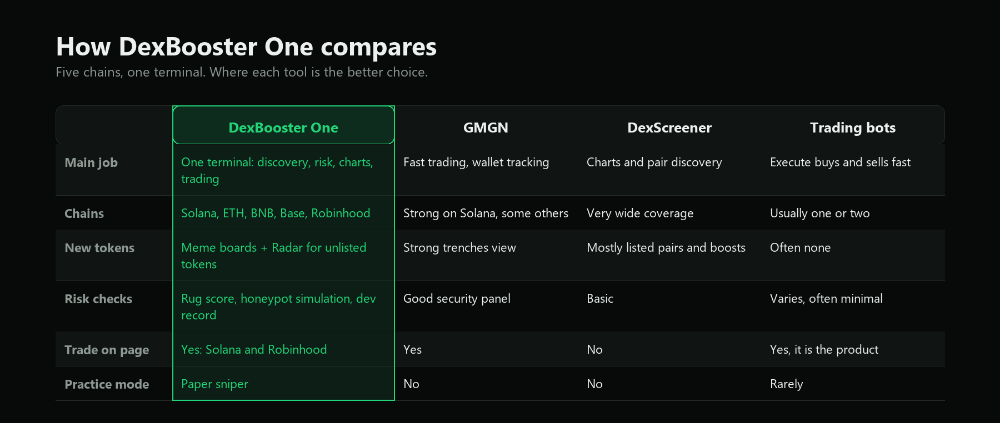
- GMGN is very good at what it was built for. If you trade Solana memecoins all day and live inside copy-trading and smart-money tracking, it is a deep tool with a large user base. DexBooster does not try to replace that depth; it tries to give you more context around a token on more chains.
- DexScreener covers far more chains and pairs than we do. If you need a rare network, that is where you look. It does not trade for you and it does not tell you much about the risk.
- Telegram bots are the fastest way to click buy. They are poor at telling you whether you should.
Why Radar is the part worth trying
Every discovery tool shows you what is already listed. By the time a token reaches a trending list, the first move is often over. Radar looks at it from the other side: it watches where trades are happening, and surfaces tokens that are busy but still unlisted. It also has stricter rules for old tokens (nothing over 20 days) and looser ones for brand-new pairs, so a token that is 20 minutes old and has real wallets behind it can still show up.
It is higher risk by definition, which is why the sell-test column sits next to the price. The point is not to tell you what to buy. It is to let you look at something early and decide quickly whether it is worth a closer look.
Who it is for
- Traders who watch more than one chain and are tired of a different site for each.
- People who want the risk picture (dev, snipers, bundlers, sell test) before they buy, not after.
- Project teams who want a visible, labelled place to promote a token.
It is not for you if you only trade one chain through one bot and never look at anything else. That workflow is already well served.
Try it
Open dexbooster.one, pick a chain with the chips above the table, and start with Radar and the Meme board. Check a token page before you buy anything, and test any strategy on paper first.
This is not financial advice. New tokens carry a high risk of total loss. Do your own research.