Why Natix is Sunsetting Drive& for Something Much Bigger

If you’ve been propping your smartphone against your windshield to earn crypto while sitting in traffic, I have some news that might make you hit the brakes. Natix Network (the DePIN project that turned our commutes into a giant data-mining experiment) is officially sunsetting the Drive& app on July 1st, 2026.
Now, before you throw your phone out the window in a fit of not another pivot rage, take a breath. This isn’t a they’re running out of money move. It’s a they’re moving from middle school to NASA type move. Natix is shifting its focus from basic smartphone mapping to something they call Physical AI, and the implications for the $NATIX token and the future of autonomous driving are actually pretty wild. Here is the breakdown of the hardware pivot, the airdrops you need to claim, and why a French automotive giant just stepped into the mix.
Why You Need to Move Your $NATIX by June 30th
First things first, the logistics. If you’ve been accumulating rewards in the Drive& app, you have a hard deadline of June 30th, 2026, to withdraw them directly. While the team has stated a manual claims process will exist after the app goes dark on July 1st, it involves emailing support and waiting for quarterly batches. Hardly the instant gratification we’re used to.
To soften the blow of sunsetting their most popular entry point, Natix has launched a special staking campaign for Drive& refugees. It’s a lucrative bridge into their broader ecosystem. If you bridge your $NATIX out of the app and into their Deep Staking protocol within five days of withdrawal, you qualify for tiered airdrop rewards.
We’re talking about an additional 15% of your staked principal paid out in airdrop rewards on top of your standard staking APY, for those who commit to the long haul. The rewards are staggered to reward diamond-handed believers. A 2% bonus at three months, 3% at six months, and a final 10% kicker at the one-year mark. It’s a clever way to migrate the phone-only crowd into the core Physical AI mission while curbing immediate sell pressure during the transition.
From Dashboard Doodles to the VX360 Hardware Pivot
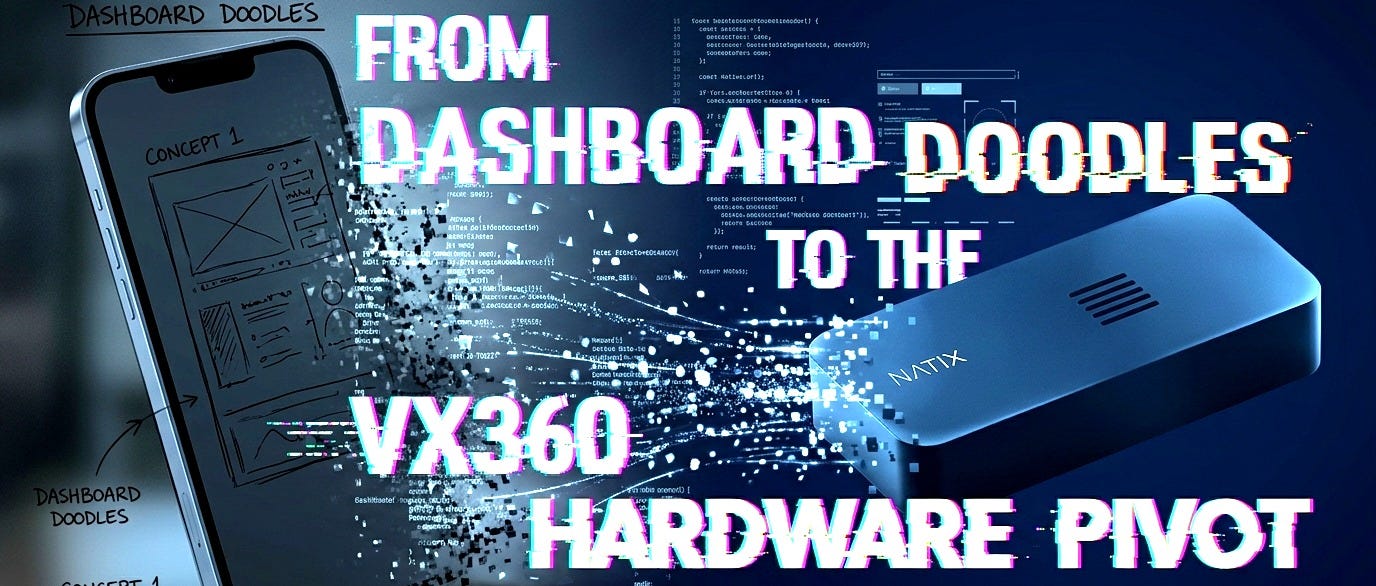
Why kill the app at all? Honestly, smartphones are great for Instagram, but they’re meh for training self-driving cars. A phone camera gives you a narrow, shaky view of the bumper in front of you. Natix is pivoting hard toward the VX360 hardware, a dedicated edge-computing device that turns your car into a high-fidelity data harvester.
The cool kid version of this is their specialized integration for Teslas. Instead of mounting a phone, you plug the VX360 into the glovebox USB. It taps into the car’s existing four-camera array, collecting a full 360-degree bubble of environmental data. With a 256 GB secure eMMC and high-precision GNSS, it’s capturing the kind of ground truth data that professional mapping fleets usually spend millions to collect.
Natix recently doubled down on this by joining the Autoware Foundation as a Premium Member. If you haven’t heard of them, Autoware is the gold standard for open-source autonomous driving stacks. Natix is essentially becoming the eyes for the world’s most important open-source self-driving projects. They are providing the raw, multi-camera footage that individual developers could never afford to collect on their own. They are no longer just making a map, they are building the training set for the future of autonomy.
The Valeo Partnership
This is where it gets a little sci-fi. Natix recently partnered with Valeo, a French Tier-1 automotive supplier whose cameras and ADAS sensors are built directly into vehicles from manufacturers like Mercedes, BMW, and Toyota, to build what they call World Foundation Models (WFM).
Think of a WFM as a predictive engine for reality. While a chatbot predicts the next word in a sentence, a World Foundation Model predicts the next few seconds of a physical scene in four dimensions (space plus time). It understands that if a ball rolls into the street, a child might follow, or if the road is wet, a car’s braking distance increases.
By using Natix’s massive library of 600,000 hours of multi-camera video, Valeo is supercharging its VaViM (Video Autoregressive Model) and VaVAM (Video-Action Model) frameworks. This moves the industry past simple if-then programming and into actual machine intuition. Most importantly, this isn’t a closed-door corporate secret. The partners are releasing these models and datasets open-source, positioning Natix as the foundational data layer for the entire global Physical AI community.
The Privacy Elephant in the Room
I know what you’re thinking, this sounds like a one-way ticket to a dystopian surveillance state. Having millions of cameras feeding a global database is usually the part of the movie where things go south. But the way Natix is building this is actually pretty clever from a privacy standpoint. They use something called Edge AI on the VX360, which is just a fancy way of saying the video is processed right there on the device in your car.
The raw footage of your neighbor walking their dog or that guy cutting you off in traffic never actually hits the internet. The device sees the data, blurs out faces and license plates instantly, and then deletes the video frame. What actually gets sent to the network is just a string of anonymized data points. It’s a privacy-by-design approach that tries to give the AI the info it needs without turning our commutes into a reality TV show. Of course, we’re still talking about a massive data ecosystem, so the responsibility is on us to hold these decentralized projects to their word, but it’s a far cry from the Big Brother setup many people fear.
Tokenomics, Burns, and the Bittensor Connection

For the I’m only here for the tech… and the gains type crowd, the tokenomics saw a major overhaul in early 2026. Natix has moved to an aggressive quarterly token burn schedule where protocol revenue is used to buy back and destroy tokens. As of late 2025, the network has successfully burned over 706 million $NATIX tokens, creating a deflationary pressure that mimics the buyback and burn models of major exchange tokens.
Perhaps the most technical move is their integration with Bittensor. Natix operates Subnet 72 (StreetVision), where they’ve created a decentralized loop. In this ecosystem, the data isn’t just stored, it’s actively worked.
Decentralized miners on Subnet 72 use the video data collected by VX360 devices to train and run AI models that detect everything from traffic density to specific road hazards. This isn’t just data collection for the sake of it, it’s a full-stack AI economy. The data is gathered by the drivers, validated and processed by Bittensor miners, and ultimately consumed by the automotive industry. All powered by the $NATIX token on the Solana blockchain.
A New Chapter

Sunsetting an app with hundreds of thousands of users is a ballsy move. It’s a signal that Natix is tired of being that mapping app and wants to be the foundational data layer for the entire Physical AI industry.
The transition from a free smartphone app to a dedicated hardware model (currently $379 for the VX360) is a high barrier to entry, but it filters for higher-quality data that companies like Valeo actually want to buy. Whether the community follows them into this deep staking future remains to be seen, but one thing is clear, the era of passive phone farming is ending, and the era of high-fidelity, decentralized AI is just getting started.
If you’re a Drive& user, go claim your rewards now. Don’t say I didn’t warn you when July 1st rolls around.
Thanks for reading everyone! Visit my site to learn more about me and explore what I’m building at Learn With Hatty. I hope everyone has a great day and as I always say, stay curious and keep learning.
Original article on PublishOX