Digital Currency Payment Gateway: How Businesses Accept Bitcoin, USDT and Other Coins
The short answer
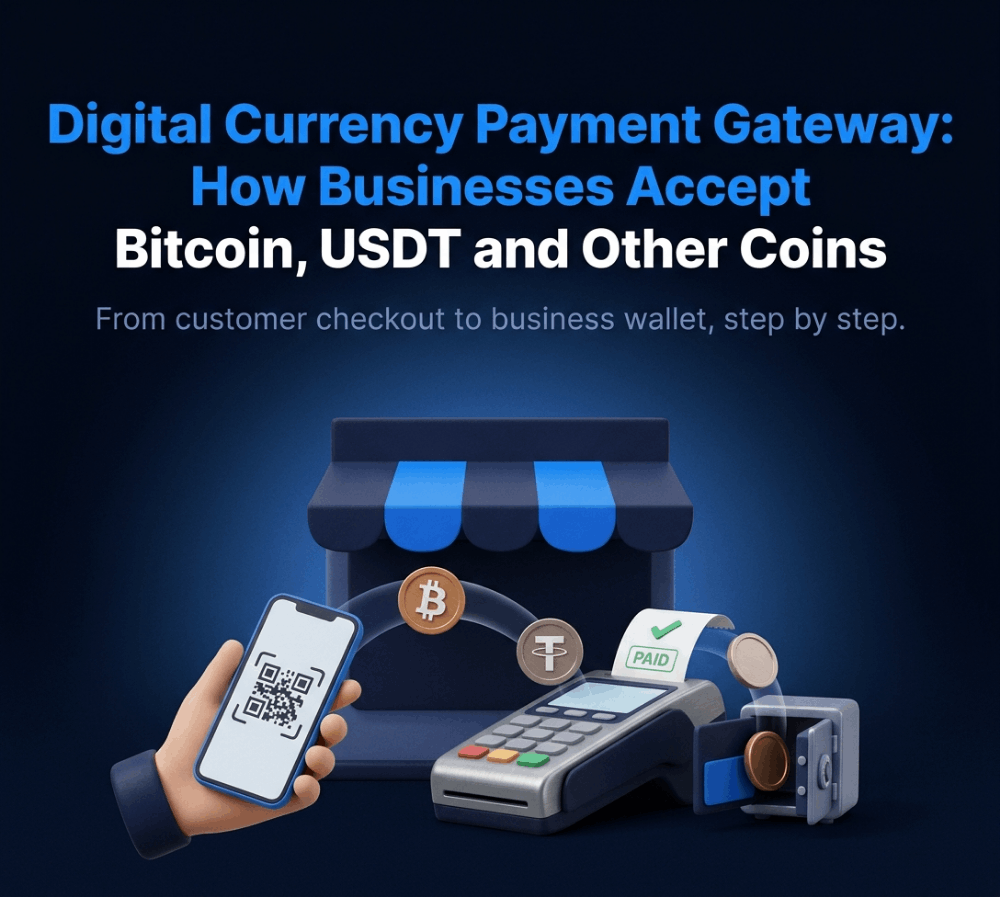
A Digital Currency Payment Gateway is a service that lets a business accept cryptocurrencies and stablecoins — Bitcoin, USDT and others — at checkout. It creates an invoice, watches the blockchain, confirms the payment, notifies your store, and settles the funds to you in crypto, a stablecoin or fiat. The coin a customer pays with changes the speed, the fee and the risk involved. A Digital Currency Payment Gateway built to handle each coin on its own terms, rather than applying one blanket rule to all of them, is the one that actually serves a growing checkout well.
Why "digital currency" needs a precise definition
The phrase covers a lot of ground, so it helps to be specific. In practice it means cryptocurrencies like Bitcoin and Ethereum, plus stablecoins like USDT and USDC that track a national currency's value. Central bank digital currencies are mostly still in pilot stages and aren't something a typical Digital Currency Payment Gateway handles today, so they sit outside the scope of this guide. What matters for a merchant is the mix most customers actually use: a leading stablecoin, Bitcoin, and occasionally a handful of other coins by request.
Why the payment flow is the same, but the coin changes everything downstream
Every transaction follows roughly the same sequence. The customer picks crypto at checkout, and your store sends the order amount to the gateway. The gateway creates an invoice, converting the amount into the chosen coin at a live rate and showing an exact figure, a deposit address or payment request, and usually a countdown timer. The customer sends the coin from a wallet or exchange account on the network the invoice specifies. The gateway watches the blockchain until the payment clears enough confirmations under your rule, then notifies your store through a webhook or app connection so the order moves to paid. You settle — in the coin itself, converted to a stablecoin, or converted to fiat straight into a bank account, depending on your settings — and you reconcile, since every payment carries a transaction hash you can match to an order for your audit trail. Two properties shape everything downstream of this flow: a confirmed payment is final, so there are no chargebacks and any refund is a brand-new transfer, and the network matters as much as the coin, since a payment sent on one network can only ever arrive on that same network.
Why Bitcoin, USDT and other coins aren't interchangeable for a merchant
Bitcoin is the coin customers ask for most, and it's the one where the rail you choose matters most. On the main network a new block arrives roughly every ten minutes, and most merchants wait for somewhere between one and six confirmations before treating an order as paid — meaning 10 to 60 minutes of wait time in practice. Miner fees swing from a few cents to several dollars depending on how busy the network is. The Lightning Network, a second layer built on top of Bitcoin, changes this entirely: payments typically settle in seconds with fees under a cent, which makes it a strong fit for smaller, faster orders if your gateway supports it.
USDT, by contrast, is the biggest stablecoin by a wide margin, and for a merchant that means two practical things: many buyers already hold it, and the amount you invoice stays close to the amount you actually receive. The catch is that USDT lives on several blockchains — mainly Tron and Ethereum, with BNB Chain and Solana smaller players — so fees and the risk of a wrong-network payment both depend heavily on which network the customer picks. Ethereum and other altcoins widen your reach further but add their own questions: is the coin liquid enough to convert a large payment at a fair rate, which networks are supported, could the coin be delisted, and does the gateway verify contract addresses rather than crediting payments by ticker symbol alone. A short list of liquid coins generally beats accepting everything a provider happens to list.
Why confirmation policy should scale with order value
How many confirmations should a business require before treating a Bitcoin order as paid? It depends on what's genuinely at stake. A sensible starting pattern treats orders under $100 as candidates for Lightning or zero to one on-chain confirmation, since low value makes speed the priority. Orders between $100 and $1,000 often wait for one to two confirmations, balancing speed against safety. Orders over $1,000 typically justify waiting for three to six confirmations, since the higher value makes the extra wait worthwhile. Treat this as an illustration rather than a fixed rule, and set a policy that matches your own typical order sizes.
Why the real cost of a Digital Currency Payment Gateway is rarely the headline number
The cost formula is short: gateway fee, plus any conversion spread, plus network fees, plus payout fees, plus any fixed charge per invoice. Published headline rates generally run from 0% for self-hosted tools up to roughly 1% for hosted gateways, with some providers charging up to 2% plus a small fixed amount per invoice. On $50,000 a month of sales, a 1% gateway fee costs $500, a 0.75% fee costs $375, and a 0.5% fee costs $250 — compared with card processing commonly cited in the 2% to 3% range, which would run about $1,250 at 2.5%. A 0% headline platform fee paired with an assumed 0.4% conversion spread would still cost around $200 a month, which is the detail a lot of comparisons skip entirely. The lesson holds regardless of which numbers you're looking at: a clean, stated 1% fee can end up simpler and more predictable than a lower headline rate with a vague conversion spread attached. Always ask each provider for the all-in price on the exact coin and route you'll actually use.
Why settlement choice changes your exposure, not just your bank balance
A business can keep the coin it was paid in, convert to a stablecoin, or convert straight to fiat, and each path carries different trade-offs. Keeping the original coin means all the price risk is yours, which only makes sense as a deliberate treasury position. Converting to a stablecoin like USDT or USDC suits businesses that pay suppliers in crypto, though spread, issuer and peg risk still apply. Converting to fiat puts USD, EUR or GBP directly into a bank account, which suits businesses with fiat bills, at the cost of conversion fees, banking charges and slower timing. Three questions decide how good any given setup is: when does conversion actually happen, which rate is used and can it be locked, and who carries the price move between invoice and settlement. Some providers lock a rate the moment an invoice is created; FaradPay, for instance, lists rate locks of ten minutes to 24 hours on stablecoin payments.
Why custodial and non-custodial setups suit different businesses
A custodial gateway holds your funds briefly before paying you out, which is what makes auto-conversion, fiat payouts and multi-coin balances possible — and it's how most hosted gateways work, in exchange for trusting the provider's security and policies. A non-custodial setup, such as a self-hosted tool, sends payments straight to a wallet you control, cutting counterparty risk but typically offering fewer coins, no fiat settlement and considerably more technical work. If you want a small number of coins and have the in-house skill, non-custodial is worth considering. If you want broad conversion across many coins, you'll likely end up custodial regardless, so the real work is checking how that provider actually holds funds and what withdrawal limits apply.
A practical checklist for setting up your gateway
- Decide which coins and networks to accept, starting with a stablecoin and Bitcoin on one or two networks each.
- Choose a provider, verify your account, and turn on two-factor authentication immediately.
- Set your settlement and confirmation rules, including how many confirmations you require by order value.
- Create scoped API keys and a signed webhook, then connect your checkout or invoicing system.
- Test every coin and network with a small real payment before going live.
- Deliberately test underpayment, overpayment and an expired invoice, then reconcile weekly once live.
Where FaradPay fits
FaradPay lists coverage across 350+ assets in one balance spanning 24 networks, including Bitcoin and major stablecoins — worth checking its assets page for your exact coins and asking directly whether Bitcoin on Lightning is live on your account. It lists a 0% platform fee on standard processing, cross-currency exchange, wallet conversions and mass payouts, with network fees applying separately, and fiat conversions to USD, EUR or GBP described as competitive rather than free. Settlement options include payout straight to your wallet or conversion inside your account, with rate locks of ten minutes to 24 hours on stablecoin payments. Its pages describe cold-storage custody, two-factor authentication, scoped API keys and AML screening on incoming payments, alongside plugins for Shopify, WooCommerce and Magento plus an API and signed payment notifications. Where it may not be the obvious pick: if you only take Bitcoin and want to run your own server, a self-hosted tool gives you full control with no platform fee at all, and if you need a licensed provider paying euros into a European bank the next business day, check which gateways offer exactly that in your region.
FAQ on Digital Currency Payment Gateway
What is a digital currency payment gateway? It's a service that lets a business accept cryptocurrencies and stablecoins, such as Bitcoin and USDT, at checkout. It creates an invoice with a deposit address, watches the blockchain, confirms the payment, notifies your store, and settles the funds to you in crypto, a stablecoin or fiat currency.
How do businesses accept Bitcoin through a payment gateway? The gateway generates a Bitcoin invoice with an address or a Lightning request, the customer pays from their wallet, and the gateway waits for the number of confirmations you've set. Once confirmed, your store marks the order paid and the gateway settles to you in Bitcoin, a stablecoin or fiat.
Can a payment gateway accept USDT? Yes. Most digital currency payment gateways accept USDT, and many treat it as the default option because its value stays close to a dollar. USDT lives on several networks, including Tron, Ethereum and BNB Chain, so check which networks your gateway supports and show the right one clearly at checkout.
How long does a Bitcoin payment take to confirm? On the main Bitcoin network, one confirmation takes about ten minutes, and most merchants wait for one to six, meaning confirmation can take 10 to 60 minutes. Payments over the Lightning Network usually settle in seconds. Your gateway lets you choose how many confirmations to require, often based on order value.
How much does a digital currency payment gateway cost? Published headline fees generally run from 0% up to about 1%, with some providers charging up to 2% plus a fixed amount. Add any conversion spread, network fees and payout charges. On $50,000 a month, a 1% fee is $500 and a 0.5% fee is $250 — and a 0% platform fee can still leave spread and network costs behind.
Which coins should a business accept first? Start with the coins your customers already hold. For most businesses that means a leading stablecoin such as USDT or USDC, plus Bitcoin, and perhaps Ethereum. Add other coins only when customers specifically ask, checking each for liquidity, supported networks and conversion limits first.
Final thoughts
A Digital Currency Payment Gateway is simple in outline — an invoice, a confirmation, a settlement — but the decisions that actually matter live in the details: which coins you accept, how many Bitcoin confirmations you require, what the all-in cost really works out to, and whether you hold or convert. Start with a leading stablecoin and Bitcoin, test each one with a small real payment, and add further coins only as customers genuinely ask for them.