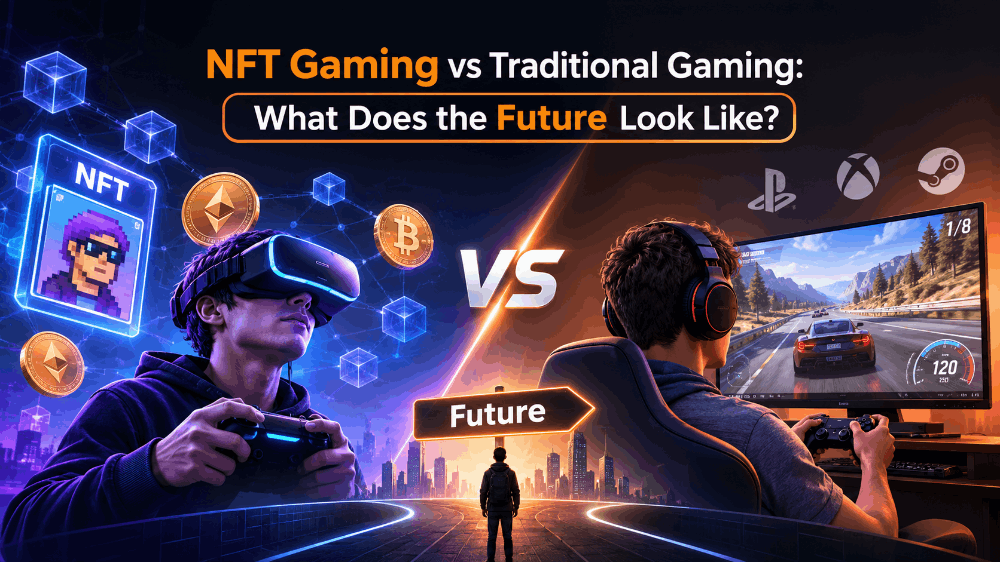
NFT Gaming vs Traditional Gaming: What Does the Future Look Like?

The gaming industry has always evolved alongside technology. From arcade machines and console games to mobile gaming, cloud gaming, and multiplayer online experiences, every major technological shift has changed how people play, interact, and experience virtual worlds.
Now, blockchain technology is introducing another interesting development: NFT gaming.
Traditional games allow players to unlock characters, collect rare weapons, purchase skins, and build achievements. However, most of these digital items remain controlled by the game publisher. Players can use them within the game, but they generally cannot independently sell, transfer, or retain ownership of those assets outside the publisher's ecosystem.
NFT gaming introduces a different approach. By using blockchain technology and non-fungible tokens (NFTs), developers can create digital assets that players can independently own, verify, and potentially trade through compatible marketplaces.
This raises an important question: Will NFT gaming replace traditional gaming, or will both models coexist in the future?
The answer is more interesting than a simple competition between the two. Traditional gaming has a strong foundation built around gameplay, storytelling, and entertainment. NFT gaming introduces additional possibilities around digital ownership, player-driven economies, and decentralized ecosystems.
Let's explore how these models work, where they differ, and what the future could look like.
1. What Is Traditional Gaming?
Traditional gaming refers to games developed and operated through centralized systems. Game publishers and developers control the game's servers, player accounts, progression systems, virtual currencies, and in-game marketplaces.
Popular examples include action games, multiplayer battle games, sports simulations, racing games, and role-playing games.
When players purchase a character skin, weapon, vehicle, or other digital item, they typically receive a license to use that item within the game rather than independent ownership of the underlying digital asset.
For example, imagine purchasing a rare weapon in an online multiplayer game. You can use it, customize it, and show it to other players. However, the publisher generally controls whether you can trade it, transfer it, or continue accessing it.
Key characteristics of traditional gaming
- Centralized control: Game publishers manage the game environment, accounts, and virtual economies.
- In-game purchases: Players purchase skins, characters, weapons, upgrades, and other digital content.
- Publisher-controlled assets: Digital items are generally restricted to the game's ecosystem.
- Established monetization: Revenue comes from game purchases, subscriptions, downloadable content, advertisements, and in-app purchases.
- Controlled gameplay experience: Developers manage updates, balancing, matchmaking, and progression.
- Familiar onboarding: Players can usually start playing without understanding cryptocurrency wallets or blockchain transactions.
Traditional gaming has succeeded because it prioritizes entertainment and accessibility. Players do not necessarily need financial incentives or digital ownership to enjoy a well-designed game.
2. What Is NFT Gaming?
NFT gaming combines conventional game development with blockchain technology.
An NFT, or non-fungible token, is a unique digital token recorded on a blockchain. Unlike interchangeable tokens, each NFT has an identifiable record that distinguishes it from other tokens.
In a blockchain-powered game, NFTs can represent different digital assets, including:
- Characters and avatars
- Weapons and equipment
- Skins and costumes
- Virtual land and properties
- Collectible cards
- Vehicles and accessories
- Special in-game items
For example, a player might acquire a rare character represented by an NFT. Ownership can be verified through the blockchain, and the player may be able to transfer or trade that asset through a compatible marketplace.
This introduces a different relationship between players and their digital collections.
However, owning an NFT does not automatically mean owning the game's intellectual property, artwork copyright, or permanent access to the game. The actual rights depend on the project's terms, smart contracts, and supporting infrastructure.
Key characteristics of NFT gaming
- Blockchain-based ownership: Eligible assets have ownership records stored on a blockchain.
- Digital asset trading: Players may be able to buy, sell, or transfer supported NFTs.
- Smart contract integration: Contracts can manage asset creation, ownership transfers, and certain reward mechanisms.
- Player-driven economies: Marketplaces can allow players to participate in the exchange of digital assets.
- Token-based systems: Some games introduce tokens for rewards, purchases, or governance.
- Community participation: Certain projects allow players to contribute to ecosystem decisions.
NFT gaming is not limited to play-to-earn mechanics. A game can incorporate NFTs for collectibles, customization, trading, or ownership without requiring players to earn cryptocurrency.
3. NFT Gaming vs Traditional Gaming: Key Differences
Both gaming models can deliver immersive experiences, but their underlying ownership structures and economic systems are different.
Here are the major differences:
1. Digital Asset Ownership
- Traditional Gaming: In-game items are generally controlled by the game publisher and remain within its ecosystem.
- NFT Gaming: Selected digital assets can be represented by NFTs, allowing players to verify ownership through blockchain records.
2. Asset Trading
- Traditional Gaming: Trading is usually restricted to publisher-approved systems, and some games do not allow it at all.
- NFT Gaming: Players may be able to buy, sell, or transfer supported assets through compatible marketplaces.
3. Game Economy
- Traditional Gaming: The publisher generally controls virtual currencies, item prices, rewards, and marketplace rules.
- NFT Gaming: The economy may combine publisher-managed systems with blockchain-based assets, tokens, and decentralized marketplaces.
4. Technology
- Traditional Gaming: Primarily uses game engines, backend infrastructure, databases, and centralized servers.
- NFT Gaming: Combines game engines and backend systems with blockchain networks, smart contracts, and wallet integrations.
5. Monetization
- Traditional Gaming: Revenue commonly comes from game purchases, subscriptions, advertisements, downloadable content, and in-app purchases.
- NFT Gaming: Developers can combine conventional revenue models with NFT sales, marketplace fees, and token-based features.
6. Player Rewards
- Traditional Gaming: Rewards generally remain within the game and are used for progression or customization.
- NFT Gaming: Some games allow players to receive transferable digital assets or tokens as rewards.
7. Transparency
- Traditional Gaming: Asset ownership and transactions are managed through the publisher's internal systems.
- NFT Gaming: Selected ownership records and transactions can be independently verified on a public blockchain.
8. Accessibility
- Traditional Gaming: Players can generally start playing without understanding cryptocurrency or blockchain wallets.
- NFT Gaming: Some games require wallet integration and familiarity with blockchain transactions, although simplified onboarding solutions are becoming available.
9. Interoperability
- Traditional Gaming: Digital assets are usually limited to the original game or publisher's ecosystem.
- NFT Gaming: Selected assets may work across compatible platforms if the participating games support the same standards and functionality.
The biggest difference is not necessarily how the games look or feel. It is how digital assets are created, controlled, and exchanged.
A traditional game can offer outstanding graphics, multiplayer features, and engaging progression. An NFT game can offer those same features while adding blockchain-based ownership.
Importantly, blockchain does not automatically make a game better. The technology must solve a meaningful problem or improve the player experience.
4. Digital Ownership: One of the Biggest Differences
Digital ownership is one of the main reasons developers and businesses are exploring NFT gaming.
In traditional games, players invest time and sometimes significant money collecting virtual assets. However, these assets generally remain connected to their accounts and the publisher's platform.
If a game shuts down, changes its policies, or removes an item, players may lose access to their digital collections.
NFT gaming introduces an alternative ownership model.
When an in-game asset is represented by an NFT, its ownership record can exist independently on a blockchain. Depending on the implementation, players may be able to transfer the asset, list it on a marketplace, or use it in another compatible environment.
Example: Traditional weapon vs NFT weapon
Imagine two players purchasing the same rare weapon in two different games.
In a traditional game:
- The weapon is recorded in the publisher's database.
- The player can use it within the game.
- Trading may be unavailable or restricted.
- Its availability depends on the publisher's systems and policies.
In an NFT game:
- The weapon can be represented by a unique NFT.
- Ownership can be verified on the blockchain.
- The player may transfer or sell it through a compatible marketplace.
- Its use still depends on the game's rules and technical support.
This distinction creates new possibilities for collecting, trading, and managing digital assets.
However, blockchain ownership does not guarantee that an item will retain its market value. Demand, rarity, utility, and the long-term health of the game all influence its usefulness and potential resale value.
5. How NFT Gaming Changes In-Game Economies
Traditional gaming economies are generally controlled by developers.
Game publishers determine the prices of digital items, the availability of collectibles, the distribution of rewards, and the rules governing in-game currencies.
NFT gaming can introduce more open economic systems.
Players may participate in digital marketplaces where supported assets can be bought, sold, or exchanged. Developers can also use smart contracts to define how certain transactions and reward mechanisms work.
Different economic models in NFT gaming
1. NFT marketplaces
Players can trade eligible digital assets through marketplaces. Rare characters, collectibles, weapons, or virtual land may become part of a player-driven economy.
2. Play-to-earn models
Some blockchain games reward players with tokens or digital assets for completing missions, winning matches, achieving milestones, or participating in game activities.
However, rewards must be supported by a sustainable economic model. Simply distributing tokens does not create long-term value.
3. Play-and-own models
This approach focuses on making gameplay enjoyable while allowing players to own selected digital items.
Rather than making earning the primary reason to play, developers use blockchain to support ownership and optional trading.
4. Player-driven trading
A marketplace can allow players to decide how much they are willing to pay for particular assets. Prices may change based on rarity, demand, utility, and availability.
Why economic balance matters
One of the biggest challenges in NFT game development is designing a sustainable economy.
If a game distributes too many rewards, asset values may decline. If it makes important items too expensive, new players may struggle to participate.
A successful economy needs meaningful asset utility, controlled supply, balanced rewards, and engaging gameplay.
6. The Role of Blockchain and Smart Contracts in NFT Games
NFT gaming requires more than creating digital collectibles.
Developers need a technical architecture that connects the game engine, backend systems, blockchain network, wallets, smart contracts, and marketplaces.
Each component has a different responsibility.
Blockchain networks
Blockchain networks maintain transaction records and ownership information for supported digital assets.
Popular options for blockchain gaming include Ethereum, Polygon, Solana, and BNB Chain. The right choice depends on transaction costs, network performance, security, ecosystem support, and the game's requirements.
Smart contracts
Smart contracts are programs deployed on blockchain networks.
In NFT games, they can support:
- NFT creation and minting
- Asset ownership transfers
- Marketplace transactions
- Token distribution
- Selected reward mechanisms
- Rules for certain digital asset interactions
Smart contracts should be thoroughly tested and independently audited where appropriate because vulnerabilities can expose player assets and funds to risk.
Game engines
Game engines remain essential for creating the actual gaming experience.
Unity and Unreal Engine are commonly used for developing interactive environments, character systems, physics, animations, and multiplayer experiences.
Blockchain integration can be added to these game environments without moving every gameplay operation onto the blockchain.
Wallet integration
A blockchain wallet allows players to interact with blockchain-based assets.
Depending on the game, wallet integration can support login, asset viewing, NFT transactions, and marketplace activities.
For mainstream audiences, developers should minimize unnecessary wallet complexity. Account abstraction, embedded wallets, and other onboarding approaches can make blockchain features easier to access.
Off-chain and on-chain architecture
Not every game operation should happen on a blockchain.
Fast gameplay actions such as movement, combat, physics, and matchmaking generally belong in conventional game servers.
Blockchain is better suited to selected functions such as asset ownership, token transfers, and marketplace transactions.
This hybrid architecture helps developers balance performance, security, and decentralization.
For a deeper technical explanation, see ChicMic Studios' guide: How Web3 Games Are Built: Blockchain Architecture, Tools & Process.
7. Advantages of NFT Gaming Over Traditional Gaming
NFT gaming introduces several possibilities that conventional gaming systems may not provide by default.
1. Greater control over digital assets
Players can hold blockchain-recorded ownership of supported items instead of relying exclusively on a publisher's internal database.
2. Opportunities for asset trading
NFT marketplaces can allow players to trade eligible digital items, creating additional ways to participate in the gaming ecosystem.
3. Transparent ownership records
Blockchain transactions can provide publicly verifiable records of asset ownership and transfers.
4. New monetization opportunities
Developers can explore NFT sales, marketplace fees, token-based systems, and other models alongside conventional purchases and subscriptions.
5. Community-driven ecosystems
Some blockchain games allow communities to participate in governance or ecosystem decisions through defined voting mechanisms.
6. Potential interoperability
Compatible games and platforms may support the use of certain digital assets across multiple experiences.
However, interoperability requires technical and design coordination. An NFT does not automatically work in every game simply because it exists on a blockchain.
8. Challenges and Limitations of NFT Gaming
Despite its potential, NFT gaming has several challenges that developers must address before it can achieve wider adoption.
1. Blockchain complexity
Many conventional gamers are unfamiliar with wallets, cryptocurrency, gas fees, private keys, and blockchain transactions.
If players need to understand all these concepts before starting a game, the onboarding process can become a barrier.
Possible solution: Use simplified account creation, embedded wallets, clear transaction explanations, and optional blockchain interactions.
2. Transaction costs
Some blockchain networks charge transaction fees. High fees can make frequent in-game transactions impractical.
Possible solution: Select a suitable network, use scaling solutions, and reduce unnecessary on-chain transactions.
3. Security risks
NFT marketplaces, wallets, and smart contracts can become targets for attacks.
A vulnerability in a smart contract may result in unauthorized asset transfers or financial losses.
Possible solution: Follow secure development practices, conduct contract audits, test integrations, and establish monitoring and incident-response procedures.
4. Unstable token economies
Games that depend heavily on token rewards may struggle when token demand declines or reward distribution exceeds economic demand.
Possible solution: Build the game around entertainment and meaningful progression rather than relying entirely on speculative rewards.
5. Regulatory uncertainty
NFTs and tokens may be subject to different legal and regulatory requirements depending on the asset design, jurisdiction, marketing, and economic functionality.
Possible solution: Obtain appropriate legal advice before launching token sales, reward programs, or financial features in target markets.
6. Limited interoperability
Different games may use different blockchain networks, token standards, asset formats, and gameplay systems.
Even when assets can be transferred, another game may not know how to display or use them.
Possible solution: Plan interoperability around specific use cases, compatible standards, and partnerships rather than promising universal asset compatibility.
9. Will NFT Gaming Replace Traditional Gaming?
Not necessarily.
Traditional gaming has a mature audience, established development practices, recognizable franchises, and monetization models that continue to work.
Many players simply want enjoyable gameplay. They may not be interested in managing NFTs or trading digital items.
At the same time, blockchain gaming offers features that can appeal to players who value digital ownership, collectibles, and open marketplaces.
The future may therefore involve a combination of both models.
A hybrid gaming experience
Imagine a multiplayer role-playing game with the following features:
- Players explore detailed environments and complete missions.
- Characters develop through traditional progression systems.
- Certain rare items can be represented by NFTs.
- Players can trade supported collectibles through a marketplace.
- In-game combat and matchmaking operate through conventional servers.
- Smart contracts manage selected ownership and marketplace transactions.
- Players can enjoy the game without being required to trade NFTs.
This approach combines familiar gaming mechanics with optional blockchain functionality.
It also gives developers more flexibility. They can introduce blockchain features where they add value without making every part of the experience dependent on cryptocurrency.
10. What Does the Future of NFT Gaming Look Like?
The future of NFT gaming will likely depend on how effectively developers address usability, gameplay quality, security, and economic sustainability.
Several developments could influence the next stage of the industry.
1. Gameplay-first Web3 games
Early blockchain gaming projects often placed significant emphasis on earning tokens and trading assets.
Future projects are likely to place greater importance on gameplay quality, storytelling, competitive balance, and long-term player retention.
Blockchain should support the experience rather than become the entire reason for playing.
2. Invisible blockchain technology
Mainstream players may not want to interact directly with blockchain networks.
Simplified wallets, sponsored transactions, and familiar account systems can make blockchain features less noticeable.
The ideal experience would allow players to enjoy the game first and explore ownership features when they choose.
3. Better digital asset interoperability
Developers may increasingly explore ways to use selected digital assets across connected gaming environments.
For example, a collectible character could potentially appear in multiple experiences if the games agree on its identity, appearance, functionality, and ownership rules.
This requires more than NFT ownership. It needs shared technical standards and deliberate game design.
4. More sustainable game economies
Developers are likely to pay greater attention to reward distribution, asset utility, player retention, and marketplace activity.
The objective should be to create a healthy game economy that supports the experience over time rather than depending on continuous speculative demand.
5. AI and blockchain integration
AI and blockchain can serve different purposes within gaming.
AI can support non-player character behaviour, procedural content generation, player personalization, and automated testing. Blockchain can support digital ownership, transparent transactions, and asset management.
Combining these technologies could create more dynamic and personalized gaming environments.
6. Cross-platform gaming
Players increasingly expect games to work across mobile, desktop, and other supported platforms.
Future blockchain games may focus on consistent player accounts and asset access across devices, subject to platform rules and technical compatibility.
11. What Should Businesses Consider Before Developing an NFT Game?
For businesses planning to enter blockchain gaming, choosing the right technology is only one part of the development process.
The first priority should be defining the actual gaming experience.
Here are some important considerations.
Define the target audience: Understand whether the game is designed for traditional gamers, blockchain enthusiasts, collectors, or a combination of these groups.
Choose the right game genre: RPGs, strategy games, card games, racing games, simulation games, and multiplayer experiences can all support blockchain features.
Design the NFT utility: Determine why an item should be an NFT. Is it a collectible, a tradeable character, a virtual property, or a game progression asset?
Plan the economy: Define token supply, rewards, marketplace fees, asset scarcity, and other economic mechanisms before development.
Select the blockchain: Compare network performance, transaction costs, security, developer tools, and ecosystem maturity.
Prioritize security: Include wallet security, smart contract testing, transaction validation, and appropriate audits in the project plan.
Keep onboarding simple: Avoid making wallet creation and cryptocurrency transactions mandatory for basic gameplay unless they are essential to the game's concept.
Plan for post-launch operations: A game requires regular updates, bug fixes, content improvements, performance monitoring, and community engagement.
Businesses exploring this space can also review ChicMic Studios' blockchain game development services to understand how blockchain integration can be combined with game development.
For projects focused specifically on NFT-based game assets and marketplaces, NFT game development services provide another relevant area to explore.
12. How to Choose Between Traditional Game Development and NFT Game Development
The right approach depends on the purpose of the game rather than which technology is currently attracting more attention.
The right approach depends on the purpose of the game rather than which technology is currently attracting more attention.
Consider these project requirements:
- Story-driven single-player game: Traditional game development is generally suitable because the primary focus is storytelling, gameplay, and progression.
- Competitive multiplayer game: Traditional or hybrid development can work well, depending on whether blockchain-based assets are necessary.
- Collectible card game with transferable assets: NFT-enabled gaming can support digital ownership and marketplace functionality.
- Virtual land and digital property: Blockchain gaming can help represent ownership of selected virtual assets.
- Casual mobile game: Traditional development is often preferable when blockchain features do not add meaningful value.
- Player-owned digital collectibles: NFT integration can support verifiable ownership and optional trading.
- Large multiplayer virtual world: A hybrid Web2 and Web3 architecture can combine conventional game servers with blockchain-based asset management.
- Game with optional digital asset trading: Hybrid game development can introduce blockchain features without making them mandatory for every player.
A traditional game does not need blockchain simply because the technology is available.
Similarly, an NFT game should not sacrifice gameplay quality to introduce unnecessary token or marketplace features.
The best architecture is the one that supports the intended player experience and business model.
Conclusion: The Future Is About Better Gaming Experiences, Not Just NFTs
NFT gaming and traditional gaming are not necessarily competing technologies.
Traditional gaming has demonstrated that strong gameplay, immersive storytelling, and community engagement can build successful gaming experiences. NFT gaming builds on this foundation by introducing additional possibilities around digital ownership, asset trading, and blockchain-powered economies.
However, the long-term success of NFT games will depend on more than token prices or collectible sales.
Players need engaging gameplay, fair reward systems, secure transactions, accessible onboarding, and reasons to keep returning.
For developers and businesses, the opportunity lies in combining the strengths of conventional game development with blockchain technology where it genuinely improves the experience.
The next generation of gaming may not be entirely traditional or entirely decentralized. It could be a hybrid environment where players enjoy familiar games while having more control over selected digital assets.
Ultimately, the future of gaming will belong to experiences that players genuinely enjoy, with blockchain serving as an additional layer of value rather than a replacement for good game design.
Frequently Asked Questions
1. What is the main difference between NFT gaming and traditional gaming?
Traditional games generally keep in-game assets within publisher-controlled systems. NFT games can represent selected assets as blockchain-based tokens, allowing players to verify ownership and potentially trade or transfer them through compatible platforms.
2. Are NFT games better than traditional games?
Not automatically. Traditional games often provide simpler onboarding and established gameplay experiences. NFT games offer additional digital ownership and trading features. The better option depends on the game's purpose and audience.
3. Can players earn real money from NFT games?
Some NFT games allow players to sell supported digital assets or receive tokens that may have market value. However, earnings are not guaranteed. Asset prices can fluctuate, marketplaces may have limited demand, and players may incur transaction fees.
4. Do NFT games require cryptocurrency wallets?
Many NFT games use wallets for asset ownership and blockchain transactions. However, developers can simplify the experience through embedded wallets, account abstraction, or other onboarding solutions.
5. Which blockchain is best for NFT game development?
There is no universally best blockchain. Ethereum, Polygon, Solana, and BNB Chain are among the options developers consider. The choice depends on transaction costs, scalability, security, ecosystem support, and the project's technical requirements.
6. Can NFTs be used across different games?
Potentially, yes. However, cross-game functionality requires technical compatibility and support from the participating games. An NFT can be transferable without automatically being usable in another game.
7. Is NFT gaming suitable for mobile games?
Yes. NFT features can be integrated into mobile games, including collectible systems, marketplaces, and selected asset ownership features. Developers must also consider mobile platform policies, performance, and user experience.
8. What is the difference between NFT gaming and play-to-earn gaming?
NFT gaming uses non-fungible tokens to represent digital assets. Play-to-earn gaming focuses on rewarding players with tokens or digital assets for participating in gameplay. A game can use NFTs without being play-to-earn.
9. How much does it cost to develop an NFT game?
The cost depends on gameplay complexity, graphics, platforms, multiplayer infrastructure, smart contracts, wallet integration, marketplace functionality, and security requirements. A simple NFT game and a large multiplayer blockchain game can have very different budgets.
10. What skills are required to develop an NFT game?
NFT game development can require game designers, Unity or Unreal developers, blockchain engineers, smart contract developers, backend engineers, UI/UX designers, and QA specialists. The team composition depends on the project's scope and architecture.
About the development approach
A successful NFT game requires a balance of creative game design, reliable engineering, blockchain integration, and sustainable economic planning. Studios such as ChicMic Studios work across game development and blockchain integration to help businesses explore these types of experiences.
Explore the relevant solutions: