How AI and Blockchain Are Influencing Prediction Market Platform Development
Introduction
Prediction markets are changing how people interpret information, evaluate possibilities, and express opinions about future events. From election outcomes and cryptocurrency movements to sports results and business developments, these platforms allow participants to trade contracts linked to specific outcomes. As interest in event-based forecasting grows, artificial intelligence (AI) and blockchain technology are becoming important forces in prediction market platform development.
AI helps platforms process information, identify patterns, and improve market analysis. Blockchain supports transparent transactions, programmable market rules, and verifiable settlement mechanisms. Together, these technologies can help developers build prediction market platforms that are more intelligent, accessible, and accountable.
For businesses exploring a Polymarket clone development project, understanding this technological combination is essential. The objective is not simply to replicate existing functionality but to create a platform that addresses user trust, market efficiency, operational reliability, and long-term scalability.
What Is a Prediction Market Platform?
A prediction market platform enables participants to trade outcome-based contracts associated with future events. Each market presents a defined question, such as whether a particular event will occur before a specified date. Participants take positions based on their interpretation of available evidence and changing market sentiment.
Unlike traditional polling, prediction markets combine individual expectations with financial incentives. Market prices can indicate the collective probability assigned to an outcome, although they should not be treated as guaranteed forecasts or objective measures of truth.
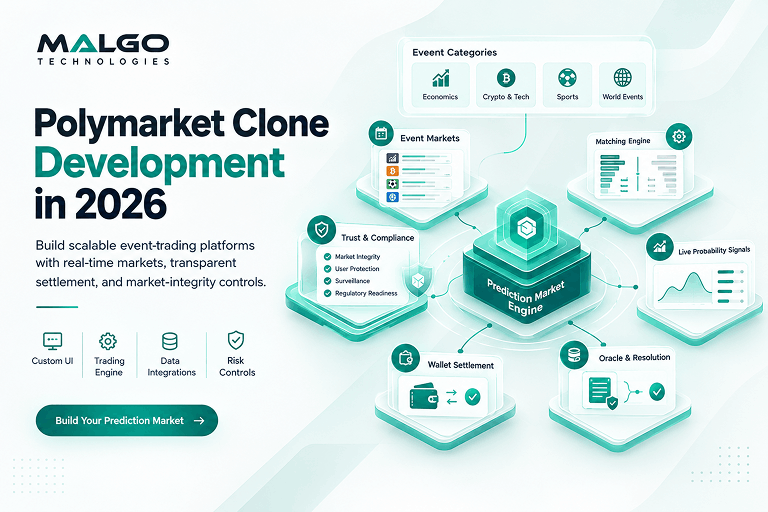
Modern prediction market development involves several interconnected components, including market creation, trading interfaces, liquidity management, outcome verification, wallet integration, and settlement infrastructure. AI and blockchain can improve different parts of this system when implemented with clearly defined responsibilities and appropriate safeguards.
How Artificial Intelligence Is Transforming Prediction Markets
1. Smarter Market Analysis and Forecasting
AI can analyze large volumes of structured and unstructured information, including news reports, public announcements, historical records, and relevant market activity. Machine learning models can identify patterns that may be difficult to detect through manual analysis alone.
For example, an AI-powered prediction market platform covering economic events could process inflation announcements, employment reports, and historical market responses. These insights can help users understand the factors influencing an event without guaranteeing that a particular outcome will occur.
For developers, integrating AI-driven analytics can create a more informative trading experience. However, models must be evaluated for accuracy, data quality, bias, and performance during changing market conditions.
2. Automated Market Monitoring
Prediction markets operate in environments where information can change rapidly. AI-based monitoring systems can detect unusual trading activity, sudden shifts in market sentiment, suspicious transaction patterns, and potential manipulation signals.
These systems can flag activity for further investigation and help operators prioritize risks. They should not automatically label every unusual trade as fraudulent because legitimate participants may react to breaking news or new evidence.
Combining automated alerts with human review, transparent escalation procedures, and documented risk controls can improve platform oversight.
3. Personalized User Experiences
AI can make prediction market interfaces easier to navigate by organizing markets according to user-selected interests, explaining unfamiliar terminology, and summarizing relevant developments.
A participant following technology news, for instance, could discover markets related to product launches, regulatory decisions, or industry milestones. Contextual explanations can also help users understand how market probabilities change.
Personalization should remain transparent and avoid encouraging excessive trading. Responsible design requires user controls, clear disclosures, and safeguards against misleading recommendations.
4. AI-Assisted Market Creation and Resolution
Natural language processing can help developers turn event descriptions into clearer market questions. AI tools may identify ambiguous wording, missing deadlines, conflicting conditions, or incomplete resolution criteria before a market becomes active.
AI can also assist with collecting evidence during settlement. Nevertheless, the final outcome should follow predetermined rules and rely on trustworthy evidence. Human oversight and independent verification remain important, particularly when disputes or ambiguous real-world events arise.
How Blockchain Is Strengthening Prediction Market Development
1. Transparent and Verifiable Transactions
Blockchain technology records transactions on a distributed ledger, allowing supported activities to be independently verified. Depending on the network and implementation, users can inspect contract interactions, transaction histories, and settlement records without relying entirely on a platform operator.
For a Polymarket clone, blockchain integration can improve transparency around market participation and outcome-based transactions. Developers must still consider privacy, transaction visibility, network congestion, and the limitations of public ledger data.
2. Smart Contracts for Market Operations
Smart contracts are programs deployed on a blockchain that execute predefined instructions when specified conditions are met. In prediction markets, they can support position management, conditional payouts, collateral handling, and settlement workflows.
Automating these processes can reduce manual intervention and make market rules easier to inspect. However, smart contracts are not automatically secure or error-free. Independent security audits, comprehensive testing, and clearly defined failure-handling procedures are essential before deployment.
3. Decentralized Outcome Verification
One of the biggest challenges in prediction market development is determining whether an event has occurred. Blockchain networks cannot independently verify every real-world event, which creates a need for reliable external data sources known as oracles.
Oracles transmit information from external systems to blockchain applications. Depending on the market design, developers can combine oracle feeds, predefined resolution policies, dispute periods, and community verification mechanisms.
AI can help evaluate evidence, while oracle infrastructure delivers approved information to smart contracts. Keeping these responsibilities distinct reduces the risk of treating an AI-generated conclusion as unquestionable truth.
4. Greater Accessibility Through Web3 Integration
Blockchain-based platforms can support compatible digital wallets, on-chain transactions, and programmable financial interactions. These capabilities may enable users to participate without relying exclusively on conventional account-based infrastructure.
However, accessibility depends on wallet usability, network compatibility, transaction reliability, and compliance requirements. Developers should prioritize straightforward onboarding and clear explanations of wallet security rather than assuming every user understands Web3 technology.
How AI and Blockchain Work Together
The greatest opportunity emerges when AI and blockchain complement each other. AI processes information and identifies patterns, while blockchain provides an execution environment for transparent, rule-based transactions.
Consider a prediction market focused on a scheduled economic announcement:
- AI analyzes relevant public information and identifies developments affecting market sentiment.
- The platform displays contextual insights alongside the market's current implied probability.
- Participants trade contracts according to their individual assessments.
- After the event, an approved data source or oracle supplies the information required for resolution.
- Smart contracts execute settlement according to the market's published rules.
This architecture can improve information discovery, operational consistency, and settlement transparency. Its effectiveness still depends on reliable data, sound market design, secure contracts, and appropriate human oversight.
Essential Features for AI-Powered Prediction Market Development
Businesses planning a prediction market platform should evaluate the following capabilities:
- Real-time market analytics: Present market movements, probability changes, and relevant information in an understandable format.
- Intelligent search and discovery: Help users find markets through topic classification, semantic search, and relevant recommendations.
- Secure smart contracts: Implement thoroughly tested trading and settlement logic with documented security controls.
- Reliable oracle integration: Establish clear data-source requirements, resolution criteria, and dispute procedures.
- Liquidity management: Design mechanisms that support market participation and help users understand execution risks.
- Risk monitoring: Combine automated anomaly detection with human investigation and appropriate safeguards.
- Scalable infrastructure: Separate analytics, market data, wallet services, and blockchain interactions to support future growth.
Feature selection should reflect the platform's target audience, operating environment, and intended market structure.
Challenges Developers Must Address
Despite their potential, AI and blockchain introduce important development challenges. AI models can produce inaccurate summaries, inherit biases from training data, or misinterpret rapidly changing events. Blockchain applications can encounter smart contract vulnerabilities, network limitations, and irreversible transaction errors.
Regulatory obligations also vary by jurisdiction and may depend on market categories, participant locations, and platform functionality. Licensing, consumer protection, data privacy, and restrictions involving certain event markets should be evaluated before launch.
A robust development strategy includes independent security reviews, documented AI limitations, reliable resolution procedures, monitoring systems, and ongoing compliance assessments.
Conclusion
AI and blockchain are influencing prediction market platform development by improving information analysis, automating selected operations, and creating more transparent transaction and settlement processes. AI supports smarter discovery and monitoring, while blockchain enables programmable market logic and verifiable records.
For businesses considering Polymarket clone development, long-term success depends on combining these technologies with responsible market design, dependable data infrastructure, strong security practices, and intuitive user experiences. Rather than treating AI and blockchain as standalone selling points, developers should integrate them to solve practical problems and strengthen user confidence.
The most effective prediction market platforms will be those that balance technological innovation with transparency, accountability, and carefully designed safeguards.