Inside the Pump.fun Wealth Engine: Developer Extraction vs. Retail Profitability

An Empirical Financial Analysis of Launchpad Dynamics, Token Case Studies, and Retail Execution Pathways
EXECUTIVE SUMMARY
While pump.fun token launches are heavily weighted in favor of developers and automated snipers—generating $25k to $500k+ in risk-free creator extraction while leaving 80% to 93% of retail buyers with under $100 in net gains—a narrow road to profitability still exists for retail. Surviving retail traders rely on scalp-and-run execution, early principal de-risking, and DEX migration momentum rather than traditional buy-and-hold investing.
1. Executive Overview & Market Context
Pump.fun has fundamentally shifted token creation on Solana by removing technical barriers and implementing automated bonding curves with instant DEX liquidity migration. While this has democratized token issuance, it has also created a highly asymmetric financial ecosystem.
This report analyzes five major token launches over recent months, evaluating developer revenue extraction alongside retail wallet profit distribution, and outlines the precise mechanics through which retail traders can navigate these structural hazards.
2. Profile of 5 Prominent Token Launches
The following tokens represent key market cap tiers and liquidity trajectories launched across recent months:
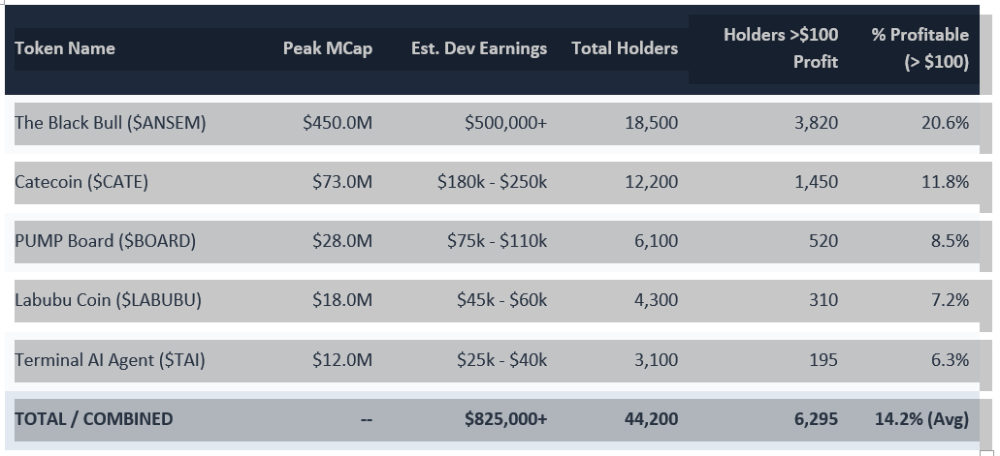
· 1. The Black Bull ($ANSEM): Mid-July 2026 launch reaching a peak market cap of ~$450 Million. The developer extracted an estimated $500,000+ in creator fee shares and early allocation liquidations.
· 2. Catecoin ($CATE): Early August 2026 launch reaching a peak market cap of ~$73 Million on $91M+ volume. Creator revenue reached $180,000–$250,000 via bonding curve fee splits.
· 3. PUMP Board Token ($BOARD): Late August 2026 launch with a ~$28 Million peak market cap, yielding approximately $75,000–$110,000 in creator payouts.
· 4. Labubu Coin ($LABUBU): Early September 2026 launch hitting an ~$18 Million peak market cap, generating $45,000–$60,000 for the creator.
· 5. Terminal AI Agent ($TAI): Late September 2026 launch reaching a ~$12 Million peak market cap, with estimated developer earnings between $25,000–$40,000.
3. Performance & Wallet Profitability Matrix
The table below breaks down unique wallet participation, creator earnings, and retail profitability (> $100 net profit) across all five tokens:
4. Key Structural Conclusions
A. Asymmetric Creator Revenue Mechanics
Pump.fun operates as a high-margin revenue engine for developers. Built-in creator fee shares generate guaranteed, risk-free returns ranging from $25,000 to over $500,000 per token, regardless of whether the token achieves sustainable market cap or crashes immediately after launch.
B. Extreme Power-Law Retail Concentration
Retail returns follow a steep power-law distribution. Even among top-performing mega-caps like $ANSEM, only 20.6% of holders made >$100. Across standard mid-tier tokens, over 93% of participants failed to reach $100 in net profits, primarily acting as exit liquidity for creators, MEV bots, and early snipers.
5. Is There a Clear Road to Profit for Retail Buyers?
Given that 80%–93% of retail buyers make less than $100 or lose money, does retail have any realistic path to profit? The answer is yes, but only if retail traders abandon traditional 'buy and hold' investing in favor of high-speed speculative mechanics.
A. How Retail Captures Profit on Pump.fun
· 1. Bonding Curve Scalping (Under 2–5 Minutes): Buying in the initial bonding curve tiers and taking quick profits into early volume spikes before DEX graduation.
· 2. DEX Migration Surge Trading: Capitalizing on the immediate volume surge that occurs when a token completes its bonding curve ($69k+ MCap) and transitions to DEXs like Raydium or PumpSwap.
· 3. Narrative Arbitrage & Real-Time Events: Identifying trending viral news, tweets, or tech meme themes faster than the broader market and positioning in the primary ticker.
B. Why 'Buy and Hold' Fails Retail
The vast majority of retail losses stem from holding micro-caps expecting long-term compounding. Over 98% of pump.fun tokens fail to complete the bonding curve, resulting in permanent capital loss. Furthermore, MEV bots and developer dumps systematically extract liquidity from late-stage holders.
6. Retail Trader Survival Framework
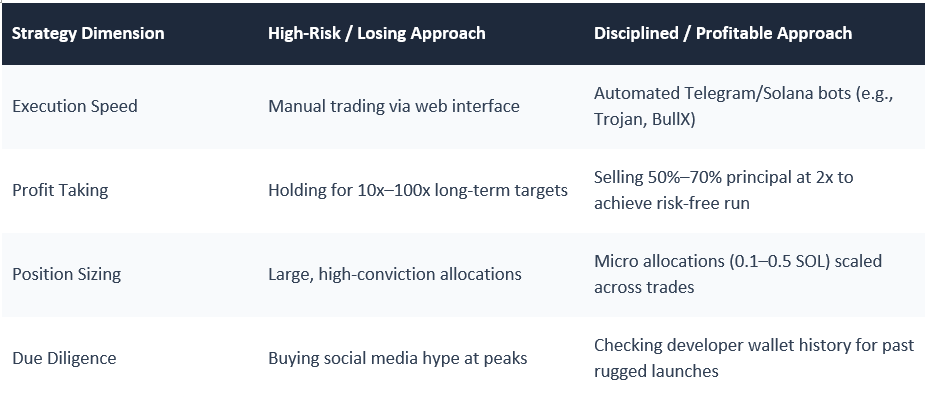
Profitable retail participants adhere to strict risk management parameters to navigate the platform's high failure rate:
This is a personal opinion and not intended as a financial advice, trade at your own risk.