Bitcoin and future fees

Good morning/evening
Do you have that 1 article that you struggle to finish or is it just me? This was started in January after a comment from a friend and I have thrown my thoughts here, not that I know what will happen in the future or that I am right, many things could happen in that time, crypto can evolve and change at great speed and at times it can be really difficult just keeping up!
Is Bitcoin is heading toward a fee crisis.
The argument goes like this, as the block subsidy continues to halve every four years, miners will eventually earn less from newly issued coins. At some point, transaction fees will need to replace that subsidy entirely. If they don’t rise high enough, miner revenue falls. If miner revenue falls too far, security weakens.
From there, the conclusion usually becomes dramatic, fees will need to explode $50, $85, maybe more per transaction and everyday users will be priced out, can Bitcoin survive that transition?
Today, miners are paid in two ways
- The block subsidy (newly issued bitcoin)
- Transaction fees
The subsidy halves roughly every four years which plays a part in the scarcity aspect but over time, fees will have to play a larger part in revenue for miners and I guess the question will be 'are enough people willing to pay for that block space'? If we look back Bitcoin fees have not just gone up in a straight line, they spike during times of demand and fall back down when things get quieter. Looking at averages it makes a Bitcoin transaction look expensive because those huge spikes pull up the average but if we look at median fees, they are usually lower.
See this as an example
- Average (Mean): Add all salaries ($1,193,000) and divide by 5 people. The mean salary is $238,600. This value is much higher than what most people in the group actually earn, due to the single high earner.
- Median: Order the salaries: $45,000, $47,000, $50,000, $51,000, $1,000,000. The middle value is $50,000. This number better reflects the typical income for the majority of employees.
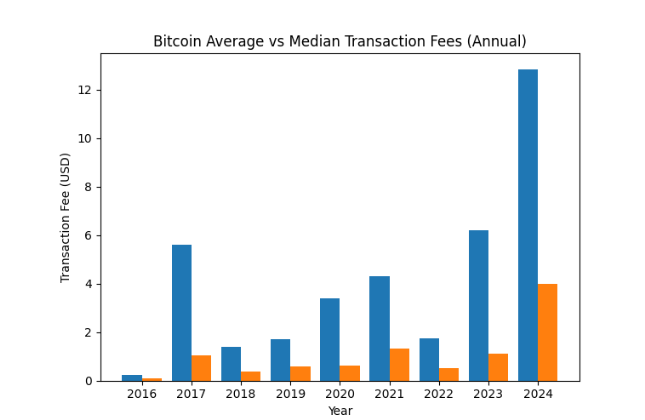
The trouble is people like cheaper transactions, which is the one of the reasons I don't use Ethereum, well not for daily usage anyway but If blockspace is always cheap, miner revenue remains less. If blockspace becomes expensive, smaller users move elsewhere. Layer 2 solutions, batching transactions, and proper UTXO management all reduce on chain demand which is good for usability and efficiency for the average user.Although there is the Lightning network for small transactions, and although it is used a lot in developing nations it is limited.
What can be done to reduce costs
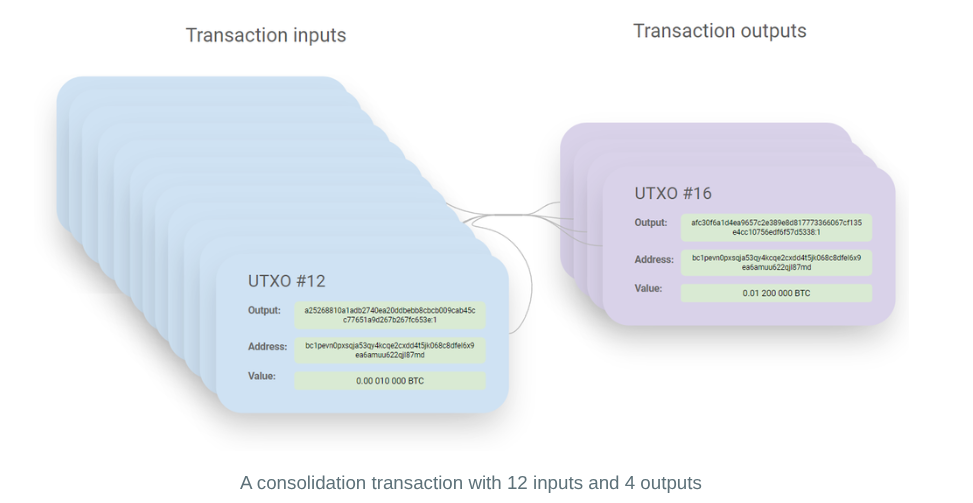
You could if needed, batch your UTXO's especially during times when transaction prices are low, so when they are high it will cost you less, now I have not tried this yet, it took me long enough to get my head around UTXOs in the first place! I blame it on old age lol but this explains it.
What are UTXOs in Bitcoin?
UTXOs, or Unspent Transaction Outputs, represent the amount of bitcoin that a user can spend. They are unique, fixed-value entities associated with a Bitcoin address.
Why is UTXO consolidation important?
UTXO consolidation is for reducing transaction fees. It involves combining multiple small UTXOs into fewer, larger ones, which simplifies future transactions and lowers their cost.
How does UTXO consolidation save fees?
Consolidating UTXOs during periods of low transaction fees reduces the number of inputs in future transactions. Fewer inputs mean lower fees.
Is UTXO consolidation relevant for all Bitcoin users?
It's particularly relevant for users receiving frequent, small transactions, leading to numerous small UTXOs. Users with fewer, larger UTXOs may not need consolidation.
What if fees don't grow enough
If miner revenue declines, hash rate adjusts and some miners will shut down. The cost to attack the network theoretically falls but it does not fall to zero and mining remains competitive and over time, mining naturally concentrates around operators with cheaper energy and better infrastructure. When blockspace is scarce, the price reflects that scarcity. When the demand surges, the fees rise. When demand falls, the fees drop. I have a hope that as the price of Bitcoin rises, so do the fees and then it is all relative. I also get that all of this then brings us back to the beginning and using Bitcoin to buy a coffee or a P2P transaction, you won't buy that coffee if the fees are more than the item you're buying!
To conclude
In my opinion yes fees will rise, but then so will the price so hopefully it will offset some of that cost, everyday transactions may well have to move to Lightning, not that I have ever been able to buy anything other than booze in Bulgaria with Bitcoin. (I have tried and the only place I have found that takes Bitcoin so far is the alcohol shop!)
I can also see that Bitcoin will become more of a store of value than it already is and that is really how I use it now, buy, hold, save some and sell some but then there is also the case that Bitcoin becomes more and more institutional to the point that people like us really get fewer and fewer.
I do not claim to have the answers, but crypto changes fast and we don't know what may be around the corner, but we adapt as always, so please feel free to share your thoughts, what do you think will happen with Bitcoin fees in the future? Will solo miners still be able to carry on?
As always thank you for reading and I will look forward to hearing your thoughts.