Why We Must Reclaim the Future for Our Kids

As a father of two young boys, I spend a lot of time thinking about what the world will look like when they’re my age. I want to tell them that technology is a ladder, something that will help them reach heights we couldn’t even imagine. But lately, when I pull back the curtain on AI and blockchain, I don’t just see a ladder, I see a complex web of surveillance and profit motives that feels like it was designed to keep us in check. It’s starting to feel like we’re being handed these revolutionary tools in small, controlled doses, not because they aren’t ready, but because the full truth would be too much for the public to swallow at once.
We’re told these technologies are for the people, yet they often feel like they’re built for the bottom line. We’re trapped in a cycle of digital leaders bickering on social media while our personal data becomes the fuel for the next quarterly earnings report. It’s time to stop being the product and start being the architects of a future where code, not ego or greed, dictates the rules of the game.
The Illusion of Decentralization and the Profit Trap

Every new blockchain project launches with a whitepaper that reads like a manifesto for freedom. They promise us a world without middlemen, yet the moment you dig into the tokenomics, you see Venture Capital firms and insiders holding the lion’s share of the power. It turns the quest for a better financial system into a high-stakes soap opera. We see figures like Charles Hoskinson frequently taking to social media to defend his ecosystem or critique others, often blurring the line between technological progress and personal brand management. When the face of a decentralized project becomes more important than the protocol itself, we haven’t actually escaped the old world, we’ve just swapped suits for hoodies.
When the motive is pure profit, the technology suffers. We see “decentralized” platforms that are actually run on a handful of centralized servers, making them just as vulnerable to censorship or shutdowns as the old systems. According to the Ethereum Foundation’s own documentation on nodes, the struggle to keep the network truly distributed is an uphill battle against the convenience of centralized providers like AWS. If we want a world controlled by code rather than emotion, we have to demand systems that are actually permissionless. True decentralization shouldn’t have a CEO or a marketing department that spends its day bashing the competition on X. It should be a silent, robust engine that works regardless of who is shouting the loudest.
The Friendly Face of Perpetual Surveillance
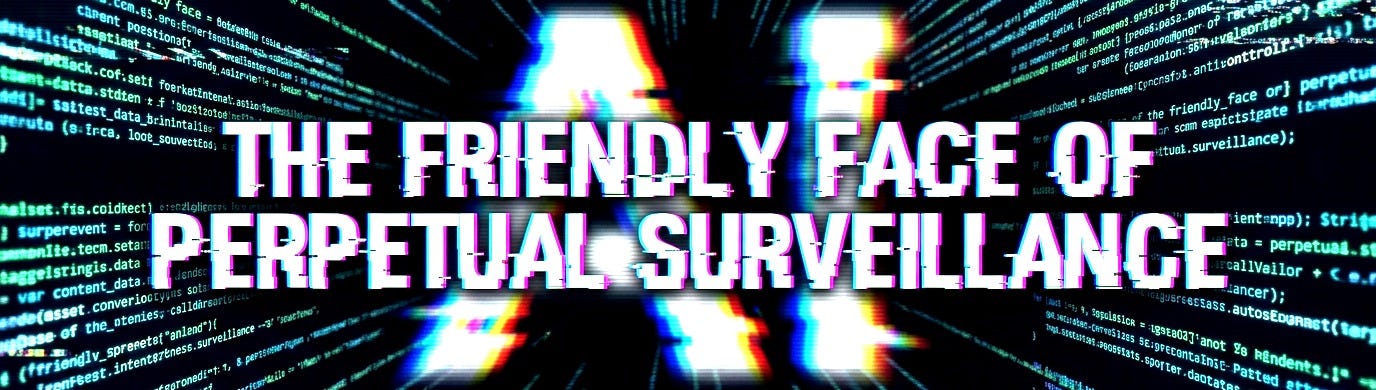
If blockchain is the ledger of our transactions, AI is the ledger of our thoughts. We use these tools to write emails or generate art, but every prompt we enter is a data point being used to train a model that will eventually know us better than we know ourselves. The Electronic Frontier Foundation (EFF) has long warned that the rapid deployment of AI in public and private sectors is creating a permanent record that could be used against individuals in the future. We are essentially building the tools of our own disenfranchisement while being told it’s making our lives easier.
Think about the world my boys are growing up in. In a cancel culture environment, a joke made at age twelve or an edgy phase at fifteen could be surfaced by an AI algorithm twenty years later to deny them a job, a loan, or a seat at a table. We are being conditioned to accept this trade-off (convenience for privacy) without realizing that once our digital privacy is gone, it’s gone forever. Even the United Nations has raised alarms about AI surveillance, noting that without strict guardrails, these technologies will be used to track and profile us in ways that make 1984 look like a children’s book. We need to fight for the right to be forgotten by the machines, ensuring that our children aren’t haunted by the digital ghosts of their past.
The Slow-Drip Theory of Disclosure

There is a nagging feeling among many tech-savvy observers that we aren’t being told the whole story. Take Bitcoin, for example. If the government, or a group of global intelligence agencies came out tomorrow and admitted they created it as a way to track global capital flows under the guise of anonymity, half the user base would vanish overnight. While the original Satoshi Nakamoto whitepaper outlines a peer-to-peer electronic cash system, the mystery of its origin remains a perfect cover for a system that is, by design, the most transparent tracking tool ever invented.
This slow-drip of information applies to AI as well. Companies like OpenAI and Google aren’t releasing their most powerful models all at once. They are conditioning the public to accept a new reality in increments. This isn’t just about safety, it’s about control. By the time we realize how much power these systems have over our daily lives, we’ll be too reliant on them to turn them off. It’s a brilliant strategy if your goal is to manage a population, but it’s a terrifying one if your goal is to raise free-thinking children. We have to ask ourselves a question. Is the tech being released because it’s ready, or because we’ve been sufficiently prepared to accept its next level of intrusion?
Moving from Ego-System to Ecosystem

We are the most sophisticated species in the known universe, yet we spend our time arguing over which billionaire’s coin is better. It’s honestly a bit embarrassing. We have the tools to create a world run on growth and knowledge. A world where code ensures fairness regardless of who you are or where you come from. But to get there, we have to stop following leaders who operate on emotion and start building protocols that operate on logic. We need to shift our focus back to the principles of Open Source, where the code is public and the motives are transparent.
True progress isn’t a higher price for a digital asset. It’s the ability for a kid in a developing nation to access the same financial tools and information as a kid in New York without having to ask for permission. We owe it to the next generation to leave them a digital world that empowers them rather than one that polices them. If we continue to prioritize profit over growth, we aren’t innovating, we’re just perfecting the art of the grift. We need to demand that the technology we use (and the tech our children will inherit) is built on the foundation of human advancement rather than corporate extraction.
Final Thoughts

I want to be clear about something. I am not against technology. I love the potential of what we’re building. I’m an optimist by nature, and I want my boys to be the beneficiaries of an era of unprecedented human achievement. What I am against, however, is the small group of people who control these tools and use them to serve their own interests at the expense of our freedom. I’m against the gatekeepers who tell us that privacy is an outdated concept while they hide their own agendas behind layers of proprietary code.
The future hasn’t been written yet, but the ink is drying fast. If we want a world where technology elevates our dreams instead of tracking them, we have to be the ones to draw the line. We need to fight for digital sovereignty, demand radical transparency, and ensure that the reason behind these technologies is the betterment of mankind and not just the enrichment of a few. Our kids deserve a future where they are free to grow, fail, and succeed without a digital shadow following their every move. Let’s make sure we’re building that world, not just a more efficient cage.
Thanks for reading everyone! Visit my site to learn more about me and explore what I’m building at Learn With Hatty. I hope everyone has a great day and as I always say, stay curious and keep learning.