How Agentic AI is Turning Roblox into a Global Powerhouse

It used to be that building a video game required a very specific kind of wizardry. You needed to speak the arcane languages of C++ or Luau, understand the physics of 3D vectors, and possess the patience of a saint to track down a single misplaced semicolon that broke everything. For most people, saying I want to make a game stopped right there. Somewhere between a half‑watched YouTube tutorial and a blank editor window. The tools were powerful, but they were also unforgiving. One wrong bracket and your dream project lived forever as a folder called final‑final‑v3.5 on an old hard drive.
But walk into any room where a kid is glued to a laptop today and you’ll see that those barriers haven’t just been lowered, they’ve been demolished. Instead of wrestling with compilers and graphics pipelines, they’re dragging parts into a 3D scene, tweaking sliders, and hitting play to test their ideas in real time. The distance between I have a cool idea and I can actually run around inside it has shrunk from months to minutes. You still can go deep on the technical side if you want, but you no longer have to pass a midterm in computer science just to get something fun and playable on the screen.
Roblox is at the center of that shift. Once dismissed by the serious gaming world as a simple blocky sandbox for kids, it has quietly evolved into a full‑blown tech titan with its own economy, culture, and career paths. What used to look like a messy pile of user‑generated games is now a massive platform where entire studios operate, brands launch experiences, and teenagers accidentally build hits that rival indie releases. The visual style is still charmingly chunky in a lot of places, but the underlying platform is anything but simple.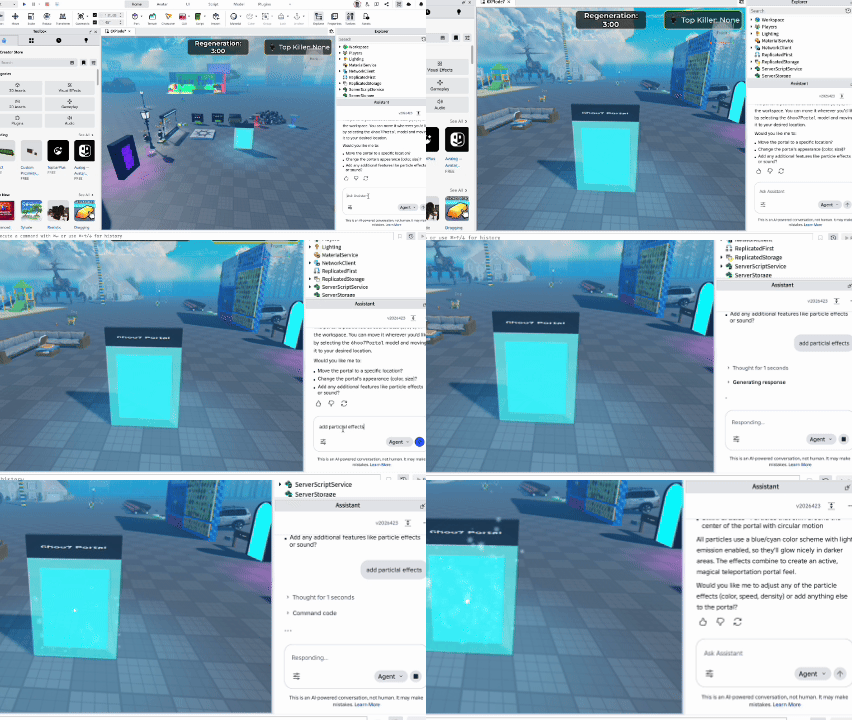
The wild part is how it got there. By weaving agentic AI directly into the fabric of its development environment, Roblox has transformed from a basic game engine into something that feels more like a collaborative partner. Instead of you doing all the meticulous grunt work by hand, you now have an assistant that can read your scene, understand your intent, and help you wire everything together. It’s not just auto‑complete for code, it’s more like having a teammate who never gets tired of the boring parts.
I’ve seen this shift firsthand, not just in the earnings reports and press releases, but at my own kitchen table, where my son and I have been building our own slice of the digital universe called 6XPLODE7. For us, game development night used to mean me hunched over documentation while he waited to see if anything worked. Now, we talk to the tools like we’re talking to another person. We type something like, “Set up a lobby where players vote on the next map” and watch as the scaffolding appears. It’s a wild time to be alive when the I have a great idea for a game guy/girl actually has the tools to finish it. Even better, can finish it with his kid sitting right next to him.
The Gravity of the Roblox Galaxy

To understand why this AI shift matters, you have to look at the sheer gravity of the platform itself. As we move through 2026, Roblox isn’t just a game, it’s a demographic phenomenon that’s swallowing more and more of the internet’s attention. For a huge slice of younger players, it’s where they hang out with friends, watch events, discover new creators, and try their hand at building worlds of their own. According to the latest usage statistics from DemandSage, the platform has ballooned to a staggering 381 million monthly active users. To put that in perspective, if Roblox were a country, it would be the third-largest in the world, tucked right between India and the United States.
That kind of scale does something strange to your sense of what normal internet use looks like. For a lot of kids, saying “I’m going on Roblox” is as routine as previous generations saying “I’m watching TV” or “I’m going outside to play.” It’s not just one game they bounce in and out of. It’s a whole galaxy of experiences that feels endless from the inside. When hundreds of millions of people treat a single platform as their default digital hangout, any change in how things are built there (especially something as big as AI) starts to look like a shift in the culture, not just a software update.
But it’s not just about the headcount, it’s about the stickiness. People are spending billions of hours quarterly within these virtual walls, often choosing Roblox over traditional social media or video streaming when they have free time. You don’t rack up that many hours by accident. According to official Roblox investor data, daily active users have climbed to over 144 million, meaning this isn’t a once‑a‑month curiosity, it’s part of their daily or weekly routine. For many players, Roblox is the chat room, the mall, the theme park, and the after‑school club all rolled into one tab.
At that point, the platform stops looking like a toy and starts looking like an economy. This massive scale has birthed a legitimate professional ecosystem wrapped around it. We’re talking about over 3.5 million active developers who aren’t just messing around with blocks, they’re building high‑fidelity experiences that rival AA indie titles. Some of them are teenagers learning as they go. Others are small studios treating Roblox as their main distribution channel, complete with roadmaps, analytics dashboards, and monetization strategies. There are creators paying rent, hiring teammates, and building careers on top of this kids’ game that a lot of adults still haven’t taken the time to understand.
The Rise of the Roblox Engine

What makes that rise even more interesting is how far Roblox has traveled from its original form. The shift from its 2006 origins as a relatively simple physics simulation to a metaverse leader is largely due to how aggressively they’ve democratized the tools. Early on, the bet was simple. If you give a million kids a hammer, someone is going to build a skyscraper. So instead of locking the toolbox behind advanced programming skills, they kept simplifying the on‑ramp. Better documentation, visual editors, templates, and now, AI‑powered helpers that meet you where you are.
Now, with AI layered on top of all that, they’ve essentially handed everyone an autonomous construction crew. The kid who would’ve bounced off their first error message can now describe what they want in plain language and get a working prototype. The small team that used to burn weeks on repetitive setup work can let the assistant handle the scaffolding while they focus on design, story, and community. When you combine that level of reach with that level of creative firepower, just a game starts to look a lot more like a global creative infrastructure that happens to be wearing a blocky avatar.
The Agentic Assistant
The real magic trick happened with the major 2026 updates to the Roblox Assistant. We’ve moved past the era of simple chatbots that just spit out snippets of code like a glorified auto-complete. We are now firmly in the age of Agentic Workflows.
In the tech world, an agent is an AI that can perceive its environment, reason through a problem, and take actions to achieve a goal. On Roblox, this manifests as Planning Mode. Instead of you typing a command and crossing your fingers, the Assistant now acts like a seasoned Lead Developer. When you give it a complex prompt, it enters a Plan-Build-Test loop. It looks at your existing game hierarchy, analyzes your DataStores, and presents a multi-step action plan. You get to review the logic (like seeing a blueprint before the house is built) and approve the steps.
This Neural Code Synthesis is a lifesaver for the stuff that usually kills a project’s momentum. For example, setting up an in-game currency shop used to require hours of connecting UI buttons to server scripts and security checks. Now, the Assistant handles the Luau (Roblox’s coding language) for you (The shop in my game was made entirely using the built in AI). It can even handle Procedural Model Generation, where you can prompt it to create a destroyed city block with realistic lighting, and it generates the 3D meshes and textures on the fly. It’s moving away from static assets and toward dynamic, AI-assisted creation that understands the context of your game.

A Father-Son Field Test

The theory of agentic AI is cool, but the practice is where it gets personal. My son and I have been deep in the trenches of our own game, 6XPLODE7, slowly turning a half‑joking idea into an actual thing you can play. If you’ve ever tried to work on a project with a 5 year old, you know that their feature requests come at a rate of roughly 400 per minute. One minute it’s “Can we add a secret room?” and the next it’s “What if the floor explodes if you stand still too long?” Previously, I was the technical bottleneck in all of this. He’d want a teleportation system that sends winners to a VIP lounge, or a countdown sequence with particles and sound effects, and I’d have to spend my Friday night digging through developer forums and YouTube tutorials to get the logic right.
In the old workflow, every new idea came with an invisible tax. I’d mentally calculate how many hours it would take, whether I could find a reliable code sample, and how likely it was that I’d break three other systems in the process. There’s nothing like telling a hyped‑up kid, “Yeah, we can do that…maybe next weekend,” because you know it means cracking open documentation after a long day. The creativity was there, but the pipeline from cool thought to working feature was clogged with tiny technical roadblocks.
With the new AI tools, our workflow has flipped on its head. Now, instead of me disappearing into Stack Overflow, we sit together and literally describe what we want the game to do. We told the Assistant that winners should be teleported to a VIP lounge after each round, and it mapped out the entire teleportation logic, including the debounce scripts that prevent players from getting stuck in a loop or spamming the teleporter. It didn’t just spit out a random code blob. It generated a step‑by‑step plan we could read through first, then implemented the pieces. The speed is genuinely startling, what used to be a two‑hour task now takes about thirty seconds of prompting and a quick review of the Planning Mode output before we hit run and test it together.
And it’s not limited to one feature. We’ve used the Assistant to wire up basic UI, tweak round timers, and even refactor parts of scripts that had quietly turned into spaghetti. Instead of me guarding the keyboard like a nervous sysadmin, my son can jump in and help refine prompts, tweak names, and suggest changes, because the conversation is happening in plain language, not in a wall of syntax.
AI Reality Check

However, being a helpful peer, I have to give you the reality check. It’s not flawless. We’ve learned to live by the save early, save often mantra like it’s carved above the doorway. Sometimes the AI will hallucinate a function that doesn’t exist, call an API slightly wrong, or try to reference a Part that we renamed three days ago and forgot about. Every now and then it confidently proposes a solution that looks great until you press Play and your lobby turns into a black hole. There are still moments where I have to step in, read the code, and nudge it back on track.
But even with the occasional logic error, the friction is gone. The boring parts (the hours of boilerplate, the endless copy‑paste from old scripts, the hunt for that one property you always forget) are no longer the bottleneck. The most profound impact isn’t the code itself, it’s the fact that a parent and child can sit down and collaborate on high‑level design without getting bogged down in all the glue work in between. We get to spend more time asking, “What would make this funnier? What would make this more epic?” and less time typing the same patterns over and over. In the process, we’re not just shipping updates to 6XPLODE7, we’re building memories and a shared digital universe at the same time. My son also is learning how to create prompts and use AI in a fun way. I am hoping this will be helpul in the years to come.
The Horizon of Creation

We are rapidly approaching a point where the distance between I have an idea and I can play this with my friends, is essentially zero. Not someday in the future, but this weekend if I clear a few hours. On Roblox, that looks like a loop where you think of a mechanic, describe it to the Assistant, hit Play, and suddenly you’re stress‑testing it with your friends in a live server. The gap that used to be filled with months of tutorials, rewrites, and half‑broken prototypes is getting compressed into a tight feedback cycle of imagine, describe, test, iterate. When you stack that on top of a platform that already has hundreds of millions of players, it stops feeling like a tool upgrade and starts feeling like a shift in what it even means to be a creator.
Roblox is already teasing a future where the AI doesn’t just help you build the game, but helps run it moment to moment. You can imagine systems that quietly adjust difficulty on the fly, nudging struggling players with assists while cranking up the challenge for the people who are clearly speed‑running your map. Or agents that watch how your community plays and spin up new quests, events, or rewards in real time, tuned to what people are actually doing instead of what you predicted months ago. We’re not all the way there yet, but the direction of travel is obvious. Less hard‑coding every possibility, more collaborating with systems that can adapt the experience as players pour in.
Final Thoughts
As these tools become more autonomous, the human role in game development is shifting in a big way. We’re moving from being builders to being directors. Instead of spending 90 percent of your time wiring up triggers and edge cases, you start spending 90 percent of your time making taste calls. Does this feel fair? Is this encounter memorable? Does this world say something about who we are? The technical barrier (that wall of code that kept so many creative people out of the industry) has been replaced by a doorway. You still need judgment, curiosity, and a willingness to tinker, but you no longer need to dedicate a decade of your life to pointer arithmetic just to get in the room.
For us, building 6XPLODE7 has been a masterclass in this new reality. We’ve felt that role shift in real time. A lot of our best sessions don’t look like coding nights at all. They look like two people sitting in front of a computer asking, “What would make this round more intense?” or “What kind of payoff would make players grin?”. The AI fills in the scaffolding, so we can argue about game feel instead of syntax errors. My son doesn’t see himself as learning to program so much as designing a world, and honestly, that’s probably closer to the truth of where this is all headed.
That’s why the question for the next generation isn’t really “How do I make this work?” anymore. The tools are increasingly designed to answer that for you, or at least meet you halfway. The more interesting question is, “What is actually worth making?” In a world where almost anyone can spin up a working prototype, the scarce resource isn’t code. It’s vision. It’s taste. It’s the ability to decide which ideas deserve to become living, breathing worlds and which ones should stay as a funny thought you had in the car.
The tools are here. The players are waiting. Somewhere out there, your future favorite game is sitting in someone’s head, waiting for that first prompt to an assistant. Now, you just have to decide what your universe looks like, and whether you’re ready to step through that doorway and start building it. If you are building anything in Roblox leave your link in the comments. I would love to see what you are building.
Before I end this I want to be 100%. AI is not always accurate. I always suggest saving each time before you use the Roblox AI. It can help a lot do not get me wrong, but all it takes is one time it doesnt work right. The last upgrade I did using AI messed up a bunch of code in my game. I am now in the process of trying to fix it all…
Thanks for reading everyone! Visit my site to learn more about me and explore what I’m building at Learn With Hatty. I hope everyone has a great day and as I always say, stay curious and keep learning.