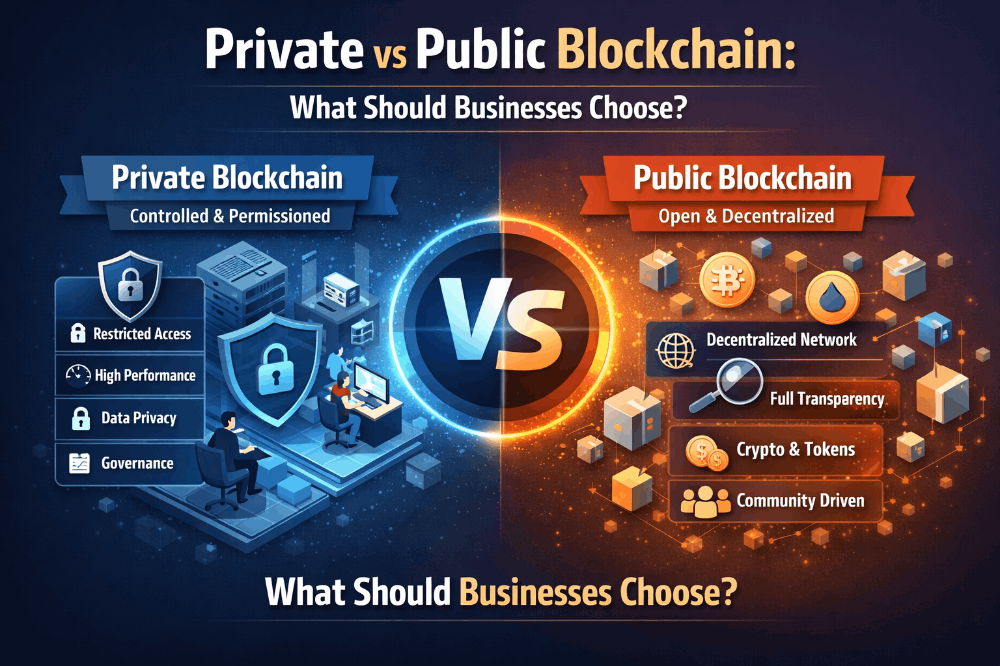
Private vs Public Blockchain: What Should Businesses Choose?

Blockchain adoption is expanding across industries—from financial services and digital payments to healthcare, logistics, and enterprise automation. As businesses explore distributed ledger technology (DLT), one fundamental question arises:
Should you choose a private blockchain or a public blockchain?
The right decision depends on your operational model, data governance needs, scalability expectations, and compliance landscape. Let’s explore both options in depth and understand how to make the best strategic choice.
Understanding Blockchain Fundamentals
A blockchain network is a decentralized digital ledger that records transactions securely and transparently. Each transaction is verified through a consensus mechanism and permanently stored using cryptographic hashing.
The two primary blockchain models are:
- Public blockchain (permissionless network)
- Private blockchain (permissioned network)
Both support smart contracts, digital assets, and decentralized applications—but they differ significantly in governance, access control, and performance.
What Is a Public Blockchain?
A public blockchain allows anyone to participate. Users can validate transactions, deploy smart contracts, and review ledger data without central authority approval.
Leading examples include:
- Bitcoin
- Ethereum
Core Characteristics
- High decentralization
- Transparent transaction history
- Open network participation
- Community-driven governance
Public blockchains are commonly used in DeFi development, token creation, NFT marketplaces, crypto exchanges, and Web3 platforms.
What Is a Private Blockchain?
A private blockchain restricts access to approved participants. Only authorized nodes validate transactions and access sensitive records.
Popular enterprise frameworks include:
- Hyperledger Fabric
- R3 Corda
Core Characteristics
- Permission-based access
- Faster transaction processing
- Controlled governance
- Enhanced data privacy
Private blockchains are widely adopted for enterprise blockchain solutions, supply chain systems, healthcare data exchange, and financial settlement networks.
Transparency vs Confidentiality
Public blockchain networks offer complete transaction transparency. This makes them suitable for decentralized ecosystems where trustless verification is required.
Private blockchains prioritize confidentiality. Businesses can control who accesses specific information and enforce compliance standards internally.
If your business handles sensitive operational or customer data, a permissioned model often provides stronger governance and data protection.
Performance and Scalability
Public blockchain networks may face:
- Network congestion
- Higher transaction fees
- Slower confirmation times during peak activity
Private blockchain infrastructure typically delivers:
- Higher throughput
- Lower latency
- Predictable transaction costs
For organizations processing high volumes of transactions—such as supply chain logistics or enterprise automation—performance efficiency becomes a critical factor.
Governance and Regulatory Compliance
Public blockchain governance is decentralized. Protocol updates and decisions are community-driven, which ensures neutrality but limits centralized control.
Private blockchain governance allows businesses to:
- Implement KYC/AML procedures
- Define validator roles
- Maintain regulatory compliance
Industries operating under strict legal frameworks often prefer private blockchain architecture for clarity and risk management.
Security Considerations
Public blockchain security is rooted in decentralization. The larger the validator network, the more resistant it becomes to malicious attacks.
Private blockchains rely on controlled validator nodes and secure infrastructure management. When properly implemented, they can offer strong enterprise-grade protection.
The key difference lies in trust model design—decentralized trust versus controlled trust.
Business Use Case Alignment
Public Blockchain Works Best For:
- Token development
- Crypto exchange platforms
- DeFi protocol development
- Web3 DApp ecosystems
Private Blockchain Works Best For:
- Supply chain tracking
- Banking and trade finance
- Healthcare data management
- Enterprise workflow automation
Some organizations adopt hybrid blockchain models to combine public transparency with private control.
Strategic Evaluation Before Choosing
Before selecting a blockchain model, businesses should assess:
- Data sensitivity requirements
- Transaction throughput expectations
- Regulatory obligations
- Integration with legacy systems
- Long-term digital transformation plans
A structured blockchain feasibility analysis can prevent costly architectural mistakes later.
Why Choose CryptoApe?
When it comes to selecting and implementing the right blockchain architecture, technical depth and strategic clarity matter. CryptoApe works with startups and enterprises to design blockchain systems aligned with real business objectives.
Here’s what differentiates their approach:
1. Architecture-First Strategy
Rather than defaulting to a public or private model, the focus begins with understanding your operational requirements and regulatory environment.
2. Full-Spectrum Blockchain Development
From smart contract development and DApp development to enterprise blockchain deployment and integration, solutions are designed for scalability and long-term sustainability.
3. Security-Centric Implementation
Blockchain infrastructure is developed with security audits, consensus optimization, and compliance-ready frameworks in mind.
4. Industry-Specific Expertise
Whether it’s fintech, healthcare, logistics, or digital asset platforms, solutions are tailored to sector-specific challenges.
5. Hybrid & Custom Blockchain Solutions
For businesses that require flexibility, hybrid blockchain models can be structured to balance transparency and privacy effectively.
Instead of offering generic development services, the emphasis remains on building blockchain ecosystems that support measurable business growth.
Making the Right Decision
The debate around private vs public blockchain is not about which is better overall—it’s about which is better for your specific use case.
Public blockchain supports decentralization, global accessibility, and open innovation.
Private blockchain enables control, performance optimization, and regulatory alignment.
Understanding your business priorities is the first step toward making the right choice.
Conclusion
Choosing between Private and Public Blockchain requires careful evaluation of transparency needs, scalability goals, governance preferences, and compliance requirements. Both models offer distinct advantages and can drive meaningful innovation when implemented strategically.
If you’re exploring blockchain adoption or planning to build a blockchain-based solution, consulting experienced blockchain professionals can provide clarity. A thoughtful, architecture-driven approach ensures your blockchain infrastructure is secure, scalable, and aligned with your long-term digital strategy.