What the Tech?! The Pager

Before the evolution of the mobile phone, the pager was king.
With the smartphone being an all-in-one device, it can often be difficult to picture how things worked before the internet was everywhere. And, rather than having an all-in-one device, society would often use different methods for different reasons.
The landline telephone network would help to connect users both nationally and internationally, while ham radios would give early radio enthusiasts their first means to pursue global communication capabilities.
And for short-range stuff, we had CB radios, private radio networks and of course the pager.
In a pre-mobile age, the pager would help to ensure that people remained contactable at short notice. Its almost rudimentary design would hide its overall importance. A small plastic box that would beep and display a phone number would help play a key role in keeping people connected before the internet age.
This was cutting-edge technology when it was introduced, and it would remain relevant for more than two decades. However, as we are about to see, it suffered from a few inherent issues that are still visible, even today.
The Background
The concept of a radio alerting system would be in place long before the belt clip would start to make its appearance as a cultural icon. These had been under development since the early days of wireless communication.
It would be 1921 when the Detroit Police Department deployed a trial, one-way radio dispatch system to reach officers in the field. While this was a far cry from the pocket-sized devices that would follow, the core concept was already in place. A centralised transmitter could reach a mobile receiver without the need for a physical connection.
This proved the overall concept however, the pager wasn’t quite ready to go mainstream yet. For this to happen, we’d need the support and intervention of another industry giant, namely Motorola.
Motorola saw the value in the military system being optimised for the civilian market, expecting a boom in revenue when it did so. They would start by targeting medical professionals in the late 1950s. Hospitals were the ideal environment for its new wireless communication systems. They had large buildings, staff who were constantly on the move and a genuine operational need for fast, reliable communications, which made the pager a natural fit.
The device itself was straightforward to operate. A one-way radio receiver, tuned to a specific frequency, would sit dormant until a signal was broadcast by a central transmitter. When that signal matched the device’s unique identifier, it would alert the user with a tone.
Simple, reliable, and remarkably effective for its intended purpose.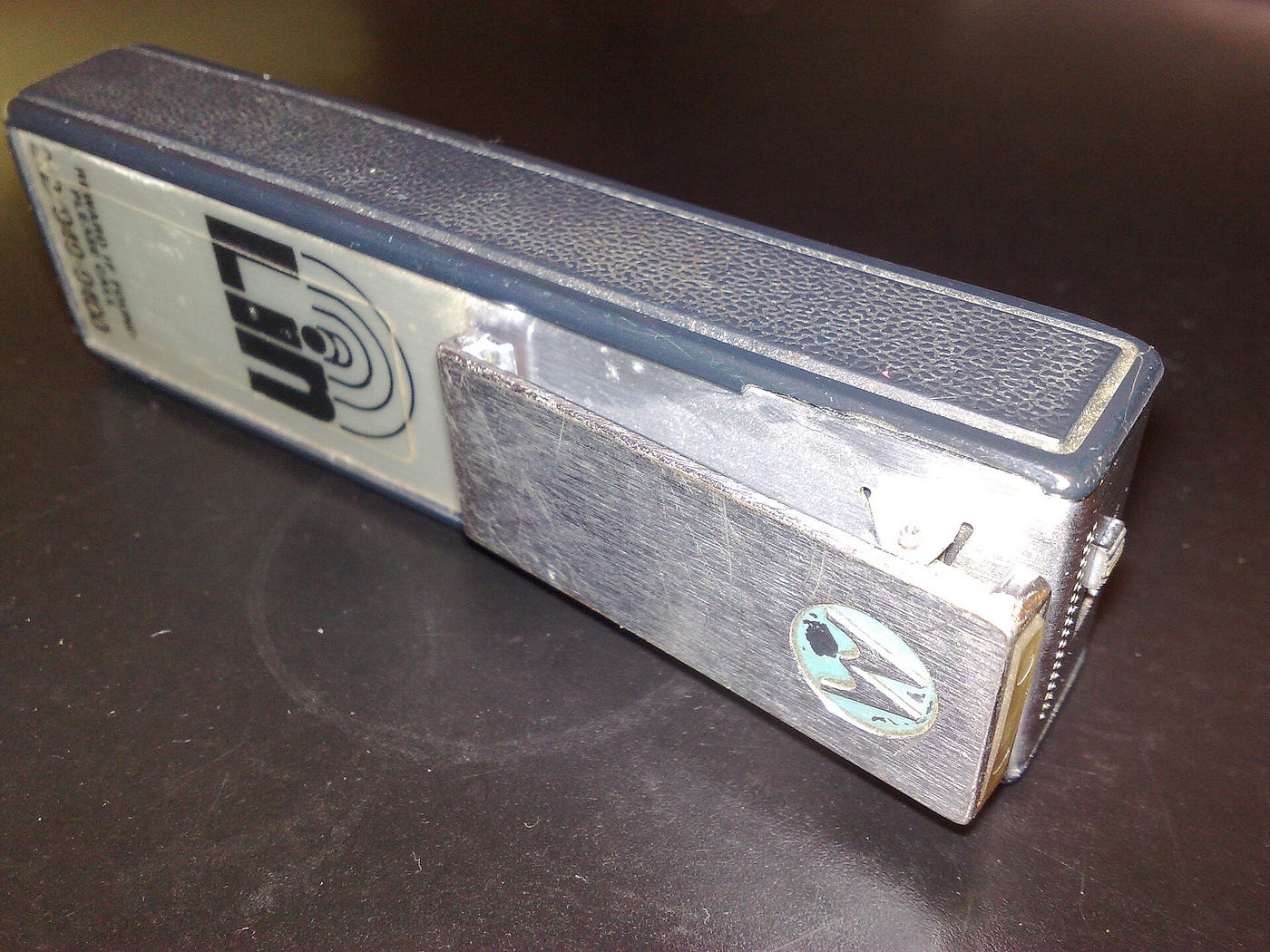 Motorola aimed to spam the market with pagers wherever possible. By the 70’s, they almost met that goal. Here’s the 70s era Pageboy II. Source: Wikipedia
A Communication Revolution
The professional world has always had a heavy interest in emerging technology, and despite the one-way communication limitations of the pager model, it would still be pretty popular, making a distinct shift into the mainstream.
The technology was evolving rapidly, helping to drive this shift as well. What would start as a simple numeric system would eventually evolve into a fully alphanumeric capable system that was capable of sending short messages, similar to the SMS we would see arrive later with the mobile phone.
As the 80s turned into the 90s and beyond, the pager became well and truly established in the mainstream. They weren’t just in hospitals anymore. They were in the consumer market, and more importantly, the pager had become and was recognised as a legitimate status symbol.
Still worn on the belt or tucked into the pocket, the presence of a pager indicated that you were somebody who needed one. The consumer market would go wild for the new technology, with even drug dealers being observed with pagers to help run their businesses.
Peak adoption was thought to be somewhere around 1994, when over 61 million users were estimated to be in the United States alone. Motorola was happy. The consumer market was happy.
But quietly happening in the background, ready to change everything and upend conventional wisdom, was the mobile telephone.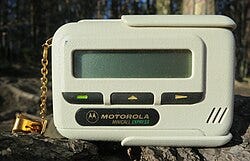 POCSAG would help power many modern pager systems. Source: Wikipedia
Built For Convenience, Not Security
Like many pieces of technology, the pager suffered from an inherent characteristic that threatened to topple its market dominance and cause significant issues.
The pager network operated on a simple and entirely open principle. A central transmitter would broadcast messages across a wide area on a known radio frequency, and any device within range that matched the target identifier would receive and display the message. The system was never designed with privacy in mind because in the 1950s and 1960s, the concept of intercepting personal messages at scale simply wasn’t a consideration.
This would have significant consequences as technology would continue to evolve. Every message sent across a pager network was broadcast unencrypted across the radio spectrum. This meant that anyone with the right receiver, tuned to the right frequency, could read every pager message being sent in their area.
Not just their own messages. Everyone’s.
For most of the pager's operational life, this vulnerability meant little. It sat in the background, relying entirely on security by obscurity to help remain invisible.
This would change, along with the rest of the world, on September 11, 2001. As the United States would deal with a mass casualty event after an attack on its own soil, pager traffic would go into overdrive as emergency services coordinated in the aftermath of the event.
The problem was that every piece of that traffic was being intercepted and archived. In 2009, eight full years after the attack, WikiLeaks would leak more than half a million pager messages from that day.
While the release was controversial, it demonstrated in the most stark terms imaginable what many had always known about the pager network.
It was never private. Not even close. The 9/11 attacks would help expose chronic insecurities in the pager networks' clear-text traffic. Source: Wikipedia.
Into The Modern Age
The mobile phone was always destined to become the eventual successor to the pager, but it might surprise you to learn that during the 90s, they coexisted for quite some time.
While the technology existed for the mobile phone, early models lacked the reliability of the pagers, and for the most part, the economics simply didn’t stack up either. It would take a distinct period of investment into the mobile phone and its networks, as well as a maturing of the technology, to help change the dynamics around this.
When the shift came, though, it would happen quickly. With mobile phones being able to do everything the pager could, cheaper and more securely than the legacy system, the writing was on the wall.
However, despite the rapid shift into irrelevance, the pager would, surprisingly, stick around for quite some time in some very niche and specific roles. In some ways, the system would return to its roots, maintaining its place as a key player in the communication systems of modern hospitals. With the pager running on a simple RF signal, it also had surprising resilience in areas of low signal.
Despite this, though, the vulnerability that is inherent to the pager protocol never really went away. Even today, a HackRF Portapack and rubber duck antenna are enough to receive POCSAG transmission in most busy cities across the globe. If this is something that interests you, check out our Radio Hackers publication for more info.
The device that once signalled importance and relevance has essentially drifted into irrelevance itself.
If you liked the article, get the book.
Investigator515 explores the RF spectrum, cybersecurity, and the hidden tech behind modern espionage.
Follow for new content weekly
Bluesky • X • Substack
You might also like,
- OSINT Investigators Guide to Self Care & Resilience
- Spies In The Mud: The RF-111 Aardvark
- What The Tech?! Space Shuttles