Decentralized Communication? Yes Please

We’ve all been there, you’re deep in the woods, or maybe just at a massive music festival where 50,000 people are all trying to upload a TikTok at once, and your phone becomes a very expensive paperweight. You see that no service icon or the dreaded spinning wheel, and suddenly, you’re digitally stranded. In our hyper-connected world, we’ve become surprisingly fragile, relying on multi-billion dollar towers that can be knocked out by a single storm, a simple crowd, or a provider having a bad day. It’s a bit wild when you think about it. We have these smart phones that are essentially useless the second they can’t talk to a giant corporate monolith.
The answer, surprisingly, is a $30 radio board and a project called Meshtastic. It’s an open-source, community-driven project that essentially lets you build your own private, off-grid communication network using tiny, cheap radio devices. Think of it like a walkie-talkie for the 21st century. Instead of yelling into a microphone and hoping someone hears you, your devices are quietly texting, sharing GPS coordinates, and passing data back and forth through a decentralized mesh of peers. It’s part survivalist tech, part cyberpunk hobby, and entirely cool. It’s basically the stone soup of networking. Everyone brings a little bit of hardware to the table, and suddenly, we have a feast of connectivity.
What Is It and Who Made It?
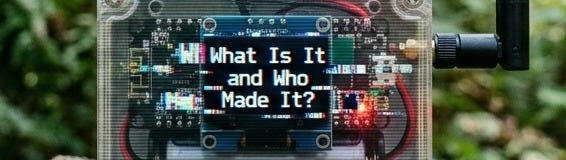
So, let’s peel back the curtain on where this came from. At its core, Meshtastic is a software platform (specifically firmware) that runs on inexpensive LoRa (Long Range) radio hardware. It didn’t start in a boardroom with guys in suits. It was started in early 2020 by Kevin Hester, a developer who was into paragliding and hiking. He realized that when you’re hanging off a cliff or lost in the brush, having a way to tell your friends “I’m alive and here are my coordinates” is pretty important. Since cell service is non-existent in the clouds or the deep woods, he built a solution.
Since then, it has exploded into a massive global movement. We’re talking about a hobbyist scene that feels a lot like the early days of the internet . Full of people who just want to see what’s possible. There is no Meshtastic Inc. charging you a $15/month subscription fee or selling your location data to advertisers. It’s 100% community-owned and governed. According to the official GitHub project, the code is constantly being poked, prodded, and improved by hundreds of volunteers. It’s built on the philosophy that communication shouldn’t be a privilege granted by a carrier. It should be a tool we own ourselves. It’s the ultimate power to the people move in the tech space.
How the Magic Actually Works (The Nerd Stuff, Simplified)
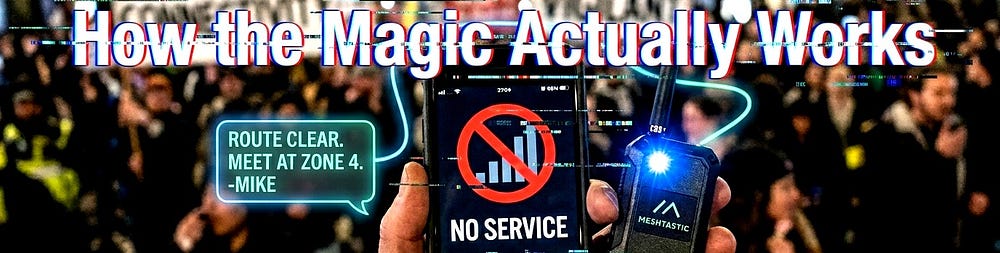
I know radio waves sounds like something your grandpa used to listen to baseball games, but bear with me because this is actually brilliant. Most of our modern tech (like Wi-Fi or 5G) is built for speed. It’s like a Ferrari. It’s incredibly fast, but if there’s even a tiny pebble (or a wall, or a tree) in the road, it crashes. Meshtastic uses something called LoRa. LoRa is more like a beat-up old Jeep. It’s not fast (you aren’t going to be watching 4K YouTube videos on this) but it can go absolutely anywhere. It operates on unlicensed frequencies like 915 MHz in the US, which are fantastic at traveling massive distances and punching through obstacles that would kill a cell signal.
But here’s the mesh part that makes it legendary. The Flood Routing protocol. Imagine you want to send a text to your friend Dave, but Dave is on the other side of a mountain. Normally, you’d be out of luck. But if there are three other people with Meshtastic devices scattered on that mountain, your device sends the message to the first person, their device automatically screams it out to the second, and so on, until it hits Dave. Your message hops from node to node. The beauty of this is that the devices are smart enough to not cause a broadcast storm (they don’t just scream forever) they use clever algorithms to make sure the message gets where it needs to go efficiently. Every person who joins the network doesn’t just use the network, they become the network, making it stronger for everyone else.
Building Your Own Digital Lifeline

The best part about Meshtastic is that it’s incredibly cheap to get into. You don’t need a $1,000 iPhone, you need a $30 radio board. The most popular ones are the LILYGO T-Beam or the Heltec LoRa V3. These little boards are basically the Swiss Army Knives of the radio world. They have a tiny screen, a LoRa chip, and usually a GPS module. You can check out the supported hardware list to see the variety. Some are small enough to fit in a Tic-Tac container, while others are ruggedized for mounting on a 50-foot pole.
Getting it running is actually a fun weekend project. You flash the firmware onto the board (which is way easier than it sounds, there’s a web-based flasher now), pair it to your phone via Bluetooth, and boom, you have an encrypted, off-grid pager. The Meshtastic app on your phone acts as the interface, so it feels like you’re just using a normal texting app. Some people get really into it and build solar-powered base stations on low-power boards like the RAK WisBlock (which uses the nRF52840 chip), capable of running for months on a tiny battery and a small solar panel. You just stick it in a waterproof box on your roof, and suddenly your whole neighborhood has mesh coverage. It’s like being a mini-telecom mogul, but without the corporate greed.
Privacy, Security, and Why You Should Care

Let’s talk about the elephant in the room, privacy. In our modern world, your private messages are usually sitting on a server somewhere, just waiting for a data breach or a subpoena. Meshtastic is a digital fortress. Everything you send is encrypted with AES-256 by default. That’s the bad guys can’t read this level of encryption. Because the data never touches the normal internet unless you specifically set up a gateway to do so, there is no central trail. It’s just you, the radio waves, and your intended recipient.
But this isn’t just for people who wear tinfoil hats. This is vital for real-world safety. When a hurricane hits and the towers go down, or when you’re in a country where the government likes to flip the switch on the internet during protests, emergency communication is a literal lifesaver. Communities are using Meshtastic to create a civilian band for disaster relief, allowing people to coordinate help without needing a single bar of cell service. It’s also huge for van life folks or backcountry skiers who need a breadcrumb trail of their location so their friends can find them if they take a tumble. It’s the ultimate insurance policy for your digital life.
Final Thoughts

Meshtastic isn’t going to replace your phone for scrolling through memes or ordering a pizza, and it honestly shouldn’t. It’s a tool for the moments when the world gets a little too loud, or when you’re in a place where the world isn’t loud enough to hear you. It’s about taking back a little bit of the autonomy we’ve traded for convenience over the last two decades. It’s about building something together, one radio at a time.
If you’re feeling the itch to tinker, I’d say jump in. Buy a couple of boards, give one to a friend, and see how far you can push the signal. You’ll find yourself checking the map to see if you can reach that node on the hill, or geeking out over antenna gains. Before you know it, you’ll be part of a global, invisible, and completely free network.
Thanks for reading everyone! Visit my site to learn more about me and explore what I’m building at Learn With Hatty. I hope everyone has a great day and as I always say, stay curious and keep learning.