How Crypto Transactions Work: A Complete Beginner-to-Advanced Guide
Sending crypto may look simple: you enter an address, choose an amount, and click “send. But behind that single action is a powerful system of cryptography, distributed networks, and consensus mechanisms working together in seconds.
If you truly want to understand crypto not just use it this is one of the most important concepts to master.
Let’s break it down step by step.
What Is a Crypto Transaction?
A crypto transaction is the transfer of digital assets from one wallet to another on a blockchain network.
Unlike traditional banking:
- There is no central authority (like a bank)
- Transactions are verified by a network of computers
- Records are permanent and transparent
Popular networks include:
Step 1: Creating the Transaction
When you send crypto using wallets like Trust Wallet or MetaMask, your wallet creates a transaction.
This includes:
- Recipient address – where the crypto is going
- Amount – how much you’re sending
- Transaction fee – paid to process your transaction
- Digital signature – proof that you authorized it
🔐 What Is a Digital Signature?
A digital signature is created using your private key.
- Your private key = your secret password (never share it)
- Your public key / wallet address = what you share to receive funds
This ensures:
- Only you can authorize transactions
- No one can fake your identity
Step 2: Broadcasting to the Network
Once created, your transaction is broadcast to the blockchain network.
Think of it like announcing:
“I want to send this crypto—please verify it.”
Thousands of computers (called nodes) receive this request.
Step 3: Transaction Verification
Nodes validate your transaction by checking:
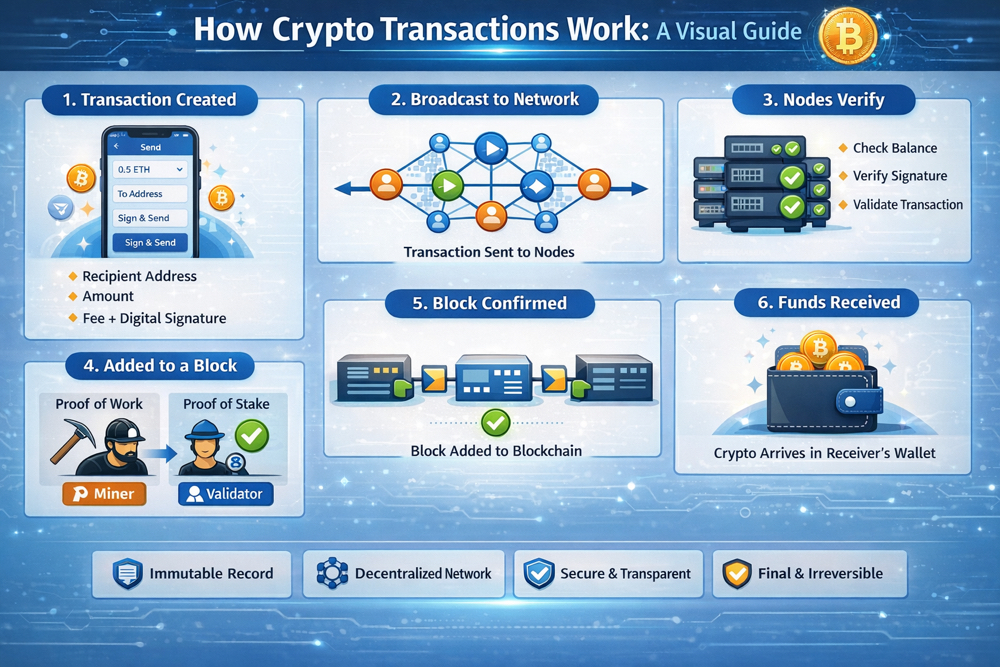
- Do you have enough balance?
- Is your digital signature correct?
- Has this crypto already been spent? (prevents double spending)
If valid, your transaction enters a waiting area called the mempool.
Step 4: Adding to a Block
Transactions in the mempool are grouped into blocks.
Who adds them?
⛏️ Miners (Proof of Work)
Used by Bitcoin
- Solve complex mathematical problems
- First to solve gets to add the block
- Earn rewards in crypto
🪙 Validators (Proof of Stake)
Used by Ethereum
- Lock (stake) their coins
- Randomly selected to validate transactions
- Earn rewards for honest behavior
Step 5: Block Confirmation
Once a block is verified:
- It is added to the blockchain
- Your transaction becomes permanent
- It receives confirmations
✅ What Are Confirmations?
Each new block added after yours increases confirmation count.
- 1 confirmation = included in a block
- 3–6 confirmations = generally secure
- More confirmations = higher security
Step 6: Transaction Completion
After confirmation:
- The receiver sees the funds in their wallet
- The transaction is irreversible
Time depends on the network:
- Seconds → fast blockchains
- Minutes → networks like Bitcoin
Understanding Transaction Fees (Gas Fees)
Fees vary based on:
- Network congestion
- Transaction size
- Blockchain design
On Ethereum, this is called gas fees.
Higher fees = faster processing
Lower fees = slower confirmation
Why Crypto Transactions Are Irreversible
Unlike banks, there is:

- No customer support to reverse mistakes
- No central authority to cancel transactions
Once confirmed:
Your crypto is gone if sent to the wrong address.
This is why attention and accuracy are critical.
Security: How to Stay Safe
Understanding transactions helps you avoid costly mistakes.
🔒 Best Practices:
- Double-check wallet addresses
- Use trusted wallets like Trust Wallet
- Never share your private key or seed phrase
- Avoid clicking unknown links
- Use hardware wallets for large funds
Simple Analogy
Imagine sending a message in a global, secure group:
- You sign it (digital signature)
- Everyone verifies it (nodes)
- It gets recorded permanently (blockchain)
- No one can edit or delete it
That’s how crypto works.
Final Thoughts
Crypto transactions are more than just sending money—they represent a shift in how value is transferred globally.
By understanding how they work, you:
- Reduce risk
- Improve security
- Gain confidence in using crypto
- Stand out as someone who truly understands the space